Stop Leakage, Win Sales: AI Lead Scoring That B2B Teams Can Trust

AI lead scoring replaces static point systems with models that calculate a lead’s real probability of converting, based on patterns learned from your own closed deals. The headline outcome is straightforward: sales reps spend their time on leads that actually close, not leads that merely look good on paper. Before building anything, the first move is a data audit, then a small pilot against a holdout group.
TL;DR:
- AI lead scoring requires a robust dataset with enough historical conversion data and multiple signals, or rule-based systems may remain more practical.
- Gradient-boosting models like XGBoost and LightGBM outperform alternatives in B2B scenarios, especially with structured, tabular data.
- Proper data hygiene, feature engineering, and preventing target leakage are critical for building accurate, reliable models.
- Regular retraining every 10 to 15 days is advisable in fast-moving markets, with monitoring for distributional shifts and performance degradation.
- Transparency and operational alignment, including clear thresholds and feature attribution, are essential for sales team adoption and model trust.
Table of Contents
- What Is AI Lead Scoring, and How Does It Differ From Rule-Based Scoring?
- What Business Impact Should You Expect From AI Lead Scoring?
- Which Models and Algorithms Work Best for Lead Scoring?
- What Data Signals Matter Most for Accurate Scoring?
- How Do You Implement AI Lead Scoring Step by Step?
- How Do You Evaluate, Calibrate, and Retrain a Scoring Model?
- What Pitfalls and Governance Issues Should You Watch For?
- What Results Can You Expect From Real-World Deployments?
- How Does Sonta AI Help Teams Adopt Lead Scoring Faster?
- Is AI Lead Scoring Worth Implementing Now?
- What Actually Determines Whether a Scoring Model Sticks
- Get Practical Help Rolling Out AI Lead Scoring
- Sources
- FAQ
What Is AI Lead Scoring, and How Does It Differ From Rule-Based Scoring?
Traditional lead scoring assigns points for actions: five points for opening an email, ten for visiting a pricing page, twenty for a demo request. Someone in operations set those numbers once, usually based on intuition, and they rarely get revisited. It works until it doesn’t, because the rules can’t adapt when buyer behavior shifts or a new channel starts producing leads that don’t fit the original template.
AI lead scoring works differently. Instead of additive points, a model outputs a calibrated probability or rank, something like “this lead has a 34% chance of converting to a qualified opportunity within 60 days.” That number comes from a model trained on your historical CRM records, learning which combinations of firmographic, behavioral, and engagement signals actually preceded closed deals in the past.

A 2025 case study on B2B lead prioritization tested 15 different classifiers against real CRM data and found that gradient-boosting models delivered the highest accuracy and AUC for predicting conversion. That result matters less as a specific benchmark and more as confirmation that machine learning finds patterns in lead behavior that manual rules simply miss.
AI scoring makes sense once you have three things in place:
- Enough historical labeled outcomes (closed-won and closed-lost records) to train against
- Multiple overlapping signal types, not just one or two behavioral triggers
- A genuine need for dynamic reprioritization as new data arrives, rather than a static list reviewed quarterly
If you’re missing any of those three, a well-tuned rule-based system might still be the more practical option.
What Business Impact Should You Expect From AI Lead Scoring?
The efficiency gain shows up first in time-to-contact. When reps know which leads carry the highest conversion probability, they call those leads first instead of working a queue in the order it arrived. That alone tends to compress the gap between lead creation and first meaningful touch.
Conversion lift follows from a related mechanism: fewer false positives clogging the pipeline. Manual and rule-based systems routinely flag “hot” leads that never had real intent, which means AEs waste hours on companies that were never going to buy. Machine learning models built on B2B CRM data have shown that prioritizing leads by predicted value improves both conversion rates and sales team satisfaction compared to ad-hoc scoring approaches.
Sonta AI note: teams evaluating a scoring pilot should track a small, fixed set of KPIs from day one, not a dashboard full of vanity metrics.
- Time-to-first-contact for top-decile scored leads
- Meetings-booked-to-opportunity ratio, segmented by score tier
- SDR hours spent per qualified opportunity generated
- Pipeline velocity (days from lead creation to closed-won)
- False-positive rate: how often high-scored leads produce no meeting
The operational upside compounds once scoring runs continuously. Instead of a sales manager manually reshuffling territory assignments, leads get routed automatically as their score changes, and outreach messaging can be tailored to the specific signals driving a lead’s score up or down.
Which Models and Algorithms Work Best for Lead Scoring?
Gradient-boosting frameworks like XGBoost and LightGBM dominate practical B2B lead scoring, and for a clear reason: CRM data is structured, tabular, and full of the kind of nonlinear interactions tree ensembles handle well. The 2025 B2B case study found gradient boosting outperformed alternatives including logistic regression, random forests, and support vector machines, with lead source and number of responses ranking among the strongest predictors.
Logistic regression still earns its place, particularly in early-stage deployments. It’s fast to train, easy to explain to a sales VP who wants to know exactly why a lead scored high, and often sufficient when your dataset is small or your feature set is narrow. If your team’s first objection to AI scoring is “how do we know we can trust this,” starting with a transparent logistic model builds credibility before you introduce anything harder to interpret.
For teams with more mature data pipelines, compound approaches add stability:
- Stacking: combine an engagement-focused model with a firmographic fit model, then let a meta-model weigh their outputs
- Ensembling: average predictions across several tree-based models to smooth out variance from any single algorithm
- Two-stage scoring: a fit score (will this account ever buy) multiplied against an intent score (will they buy now)
Neural networks show up far less often in this space, mostly because they need large volumes of event-level data to outperform simpler models. Unless you’re processing millions of behavioral events, a well-tuned gradient-boosting model will usually beat a neural net on both accuracy and maintainability.
What Data Signals Matter Most for Accurate Scoring?
Model quality depends less on algorithm choice than on the signals feeding it. A gradient-boosting model trained on thin, stale data will lose to a logistic regression model trained on rich, clean data every time.
The core signal categories worth collecting:
- Firmographic: company size, industry, revenue band, geography
- Contact-level: job title, seniority, department, buying role
- Behavioral and engagement: email opens, website visits, content downloads, webinar attendance
- Intent data: third-party signals showing research activity on competitor or category terms
- Technographic: existing tech stack, integrations already in place
- Enrichment data: appended firmographic or contact details from providers filling gaps in your CRM
Raw signals aren’t enough on their own. Feature engineering is where the real accuracy gains happen: time-windowed aggregates (email opens in the last 14 days, not lifetime opens), recency and decay functions that weight recent activity more heavily than activity from six months ago, sequence features that capture the order of actions rather than just the count, and clean source attribution that ties every lead back to its actual acquisition channel.
Data hygiene issues quietly sabotage more scoring models than bad algorithms do. Canonical IDs, deduplicated contact and account records, consistent event timestamping, and a defined process for handling delayed labels (a deal that closes eight months after the lead came in) all need to be solved before modeling starts, not after.
Pro Tip: Audit your CRM’s field-fill rates before you audit your model’s accuracy. If half your leads are missing job title or company size, no algorithm can compensate for that gap. Fix the data pipeline first.
How Do You Implement AI Lead Scoring Step by Step?
Moving from concept to a production model that sales actually trusts happens in five distinct phases, and skipping ahead is where most projects stall.
- Define success and label the target. Decide precisely what counts as a conversion (SQL, opportunity, closed-won) and set a lookback window that matches your actual sales cycle length, not an arbitrary 30 or 90 days.
- Integrate the data. Pull from the CRM, marketing automation platform, web analytics, and any third-party intent feeds into a single, queryable dataset. This is usually the slowest phase, and underestimating it is the most common planning mistake.
- Build and validate the model. Use time-consistent train/test splits so the model never sees future data during training, apply nested cross-validation, and benchmark against a simple baseline before trusting anything more complex.
- Deploy with guardrails. Set up score ingestion into the CRM, define routing rules and confidence thresholds for each score tier, and keep a rollback plan ready in case early scores misbehave in production.
- Enable the sales team. Train reps on what the scores mean, run acceptance tests comparing scored leads against rep intuition, and build a feedback loop so reps can flag scores that clearly missed.
Pro Tip: Run phase five in parallel with phase four, not after it. Sales reps who only hear about the new scoring system after it’s live tend to ignore it; reps who get a say during rollout tend to adopt it.
Platforms with self-updating records, like an AI-native CRM, remove a lot of friction from phase two, since fields stay current without manual entry lag distorting your training data.
How Do You Evaluate, Calibrate, and Retrain a Scoring Model?
A model’s accuracy on a spreadsheet means little if the probabilities don’t map to real-world outcomes. Evaluation needs to happen on two levels: statistical performance and business relevance.
The standard metrics, mapped to what they actually tell you:
- AUC (area under the ROC curve): overall ability to rank converters above non-converters
- Precision@k: of your top-scored leads (say, the top 100), what share actually convert
- Recall: what share of true converters the model successfully flagged as high-scoring
- KS statistic: how well the model separates converters from non-converters across score bands
Raw model outputs often aren’t true probabilities, just relative rankings. Calibration methods like Platt scaling or isotonic regression adjust the output so a “70% score” really does convert roughly 70% of the time, which matters enormously once operations teams start setting SLAs or routing rules directly off the score.
Monitoring after deployment matters as much as the initial build. Watch for distributional shifts in incoming leads (a new marketing campaign suddenly changing the mix of company sizes), label latency (conversions that take months to materialize, delaying your ability to measure accuracy), and degradation thresholds that trigger an alert before performance quietly erodes.
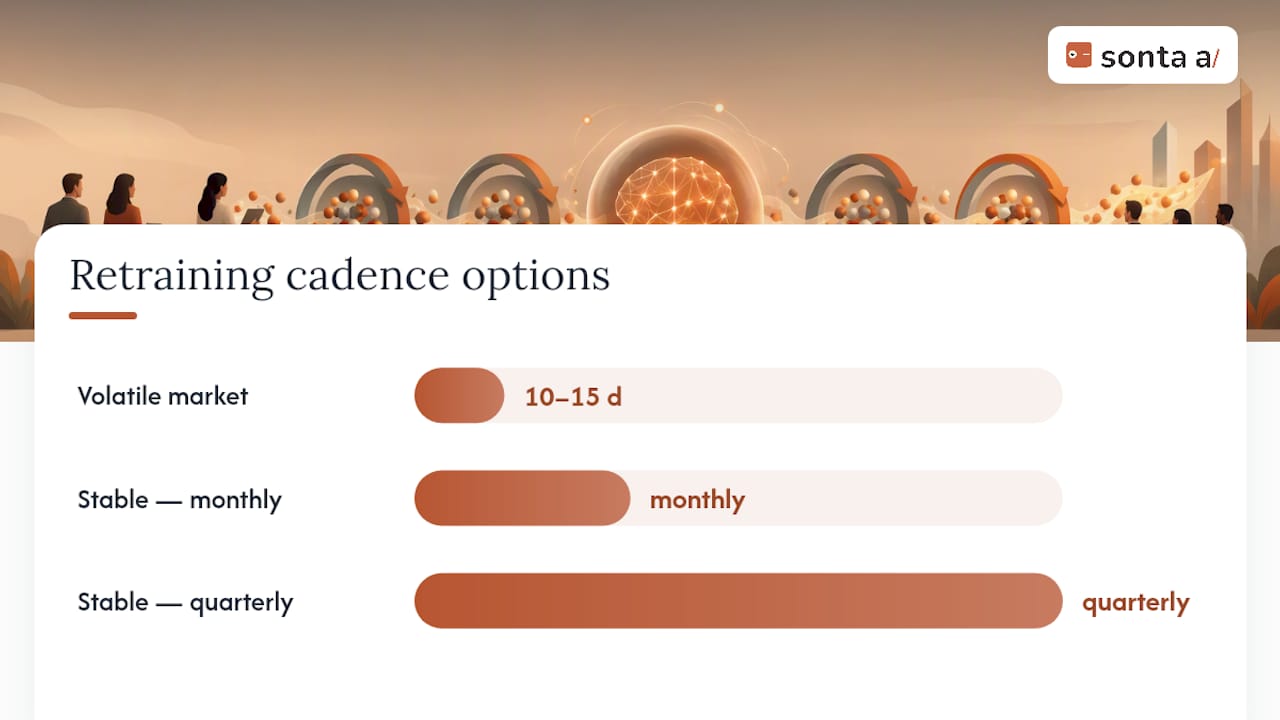
Retraining cadence depends on how fast your market moves. In volatile environments, some experts recommend retraining intervals as short as every 10 to 15 days to keep pace with shifting buyer behavior, while more stable B2B segments can often stretch to monthly or quarterly cycles. Either way, define an emergency retrain trigger (a sudden AUC drop, a major product or pricing change) rather than waiting for the next scheduled cycle.
What Pitfalls and Governance Issues Should You Watch For?
Data leakage is the single most common way a lead scoring model looks brilliant in testing and then fails quietly in production. Target leakage happens when a feature accidentally contains information from after the conversion event, like including “number of sales calls” when that field only populates once a deal is already marked as an opportunity. Test-to-train leakage happens when future data bleeds into your training set through a sloppy random split instead of a time-consistent one.
Prevention has a clear playbook: use time-consistent splits so training data always predates test data chronologically, apply nested cross-validation rather than a single train/test split, and perform all preprocessing, including scaling and imputation, strictly within each fold rather than across the whole dataset. Research on leakage prevention emphasizes that any feature reflecting information unavailable at actual score-time should be treated as invalid unless it’s explicitly lagged to match real-world timing.
Bias deserves a direct look too. If your historical data skewed toward a narrow set of industries or company sizes because that’s who your sales team happened to chase, the model will replicate that bias rather than correct it.
Governance basics that prevent silent drift:
- Assign clear model ownership (not “the data team” generically, but a named person)
- Set a retraining SLA in writing, not as an informal habit
- Keep an audit log of model versions, training dates, and performance at each version
What Results Can You Expect From Real-World Deployments?
SDR-facing deployments typically show up first in contact behavior. When reps work leads in score order instead of chronological order, contact rates on top-tier leads rise, meetings booked per hundred leads worked improves, and the leads that do convert tend to move through the pipeline faster because reps spend more prep time on accounts that are genuinely likely to close.
Enterprise and account-based motions need an adjustment: individual lead scores matter less than an aggregated account-level score, since a single enterprise deal might touch a dozen contacts over many months. Blending contact-level scores into an account rollup, weighted by seniority and engagement recency, tends to produce more actionable output for ABM teams than scoring each contact in isolation.
Before declaring victory, measure the lift honestly. The most reliable approach is a holdout test: route a portion of leads through the new scoring model and hold back a comparable segment on the old process, then compare outcomes over a full sales cycle. Practitioner guidance across B2B experimentation consistently favors randomized holdout or A/B structures over before-and-after comparisons, since seasonal and market shifts can otherwise masquerade as model-driven lift.
- ROI calculation: (incremental closed-won revenue from scored leads) minus (model build and maintenance cost)
- Time-savings calculation: (SDR hours previously spent on low-probability leads) times (average fully loaded hourly cost)
- Pipeline velocity check: average days from lead creation to closed-won, scored group versus holdout group
How Does Sonta AI Help Teams Adopt Lead Scoring Faster?
Sonta AI is built specifically for AI-first go-to-market teams, with records that update themselves in real time instead of relying on reps to log activity manually. That matters directly for scoring accuracy, since a model trained on stale or incomplete CRM fields will always underperform one trained on current data.
The AI Efficiency Diagnostic gives you a practical starting point: a 30-minute assessment that flags where operational leakage is happening in your current tech stack and lead process, before you commit to building anything.
For teams ready to move past the audit stage, Sonta AI offers:
- Migration and data modeling to get historical CRM data into a clean, model-ready state
- Industry blueprints tailored to specific verticals, including real estate, recruitment, and professional services
- Workflow build sprints and full implementation programs for teams that want hands-on deployment support
- Managed integrations connecting your existing marketing automation and intent data sources into one agentic CRM environment
Is AI Lead Scoring Worth Implementing Now?
AI lead scoring pays off once you have real historical conversion data, multiple signal types feeding your CRM, and a sales team willing to act on a probability instead of a gut feeling. If those conditions aren’t met yet, a rules-based system bought you time, not a permanent answer. The next move is a focused data audit followed by a small pilot against a holdout group, run over one full sales cycle, so you can measure actual lift before committing to a full rollout.
What Actually Determines Whether a Scoring Model Sticks
Sales reps don’t distrust models because the math is wrong. They distrust models they can’t interrogate. Publish the thresholds, show which features drove a specific score, and let reps see the reasoning, not just the number. That transparency does more for adoption than another percentage point of AUC.
Most of the effort in a scoring project has nothing to do with the algorithm — partnering with experts who specialize in organizational adoption can help ensure success, as consultants at benchmarked emphasize. Aligning what “qualified” means across marketing and sales, retraining habits, and getting managers to actually change routing rules eats far more time than model-building, a pattern consistent with findings that AI adoption success runs roughly 80% cultural and operational, 20% technical. Bring in an implementation partner when your team lacks bandwidth for that operational work, not because the modeling itself is too hard.
— Pavel
Get Practical Help Rolling Out AI Lead Scoring
Sonta AI is the CRM alternative for teams tired of feeding a scoring model with data that’s already three weeks stale by the time a rep updates the record. Self-updating fields mean your model trains on what’s actually happening in the pipeline right now, not a lagging snapshot pieced together from manual entry.

Start with the AI Efficiency Diagnostic to see exactly where your current lead process is leaking time and opportunity, in about half an hour. If you’re ready to see the platform itself, the Solo, Core, and Pro plans start at $16, $28, and $65 per seat per month, with an Enterprise tier available for larger GTM organizations. Explore the agentic CRM product to see how AI agents handle qualification and follow-up alongside your scoring model.
Sources
- The relevance of lead prioritization: a B2B lead scoring model based on machine learning
- Model maintenance and temporal validation recommendations (preprint)
- Organizational factors in AI adoption (expert commentary)
FAQ
What Is AI Lead Scoring in Simple Terms?
AI lead scoring uses a machine learning model trained on your historical CRM data to calculate each lead’s probability of converting, rather than assigning fixed points for specific actions. A B2B case study testing 15 classifiers found gradient-boosting models produced the most accurate predictions.
How Is Predictive Lead Scoring Different From Traditional Scoring?
Traditional scoring adds fixed points for actions like email opens or page visits, based on rules someone set manually. Predictive lead scoring learns those weightings from actual closed-deal outcomes, so it adapts as buyer behavior changes instead of staying static.
How Often Should You Retrain a Lead Scoring Model?
Retraining cadence depends on how fast your market shifts, but some experts suggest intervals as short as 10 to 15 days in fast-changing environments. Slower-moving B2B segments can often retrain monthly or quarterly, with an emergency retrain triggered by a sudden performance drop.
What Causes Most AI Lead Scoring Models to Fail?
Data leakage is the most common silent failure, where a model accidentally trains on information that wouldn’t be available at actual scoring time. Using time-consistent splits and nested cross-validation prevents this from inflating test performance falsely.
Does Sonta AI Offer Lead Scoring Features?
Sonta AI’s agentic CRM automates qualification and keeps records updated in real time, which directly improves the data quality any scoring model depends on. The AI Efficiency Diagnostic is the recommended starting point for teams assessing whether their current setup is ready for predictive scoring.