Get Lift in 6–12 Weeks with Customer Retention AI for Practitioners

AI reduces churn by predicting which customers are at risk and by testing which interventions actually change their behavior, not just who looks likely to leave. The single best starting point is a small uplift pilot: pick one segment, one intervention, one holdout group, and measure lift over 6 to 12 weeks. PwC’s customer experience survey finds many organizations already investing in agentic AI to turn contact centers into loyalty engines. A platform like Sonta AI can shorten the setup time for that first pilot.
TL;DR:
- Running a single, well-designed pilot with a focus on churn prediction and uplift modeling can provide clear, measurable results within one renewal cycle.
- Successful AI retention tactics involve stage-specific interventions, with onboarding and adoption offering quicker impact, while renewal and win-back require longer measurement periods.
- Data quality, proper experiment design, and transparency are essential to accurately measure AI impact and avoid common pitfalls like skipping holdout groups or over-personalization.
- Automating current customer interactions with real-time data and operational diagnostics, such as Sonta AI’s platform, shortens the path to effective retention pilots.
- Trust and human oversight remain crucial, with governance, privacy disclosures, and clear rollback criteria preventing process failures that erode customer trust.
Table of Contents
- What AI-Driven Retention Looks Like at Each Lifecycle Stage
- Which AI Retention Tactics Should You Try First?
- How Do You Measure Whether Retention AI Is Actually Working?
- What Governance and Guardrails Does Retention AI Need?
- How Do You Run a Retention AI Pilot This Quarter?
- Where Retention AI Programs Go Wrong
- How Sonta AI Supports First-Party Retention Data and Pilots
- What Practitioners Get Wrong About Retention AI
- Get a Faster Read on Your Retention Gaps
- Sources
- FAQ
What AI-Driven Retention Looks Like at Each Lifecycle Stage
Retention AI does different work depending on where a customer sits in their relationship with you. Treat it as a set of stage-specific interventions, not one model bolted onto your CRM.
Onboarding (days 0 to 90). This window carries outsized weight for lifetime retention. Research on onboarding friction shows the first 90 days function as the real battleground for churn, and automated, real-time progress tracking measurably cuts early drop-off. AI here means activation triggers: if a customer hasn’t completed a key setup step within 48 hours, an agent nudges them, routes a human follow-up, or adjusts the onboarding sequence automatically.
Adoption and expansion. Once a customer is live, product usage events (login frequency, feature depth, seat activation) feed models that flag stalled adoption before it shows up in a support ticket or a cancellation request. The output isn’t just a risk score. It’s a specific nudge: an in-app tooltip, a check-in email, or a task routed to a customer success manager.
Renewal. This is where churn scoring earns its keep, but a raw risk score tells you who might leave, not who you can actually save. Renewal-stage AI should combine churn probability with an uplift estimate: which at-risk accounts would respond to an intervention versus which were leaving regardless of what you do.
Win-back. For customers who’ve already churned, AI-driven segmentation identifies who’s worth re-engaging based on prior value and reason for leaving, then times the outreach against behavioral signals (a competitor’s price change, a seasonal usage pattern) rather than a blanket 90-day email blast.
Each stage needs different inputs:
- Onboarding needs product event logs, setup-completion timestamps, and support ticket volume in the first weeks.
- Adoption needs usage depth (features touched, not just logins) and account-level engagement trends over rolling windows.
- Renewal needs contract dates, historical usage trajectory, support sentiment, and prior intervention history.
- Win-back needs churn reason codes, last-value-received data, and external signals like seasonality or pricing changes.
The business outcome varies by stage too. Onboarding fixes typically show up as faster time-to-value and higher activation rates within the first quarter. Renewal and win-back interventions show up more slowly, in retention cohort curves over two or three quarters, which is one reason teams get impatient and abandon programs before the data matures.
Which AI Retention Tactics Should You Try First?
Not every tactic deserves equal investment. Some are quick wins you can stand up in a sprint; others are strategic bets that need executive sponsorship and a longer runway. Here’s a rough order of operations, ranked by how fast you can validate impact against how much infrastructure each one demands.
-
Predictive churn scoring with proactive journeys. Build or buy a model that flags at-risk accounts, then attach a predefined action (a CSM alert, a targeted email, a discount offer) to each risk tier. You need at least 6 to 12 months of historical churn data with labeled outcomes, and a cohort large enough to produce statistically meaningful segments, typically a few hundred at-risk accounts per tier. Pilot checklist: define the risk threshold, assign an owner for each action type, and run for one full renewal cycle before judging results.
-
Uplift modeling for targeted interventions. This is the tactic most teams skip and shouldn’t. Uplift models identify customers whose behavior would actually change in response to an offer or outreach, separating them from customers who’d stay anyway and customers who’ll leave no matter what you do. Research comparing uplift modeling against traditional propensity-based churn prediction finds it outperforms propensity scoring specifically because it targets persuadable customers rather than simply the highest-risk ones. Uplift is worth the extra modeling complexity when interventions are expensive (a discount, a dedicated CSM call) and you can’t afford to waste them on customers who were never going to churn.
-
Next-best-action recommendations. Instead of a single intervention type, this tactic scores multiple possible actions per account and recommends the one with the highest predicted impact. The CARRE approach demonstrates this well: it retrieves a catalog of retention actions, scores the counterfactual risk reduction of each one, and surfaces an explainable recommendation rather than a black-box score. Required inputs include a structured action catalog (what interventions are even available to recommend) and historical outcome data tying past actions to results.
-
Timing and frequency optimization. Even a good offer fails if it lands at the wrong moment or gets sent too often. AI models here optimize send-time and cadence based on individual engagement patterns rather than a fixed campaign calendar. This is a genuine quick win: most marketing automation platforms already capture the engagement data you need, and the pilot can run inside existing campaigns without new infrastructure.
-
In-product nudges. Contextual prompts inside the product itself (a tooltip when a user hesitates on a feature, a progress bar showing setup completion) tend to convert better than external email because they meet the customer at the moment of friction. This requires product analytics instrumentation, which is a bigger lift if your event tracking isn’t already solid.
-
Agentic orchestration for customer success. Agentic AI handles multistep workflows, drafting a renewal brief, scheduling a check-in call, and logging the outcome, without a human touching every step. PwC’s survey work on agentic AI and customer loyalty notes that executives adopting this approach are redesigning contact centers as loyalty engines rather than cost centers, but human orchestration and trust remain the limiting factor, not the technology.
-
Automated win-back campaigns. Lowest complexity, lowest ceiling. Useful as a baseline tactic, but treat it as cleanup, not strategy.
Pro Tip: Run tactics 1 and 2 together from the start. A churn score without an uplift layer just tells you who’s scared; it doesn’t tell you who’s savable. Pairing them from day one avoids burning your first quarter of pilot data on the wrong lesson.
Quick wins live in tactics 4 and 7: low setup cost, fast feedback loops, minimal data science overhead. Strategic investments live in tactics 2, 3, and 6: they need better data infrastructure, a defined action catalog, and patience through at least one full measurement cycle before the payoff shows up in the numbers.
How Do You Measure Whether Retention AI Is Actually Working?
The core KPIs are churn rate, retention rate by cohort, customer lifetime value (LTV), average revenue per user (ARPU), and activation rate for new accounts. None of these alone tells you whether AI caused an improvement or whether you’d have seen the same lift with no intervention at all.
That’s where the distinction between uplift modeling and propensity scoring matters most. Propensity scoring answers “who is likely to churn?” Uplift modeling answers “who will respond to this specific action?” A high-risk account that would have stayed regardless wastes your intervention budget; a moderate-risk account that’s genuinely persuadable is where the real lift lives. The arXiv research on uplift methods found meaningful gains over propensity-only baselines specifically in scenarios where interventions carry real cost, which describes almost every retention program.
A defensible experiment needs:
- Randomization between treatment and holdout groups, not a convenience split based on who happened to sign up recently.
- A true holdout that receives no intervention, so you can isolate the AI’s actual effect from seasonal or market-driven retention swings.
- A defined duration long enough to capture at least one renewal or usage cycle, not just a two-week email open rate.
- A minimum detectable effect set before the test starts, so you know whether a 2% lift is a real signal or noise given your sample size.
Skipping the holdout is the single most common mistake in this space. Without one, you’re measuring correlation between “customers who got the intervention” and “customers who stayed,” which tells you nothing about causation.
What Governance and Guardrails Does Retention AI Need?
Retention models touch sensitive behavioral and financial data, which means governance isn’t optional paperwork. It’s what keeps a model from quietly discriminating against a customer segment or triggering a privacy complaint that costs more than the churn it prevented.
Data readiness comes first. Your churn signals are only as good as your instrumentation: consistent event logging, clean timestamps, and a single source of truth for usage data. A model built on inconsistent product analytics will produce inconsistent risk scores, and no amount of downstream modeling fixes that upstream gap.
Model governance covers documentation, explainability, bias testing, and drift monitoring. A governance-by-design framework built around principles from recent EU AI regulation translates these obligations into a practical lifecycle of controls: document what data trained the model, test for skewed outcomes across customer segments, log every automated decision for audit, and set a monitoring cadence to catch performance drift before it erodes trust silently.

The IAB’s governance playbook adds a specific recommendation worth following closely: inventory every AI system touching customer data, map exactly where personal data flows between systems, and build monitoring that catches segmentation risk before a regulator or a customer does.
On privacy and transparency, the practical steps are simpler than most teams assume:
- Disclose when a customer is interacting with an AI-driven recommendation or automated outreach.
- Provide a visible opt-out for personalized retention offers, not a buried settings toggle.
- Log every model-driven decision so a support agent can explain, in plain language, why an account received a specific offer.
Pro Tip: Transparency isn’t a compliance checkbox, it’s a retention lever in its own right. Research on human-AI interaction design finds that transparency directly reduces algorithm aversion, meaning customers who understand why they’re seeing a recommendation trust it more and respond to it more. Findings from the Darden Institute’s white paper on trust and human-AI interaction back this directly.
How Do You Run a Retention AI Pilot This Quarter?
Treat the first pilot as a controlled experiment, not a full rollout. The sequence below gets you from zero to a measurable result in roughly one quarter.
-
Inventory your data and stakeholders. List what churn and usage data you already capture reliably, who owns the customer relationship at each lifecycle stage, and what success actually means in numbers (a specific retention percentage lift, not “improve retention”).
-
Pick one segment and one intervention. Resist the urge to personalize everything at once. Choose a single at-risk cohort, typically a few hundred accounts, large enough to produce a readable signal, and one clear action to test against it.
-
Design the experiment properly. Split the cohort into treatment and holdout groups randomly. Set your measurement window (a full renewal cycle, not a two-week sprint) and your minimum detectable effect before you launch, not after you see the results.
-
Set success thresholds in advance. Decide what lift counts as a win before the pilot starts. This prevents the common failure mode of rationalizing a marginal result after the fact.
-
Integrate with your CRM for execution. The action needs to actually happen, whether that’s a CSM task, an automated email, or an in-app nudge, and it needs to be logged against the account record so you can tie outcomes back to the treatment group. A CRM with staged autonomy for AI agents makes this handoff cleaner because the qualifying logic and the execution step live in the same system.
-
Operationalize what works. Once a tactic proves out, define service-level expectations for how fast an at-risk flag gets acted on, write a runbook for the CSM or marketing team executing it, and set a governance review cadence before scaling it to your full customer base.
Where Retention AI Programs Go Wrong
Most retention AI failures aren’t model failures. They’re process failures that erode customer trust faster than any churn score can recover it.
- Over-personalization crosses into surveillance. Referencing a customer’s browsing behavior too specifically, or acting on data they didn’t know you had, triggers discomfort even when the offer itself is relevant.
- Skipping the holdout group. Without one, you can’t tell whether your intervention worked or whether the customer was going to stay anyway. This is the single most common measurement error in retention programs.
- No human in the loop for edge cases. An automated win-back offer sent to a customer who just filed a complaint reads as tone-deaf at best. Route flagged sentiment cases to a human before automation touches them.
- Ignoring sentiment signals in favor of usage data alone. A customer can be highly active and still furious. Usage metrics miss that entirely.
The mitigations are straightforward: keep a holdout on every intervention you test, define rollback criteria before launch (if churn in the treatment group rises, pull the plug immediately), and disclose AI involvement rather than letting customers discover it on their own.
How Sonta AI Supports First-Party Retention Data and Pilots
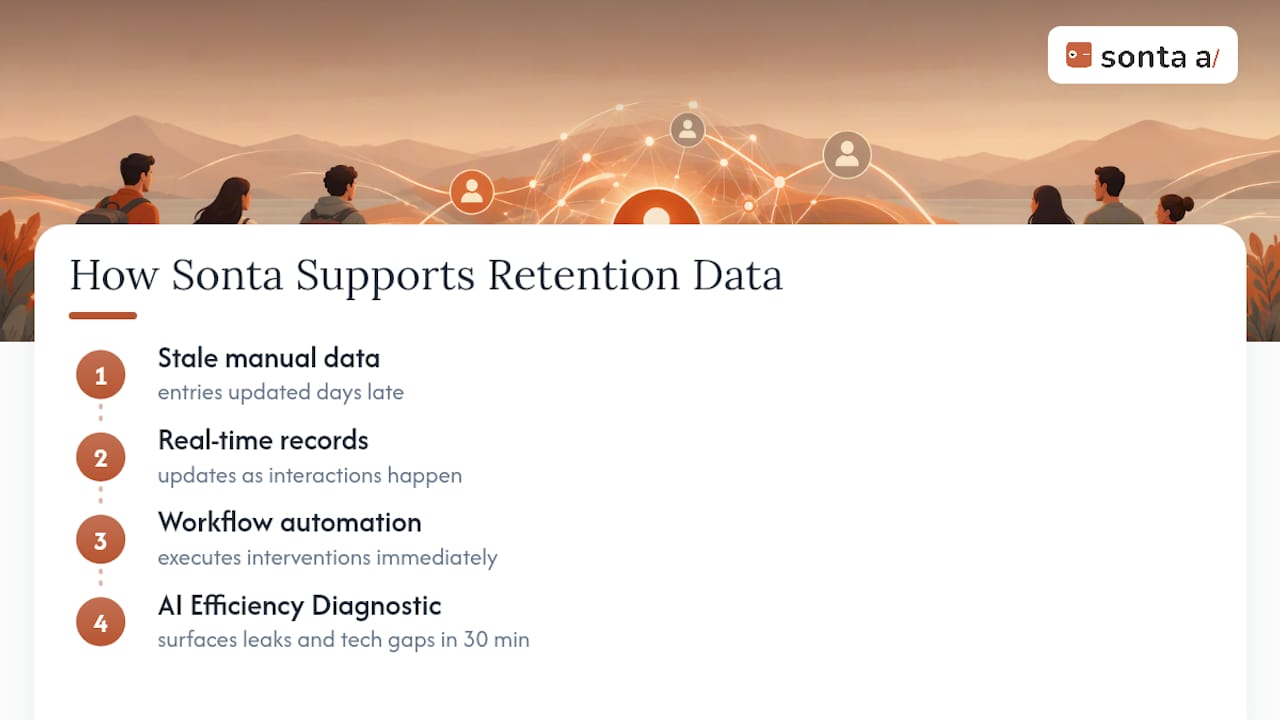
Sonta AI is built specifically for AI-first go-to-market teams, and its architecture solves a problem that undermines most retention pilots before they start: stale, manually entered customer data. The Sonta AI platform uses real-time data management so account records update themselves as customer interactions happen, rather than depending on a rep to log an activity days later.
That matters directly for retention modeling. A churn score built on data that’s a week stale is already wrong by the time a CSM acts on it. Sonta AI’s self-updating records give teams the current-state signals that uplift and churn models actually need, along with workflow automation that can execute the intervention (a task, a follow-up, a scheduled call) the moment a risk signal fires, closing the gap between detection and action that kills most pilots.
For teams unsure where their retention data gaps actually are, Sonta AI’s AI Efficiency Diagnostic surfaces operational leakages and tech stack gaps in about 30 minutes, which shortens the discovery phase that normally eats the first few weeks of any pilot before a single experiment even launches.
What Practitioners Get Wrong About Retention AI
The biggest mistake I see is teams chasing full personalization before they’ve proven a single causal effect. Broad, always-on personalization sounds impressive in a board deck, but it produces noisy, unmeasurable results. Pick one constrained uplift pilot, one segment, one intervention, one holdout, and prove the mechanism works before scaling anything.
The second mistake is treating AI as a replacement for human judgment rather than a partner to it. The research consistently shows trust and orchestration, not raw model accuracy, determine whether retention AI actually holds up.
— Pavel
Get a Faster Read on Your Retention Gaps
If your team keeps stalling before a pilot even launches, the bottleneck is usually stale or scattered customer data, not a lack of ideas. Sonta AI is built around real-time, self-updating records instead of manual data entry, which means the churn signals and usage triggers your retention models need are current the moment a customer acts, not days later when a rep finally logs it.

The fastest way to see where your own setup is leaking retention opportunity is the AI Efficiency Diagnostic, which surfaces operational gaps and tech stack issues in about 30 minutes, giving you a concrete starting point for the first uplift pilot rather than another round of guessing. From there, teams ready to move can review plans starting at $16 per seat per month and pick the tier that matches their pilot’s scope. Start with the diagnostic, then decide what to automate.
Sources
- Uplift modeling vs propensity baselines (arXiv)
- LaCrosse Institute white paper on trust and human-AI interaction
- IAB AI Governance and Risk Management Playbook
FAQ
What Does Customer Retention Mean?
Customer retention is a company’s ability to keep paying customers active and renewing over time, rather than losing them to competitors, dissatisfaction, or neglect. In the context of AI, it specifically refers to using predictive models and automated interventions to identify at-risk customers and act before they leave.
What Are the Three R’s of Customer Retention?
The three R’s commonly refer to retention, relevance, and reward: keeping customers active, staying relevant to their changing needs, and rewarding loyalty in ways that reinforce continued use. AI supports all three by flagging disengagement early, personalizing outreach based on real usage data, and timing rewards or offers to the moments they’ll actually influence behavior.
What Factors Drive Customer Retention?
Retention tends to hinge on a handful of consistent factors: a strong onboarding experience, ongoing product value, responsive support, consistent communication, and a sense of trust in how the company treats the customer’s data and relationship. AI strengthens each of these by catching friction early, particularly in the first 90 days when churn risk is highest.
Is There a Standard Framework Like the “8 C’s” of Retention?
Definitions of various “C” frameworks vary across sources and aren’t standardized in the research behind this article, so treat any specific list with some caution. What’s consistently supported is that communication, consistency, and customer-centered data practices show up across nearly every credible retention model, AI-driven or not.
How Much Does Sonta AI Cost for a Retention Pilot?
Sonta AI’s plans start at $16 per seat per month for the Solo tier, with Core and Pro tiers available for teams needing broader automation and integration support. Enterprise pricing isn’t published and is available on request through the pricing page.