Stop 25–30% Data Decay with Data Hygiene Automation for CRM & GTM Teams
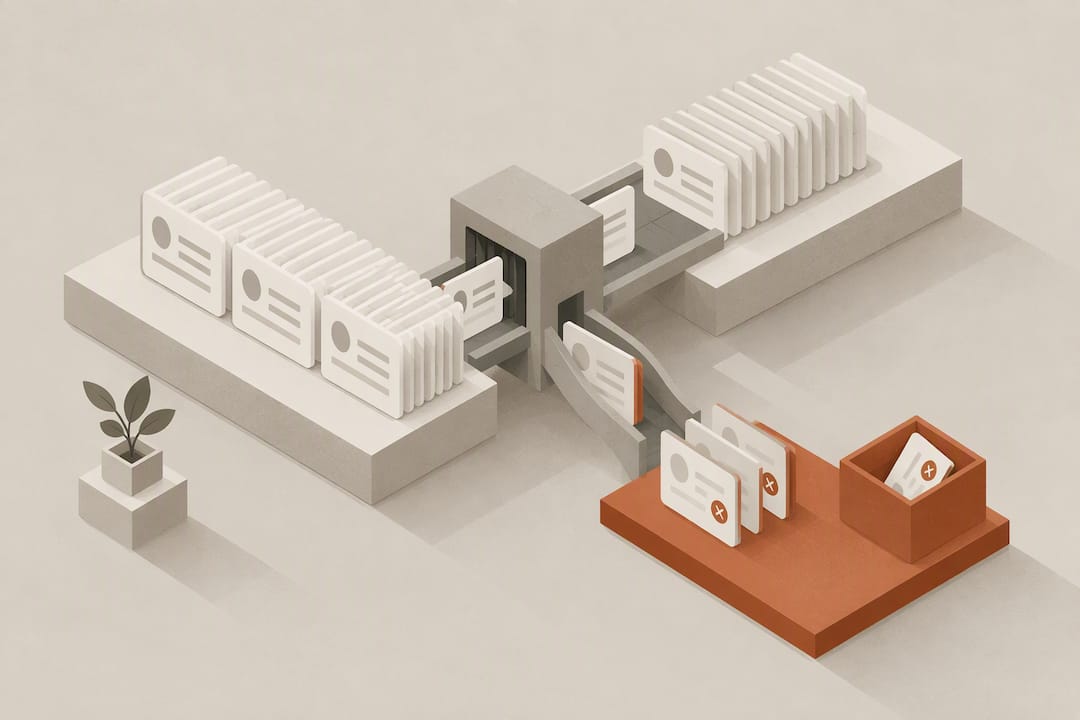
Data hygiene automation is the continuous, rule-based validation and remediation of records as they enter and move through your systems, replacing periodic manual cleanup with always-on checks. The right approach combines automated validation at ingestion with staged remediation workflows that escalate uncertain cases to a person. For CRM and GTM teams, this means fewer stale leads, more reliable automation, and forecasts that reflect what is actually happening in the pipeline.
TL;DR:
- Data decay affects 25 to 30 percent of B2B records annually, making continuous hygiene necessary to maintain data freshness and accuracy.
- Implementing layered automation with real-time validation and staged human review prevents irreversible errors, especially at record merges.
- Operational data contracts, quality service level objectives, and detailed logging are crucial for reliable, measurable data hygiene practices.
- Most effective tools combine orchestration, monitoring, enrichment, and master data management, all integrated into existing pipelines with idempotent design.
- Starting with a narrow pilot of validation, de-duplication, and enrichment for specific domains over 4 to 8 weeks helps build scalable, ongoing data hygiene processes.
Table of Contents
- Why Data Hygiene Matters Now: Business Impact and Benefits
- Core Automation Patterns and Where to Apply Them
- Operational Best Practices and a Checklist to Make Automation Reliable
- Tools and Tech-Stack Patterns: What to Buy or Build
- Implementation Roadmap: Pilot to Continuous Operation
- How to Measure Success: KPIs, Decay Rate and Operational Signals
- Sonta AI in Practice: An Illustrative Example of Continuous Data Hygiene
- Integration of Data Hygiene Automation With Existing Data Pipelines and Systems
- Case Studies or Examples Demonstrating Effective Data Hygiene Automation
- Author Perspective: Common Pitfalls and Pragmatic Cautions
- Sonta AI: Next Steps With a Demo or the AI Efficiency Diagnostic
- Sources
- FAQ
Why Data Hygiene Matters Now: Business Impact and Benefits
Dirty data is not a hygiene issue in the abstract sense: it is a revenue and cost problem that compounds every quarter it goes unaddressed. Sales reps waste hours chasing duplicate leads, marketing spend gets misrouted to disconnected contacts, and any AI layered on top of that data inherits its errors, a straightforward case of garbage in, garbage out.
B2B contact and company data decays at an annual rate of roughly 25 to 30 percent, meaning a database left untouched for a year could have a third of its records out of date, wrong, or dead. That decay rate is the reason one-time cleanups fail: by the time a team finishes scrubbing a database, a meaningful share of it has already gone stale again.
The benefits of solving this run in the opposite direction:
- Sharper personalization. Clean, current fields let marketing and sales segment and message accurately instead of guessing.
- More reliable forecasting. Pipeline reports mean something when the underlying account and contact data is trustworthy.
- Automation that actually works. Any AI agent, scoring model, or workflow trigger is only as good as the data feeding it.
- Protected revenue. Fewer misrouted leads and fewer reps working dead contacts translates directly into recovered pipeline.
25 to 30 percent of B2B contact and company data decays every year, according to Verum’s analysis of database decay. That single figure explains why hygiene has to run continuously rather than as an annual project.
Core Automation Patterns and Where to Apply Them
The most useful distinction in data hygiene automation is preventive versus corrective. Preventive automation stops bad data from entering the system in the first place. Corrective automation finds and fixes what got through anyway. Mature programs run both at once, because no ingestion rule catches everything and no cleanup job scales to handle a firehose of new records.
A practical build order looks like this:
- Ingestion-time validation. Check format, required fields, and referential integrity the moment a record arrives, before it reaches a rep’s queue or a workflow trigger.
- Idempotent ingestion and schema enforcement. Design pipelines so reprocessing the same record twice never creates a duplicate, and enforce a schema so malformed payloads get rejected or flagged rather than silently stored.
- Normalization. Standardize formats for names, phone numbers, company names, and addresses using consistent rules rather than ad hoc fixes.
- Deduplication. Match and merge records using fuzzy logic on top of exact-match keys, since real-world duplicates rarely share identical spelling.
- Enrichment. Fill gaps in firmographic or contact data from trusted sources on a schedule, not just at creation.
- Staged agent autonomy. Let automation handle routine fixes outright, but require a human decision for anything ambiguous.
A technical framework for AI-driven data quality monitoring describes this as a layered architecture: intelligent ingestion, adaptive preprocessing, real-time monitoring, and continuous learning, with techniques like active learning keeping the underlying models current as data patterns shift.
Escalation rules matter as much as the automation itself. Field normalization and activity logging are reversible, so they are safe to automate end to end. Merges are functionally irreversible: once two account records are combined, untangling them later is expensive and often incomplete. That is why most mature setups pause automation at the merge step and route it to a person, especially when the records involve sensitive customer data or high-value accounts.
Pro Tip: Automate anything you can undo with one click; route anything you cannot undo to a human reviewer.
Operational Best Practices and a Checklist to Make Automation Reliable
Automation without guardrails just moves the cleanup problem downstream. The fix is to treat data quality as an operational contract, not a best effort.
Start with data contracts: written, testable agreements between the systems producing data and the systems consuming it, defining what fields are required, what formats are acceptable, and what happens when a violation occurs. Pair those contracts with measurable quality service level objectives, so “clean data” stops being a subjective judgment and becomes a number a team is accountable for. NIST’s Research Data Framework recommends assessing quality across accuracy, completeness, consistency, timeliness, validity, and uniqueness, and tying those quality goals directly to governance rather than treating them as a side project.
A practical checklist:
- Encode validation rules as machine-checkable tests, not documentation someone reads once.
- Standardize fields with controlled vocabularies (industry codes, country lists, job title taxonomies) to cut down normalization work later.
- Build quarantine zones where suspect records sit for review instead of entering production tables.
- Make every ingestion pipeline idempotent so retries never duplicate data.
- Log every automated fix with a timestamp, source, and reason code for audit purposes.
ISO 8000 sets machine-checkable requirements for master data exchange at the interface level between systems, which is exactly where most hygiene failures originate: a field means one thing in the CRM and something slightly different in the marketing platform.
| Governance element | What it controls | Why it matters |
|---|---|---|
| Data contract | Format and required fields between systems | Prevents malformed data at the source |
| Quality SLO | Target percentage of records meeting standards | Turns hygiene into a measurable commitment |
| Quarantine zone | Holding area for suspect records | Stops bad data from reaching production |
| Change log | Record of every automated fix | Supports audit and rollback |
Tools and Tech-Stack Patterns: What to Buy or Build
Most hygiene stacks are assembled from four categories rather than one all-in-one product. Understanding where each category fits keeps you from buying overlapping tools or building something a platform already does well.
- Ingestion and orchestration. Tools like Apache Airflow schedule and sequence the pipelines that move data between systems, and are a natural place to embed validation steps.
- Data quality and observability platforms. These monitor data in flight and at rest, flagging anomalies before they reach a dashboard or a rep’s inbox.
- Enrichment APIs. Third-party services fill gaps in firmographic, contact, or intent data on a recurring schedule.
- Master data management (MDM) systems. These hold the authoritative version of a record when multiple systems disagree.
- Workflow engines. These execute the actual remediation, whether that is a merge, a field update, or an escalation.
The feature checklist worth applying to any candidate tool includes streaming checks (not just batch), explainability for why a record was flagged, staged autonomy settings so you can dial automation up gradually, and a broad enough integration surface to touch your CRM, marketing platform, and data warehouse without custom code for every connection, which is a key advantage of using a White-Label Configurator.
Build versus buy usually comes down to how specific your data model is. A generic enrichment or validation layer is rarely worth building from scratch. A rules engine tuned to an unusual sales motion or a regulated industry sometimes is. Either way, privacy and data residency considerations shape the decision: enrichment APIs that pull from third-party data pools need a clear answer on where customer data goes and how long it is retained.
Implementation Roadmap: Pilot to Continuous Operation
A rollout works better as a staged pilot than a big-bang deployment. The pattern that tends to hold up:
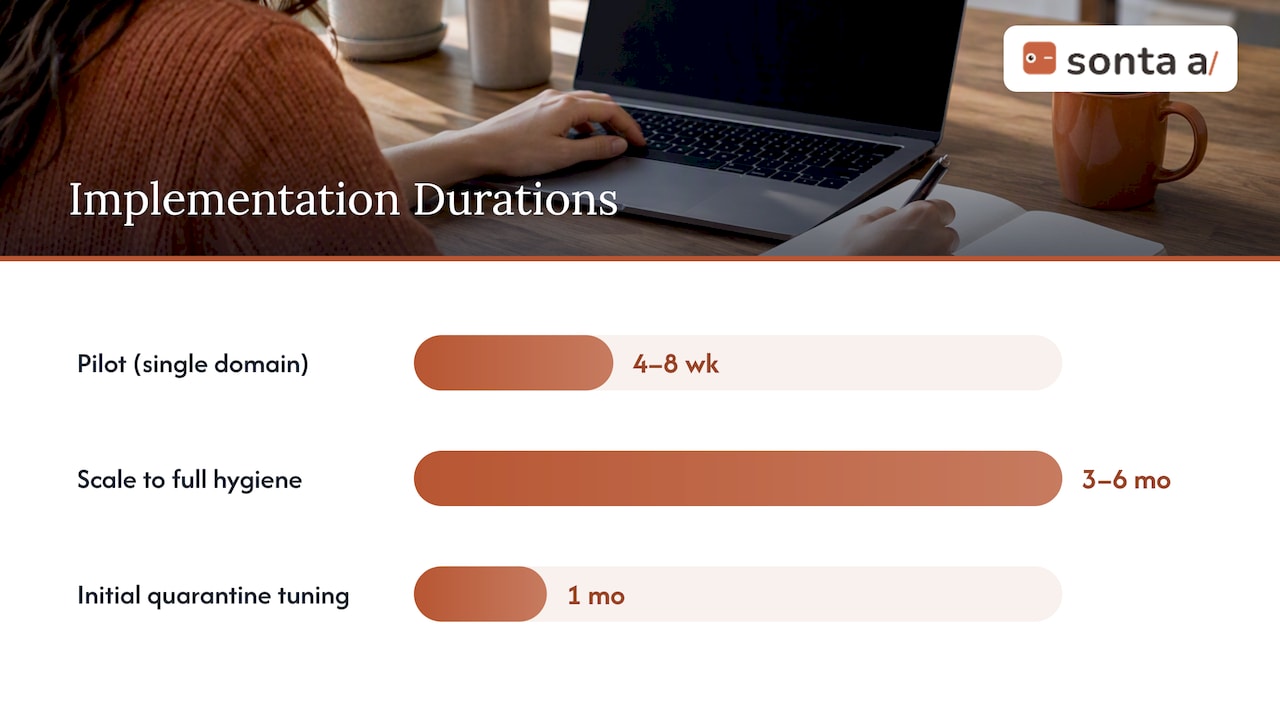
- Pick one domain for a 4 to 8 week pilot. Contact records or lead intake are common starting points because the decay rate is highest there and the business impact of stale data is easiest to measure.
- Scope the MVP narrowly. Validation, deduplication, and enrichment for that single domain, nothing broader, so you can isolate what is working.
- Set one measurable success KPI before you start. Percentage of records meeting your quality SLO is the cleanest number to track week over week.
- Expand in a deliberate cadence. Most teams take three to six months to move from a single-domain pilot to hygiene automation running across accounts, contacts, and opportunities.
- Hand off governance as you scale. The person who owns the pilot rarely scales with it, so define who owns rule changes and exceptions before expanding.
Cost drivers fall into four buckets: platform or tool licensing, integration engineering time, ongoing human review for escalated cases, and the ramp-up cost of building your controlled vocabularies and rule sets in the first place. The human-review bucket is easy to underestimate. Even a well-tuned system will route a steady stream of merges and ambiguous matches to a person, and that workload does not disappear as automation matures. It shifts in kind rather than volume.
The main risks worth planning for up front are alert fatigue, where too many flagged records train reviewers to rubber-stamp everything, and overcorrection, where an aggressive dedupe rule merges records that should have stayed separate. Both are avoidable with conservative thresholds early on and a review cadence that adjusts them based on real outcomes, not guesses.
Pro Tip: Tune your quarantine thresholds down for the first month; it is easier to loosen a strict rule later than to undo a bad automated merge.
How to Measure Success: KPIs, Decay Rate and Operational Signals
The KPIs that matter most are decay rate, the percentage of records meeting your quality SLOs, average remediation time, downstream error rate in systems consuming the data, and the review load landing on humans each week.
| KPI | What it measures | Typical cadence |
|---|---|---|
| Decay rate | Share of records going stale over time | Monthly |
| % meeting SLO | Records passing defined quality thresholds | Weekly |
| Remediation time | Time from flag to fix | Weekly |
| Downstream error rate | Errors in systems consuming the data | Monthly |
| Review load | Volume of cases escalated to humans | Weekly |
Sampling a slice of your database monthly against the 25 to 30 percent annual decay benchmark gives you an early warning if your automation is falling behind the natural rate of decay. Dashboards work best when they alert on trend breaks rather than raw counts, since a rising review queue often signals a rule that needs retuning rather than a genuine data crisis.
Sonta AI in Practice: An Illustrative Example of Continuous Data Hygiene
An AI-native CRM built around self-updating records shows what continuous hygiene looks like in a live sales environment rather than a batch job. Sonta AI uses staged AI agents to validate and remediate records as they move through the pipeline, rather than relying on reps to keep fields current.
In practice, that includes:
- Lead qualification agents that check and normalize intake fields before a record reaches a rep.
- Scheduled enrichment that fills firmographic gaps without a manual data pull.
- Staged autonomy that lets routine fixes run automatically while ambiguous merges route to a person.
Teams evaluating whether their current setup has these gaps can run the AI Efficiency Diagnostic, a 30-minute assessment built to surface where operational leakage and stale data are costing pipeline.
Integration of Data Hygiene Automation With Existing Data Pipelines and Systems
Hygiene automation rarely lives in isolation. It has to sit inside pipelines that already move data between a CRM, a marketing platform, a data warehouse, and whatever billing or support systems a company runs. The integration point that matters most is the interface between systems, which is exactly where ISO 8000’s master data standards focus their machine-checkable requirements.
Two integration patterns dominate. The first embeds validation directly into the orchestration layer, so a tool like Airflow runs quality checks as a step in every pipeline run rather than as a separate job that fires later. The second treats validation as a standalone service that pipelines call before writing data, which keeps the rules centralized but adds a network hop.
Either pattern needs idempotent design: a pipeline that reprocesses the same record after a retry or a system outage should never create a duplicate or reapply a fix twice. This matters more as automation scales, because retries become routine rather than exceptional.
Federation is the other integration reality most teams face. Customer data lives in more than one system of record, and hygiene automation has to decide which system wins when two sources disagree. An AI-native architecture built around real-time record updates handles this by treating the CRM as the coordination point, pulling and reconciling data from connected systems rather than waiting for a batch sync to catch discrepancies days later.
Case Studies or Examples Demonstrating Effective Data Hygiene Automation
The clearest examples of effective hygiene automation share a common shape: narrow scope first, then expansion once the pattern proves out. A sales team dealing with duplicate leads from multiple intake forms, for instance, typically starts by automating dedupe and normalization for that single intake source before expanding the rule set to cover every lead channel feeding the CRM.
Industry guidance on data hygiene consistently points in the same direction: HubSpot’s overview of data hygiene practices recommends combining preventive validation with corrective automation and continuous monitoring, rather than treating cleanup as a project with an end date. That framing matches what shows up in practice: teams that treat hygiene as a one-time initiative see their gains erode within months as new decay accumulates, while teams that build monitoring into the pipeline keep quality flat over time instead of watching it slide.
A recurring pattern in successful rollouts is that the human-review step never disappears entirely. Even well-tuned automation keeps a standing queue of merge candidates and edge cases, and the teams that sustain quality over multiple quarters are the ones that staffed that review function from day one rather than treating it as a temporary cost.
Author Perspective: Common Pitfalls and Pragmatic Cautions
Most rollouts fail from the wrong lever, not the wrong tool. Full automation on merges is the single most common misconfiguration, and it turns a reversible mistake into an irreversible one. Staged autonomy costs a little review time up front and saves months of untangling bad merges later. Get stakeholder buy-in on that tradeoff before writing a single rule, not after something breaks.
— Pavel
Sonta AI: Next Steps With a Demo or the AI Efficiency Diagnostic
Sonta AI’s Agentic CRM is built around self-updating records and staged AI agents, so hygiene runs as a continuous background process rather than a recurring cleanup project a team has to schedule.

If you want a concrete read on where your own pipeline is leaking data or rep time, the AI Efficiency Diagnostic gives a 30-minute assessment of operational gaps, and current pricing across the Solo, Core, Pro and Enterprise plans is available for teams ready to evaluate a switch.
Sources
- B2B data decay: why 30% of your database goes bad every year — Verum
- NIST Research Data Framework (RDaF)
- ISO 8000-100:2016 - Data quality — Part 100: Master data: Exchange of characteristic data: Overview
- A theoretical framework for AI-driven data quality monitoring in high-volume data environments — arXiv
- What Is Data Hygiene?: Why You Need It & How to Do It Right — HubSpot
FAQ
How Can I Automate Data Cleaning in Excel?
Excel supports basic automation through formulas like TRIM and PROPER for normalization, conditional formatting to flag duplicates, and macros or Power Query for repeatable cleanup steps. It works for small, static datasets, but it has no way to run continuous checks against live CRM or pipeline data, which is why growing teams move validation into a dedicated pipeline or platform.
What Is a Data Hygiene Process?
A data hygiene process is the set of rules and checks that keep records accurate, complete, consistent, timely, valid, and unique over time, rather than only at the moment of entry. NIST’s Research Data Framework frames these as the core quality dimensions that governance programs should measure and enforce.
Can You Give Me an Example of Data Automation?
A common example is ingestion-time validation paired with scheduled enrichment: a new lead record gets its fields checked and normalized the moment it arrives, then enriched with firmographic data on a recurring schedule so it stays current. Automated deduplication that merges obvious duplicates while routing ambiguous matches to a person is another widely used pattern.
Which AI Tool Is Best for Data Cleaning?
The right tool depends on whether you need batch cleanup, real-time validation, or ongoing enrichment, since these are different jobs handled by different tool categories. Platforms with staged autonomy, like Sonta AI’s Agentic CRM, are built specifically for CRM data where records need continuous, real-time hygiene rather than periodic batch cleanup.