15–25% More Qualified Leads with Agentic Generative AI CRM for GTM

Generative AI CRM embeds content generation, call summarization, and agentic orchestration directly into CRM workflows, so records update themselves and sellers spend less time on data entry and more time on selling. The primary payoff is operational: faster outreach, better-qualified pipeline, and fewer manual handoffs between sales, marketing, and service. None of that works without clean data and clear governance in place first.
TL;DR:
- Proper data hygiene and governance are critical; poor data quality causes more errors than model limitations.
- Reusable, centrally managed agents outperform one-off builds, enabling scalable automation across teams and functions.
- Successful pilots require clear metrics and baseline comparisons, with a focus on time savings and pipeline growth.
- Embedding real-time record updates and staged autonomy are key features of AI-native CRMs like Sonta Ai.
- Focusing on use cases with immediate time-cost reduction, such as call summarization and lead qualification, accelerates adoption.
Table of Contents
- What generative AI CRM does and core benefits for sales, marketing, and service
- Function-level use cases: sales, marketing, and customer support examples
- Agentic AI and the hybrid human–AI operating model
- Implementation checklist: data readiness, integration, governance, and change management
- Measuring impact: KPIs, baselines, and common effect sizes to expect
- How an AI-native CRM works in practice: Sonta Ai as an illustrative example
- Real-world case studies showcasing successful generative AI CRM deployments
- Future trends and advancements in generative AI for CRM
- Common challenges and pitfalls in adopting generative AI CRM and how to mitigate them
- An executive’s take on generative AI CRM adoption
- Next steps: evaluating AI-native CRM options
- FAQ
- Sources
What generative AI CRM does and core benefits for sales, marketing, and service
Most CRM platforms today are “AI-enabled”: a legacy system with a chatbot or a summarization feature bolted on. A generative AI CRM is built differently from the ground up. The architecture assumes AI agents read, write, and reason over records continuously rather than waiting for a rep to open a form and type. That distinction matters for anyone evaluating options because the operational benefits only show up when generation and automation are native to the data model, not layered on top of it.
In practice, the capabilities look like this:
- Drafting personalized emails, proposals, and follow-up sequences from account context.
- Summarizing calls and meetings into structured notes attached to the record automatically.
- Updating fields like deal stage, contact role, or next step without manual entry.
- Surfacing next-best-action recommendations based on account history and buying signals.
Adoption of these capabilities has moved fast. Generative AI use in core business functions more than doubled between 2023 and 2024, rising from 33% to 71%, according to the AI Index 2025 report from Stanford HAI. Global private investment in generative AI reached $33.9 billion in 2024, per the same AI Index findings, a signal that the infrastructure behind these workflows is maturing quickly rather than remaining experimental.
Function-level use cases: sales, marketing, and customer support examples
Generative AI CRM earns its keep at the task level, not as an abstract capability. Here is how it shows up across functions:
- Sales: account research compiled from public and CRM data before a call, personalized outreach drafted from buyer signals, and automated meeting prep that pulls prior notes and open commitments into a single brief.
- Sales coaching: agents that review recorded calls, grade them against a rubric, and suggest specific follow-up actions rather than generic feedback.
- Marketing: scaled personalization across segments, rapid generation of content variants for testing, and localization of campaign copy for different markets without a separate translation cycle.
- Customer support: automated ticket triage that routes issues by urgency and topic, summarized case histories that save agents from re-reading long threads, and pre-emptive outreach suggestions when usage patterns signal risk.
- Cross-functional workflows: a single agent framework that hands a qualified lead from marketing to sales with full context, then alerts service when a deal closes so onboarding starts without a manual handoff.
The common thread is that each of these tasks used to require a human to assemble scattered information before doing the actual thinking. Generative AI CRM removes the assembly step.
Pro Tip: Start with one coaching or summarization use case that has an obvious time-cost today, since quick wins build the internal case for broader rollout.
Agentic AI and the hybrid human–AI operating model
Generative AI CRM is increasingly agentic: instead of a single prompt-response tool, specialized agents handle discrete jobs like qualifying leads, drafting outreach, or coaching reps, often working in sequence with light human review at decision points. McKinsey’s research on agentic AI in growth functions describes three common agent roles: knowledge agents that retrieve and synthesize information, coaching agents that review performance, and orchestration agents that sequence work across systems.
The organizations getting the most value do not build a one-off agent for every team. They centralize reusable agents into what McKinsey calls agent factories, standardizing blueprints so a qualification agent built for one region or product line can be redeployed elsewhere rather than rebuilt.
Scaling agents responsibly requires deliberate structure:
- Assign clear roles (lead agent, practitioner agent, QA agent) so accountability is never ambiguous.
- Monitor agent outputs continuously rather than trusting a single pilot evaluation.
- Avoid siloed, one-off agent builds that cannot be reused or audited later.
- Keep a human in the loop at the point where an agent’s recommendation becomes a customer-facing action.
Coaching agents illustrate the scale difference well: McKinsey notes they can review up to 95% of sales calls automatically, compared with roughly 3% under human-only review, which changes what “coaching coverage” even means for a sales organization.
Implementation checklist: data readiness, integration, governance, and change management
A generative AI CRM rollout succeeds or fails on groundwork most teams underestimate. The sequence below reflects where pilots typically stall.
- Fix the data layer first. Canonical records, de-duplicated contacts, and clean integration sources (calendar, email, call recordings) matter more than model choice, since a generation layer built on inconsistent records just produces confident, wrong outputs faster.
- Plan the integration path. Decide how generated content and summaries land in CRM fields, what latency is acceptable for real-time use, and how you will monitor output quality once it’s live.
- Put governance in place before scaling. The NIST Generative AI Profile recommends documenting training-data provenance, maintaining an inventory of every generative AI system in use, and continuously evaluating safety and robustness rather than treating governance as a one-time sign-off.
- Design for the seller, not the demo. A pilot that adds steps to a rep’s day will be abandoned regardless of what it automates behind the scenes.
- Run a bounded pilot with a measurement plan attached. Define the metric before launch, not after.
Pro Tip: Treat the NIST provenance and inventory recommendations as a working document updated with each new agent, not a compliance form filed once.
Measuring impact: KPIs, baselines, and common effect sizes to expect
Judging a generative AI CRM pilot requires metrics that isolate the AI’s contribution from normal pipeline variance. Useful KPIs include time saved per rep on administrative tasks, meeting readiness rate (how often reps walk in with current account context), lead conversion lift, pipeline velocity, and reliability metrics for the agents themselves, such as how often outputs need correction.
Set a baseline before rollout and run the pilot against a holdout group wherever team size allows it, since before-and-after comparisons without a control tend to overstate impact. McKinsey’s research on embedding generative AI into CRM workflows found case examples where qualified leads rose 15% to 25% and parts-and-services sales lifted 25% to 30% after embedding generative AI into existing CRM processes. Those figures come from specific enterprise cases, not a universal guarantee, and attribution gets harder the more simultaneous changes a GTM team makes during a rollout.
How an AI-native CRM works in practice: Sonta Ai as an illustrative example
We are a CRM platform built specifically for AI-first GTM teams, where records update themselves in real time instead of waiting on manual entry. Our AI Efficiency Diagnostic illustrates what a data-readiness check looks like in practice: it reviews a team’s current workflows and tech stack to flag operational leakage and prioritize where a pilot would have the most effect, with results delivered within 30 minutes.
That kind of staged, diagnostic-first approach reflects a broader pattern in agentic CRM design, where agents take on narrow, well-defined tasks like lead qualification before expanding into orchestration across the funnel. Illustrative outcomes of this model include faster lead qualification and fewer manual record updates, without claiming any particular result is guaranteed for every team.
Real-world case studies showcasing successful generative AI CRM deployments
Documented deployments tend to cluster around a few repeatable patterns rather than one-size-fits-all transformations.
Sales coaching offers another concrete pattern.
A third pattern shows up in buy-versus-build decisions. McKinsey’s analysis of B2B growth through generative AI found that teams succeed fastest when they buy straightforward capabilities like email drafting and call summarization off the shelf, reserving custom build effort for strategic use cases like next-best-offer logic or pricing optimization that need to reflect a specific business model. Teams that tried to custom-build everything from day one consistently took longer to show results than teams that mixed bought and built components deliberately.
Across these examples, the deployments that stuck shared a trait: they measured a specific metric (qualified leads, call coverage, time saved) against a baseline, rather than declaring success based on adoption alone.
Future trends and advancements in generative AI for CRM
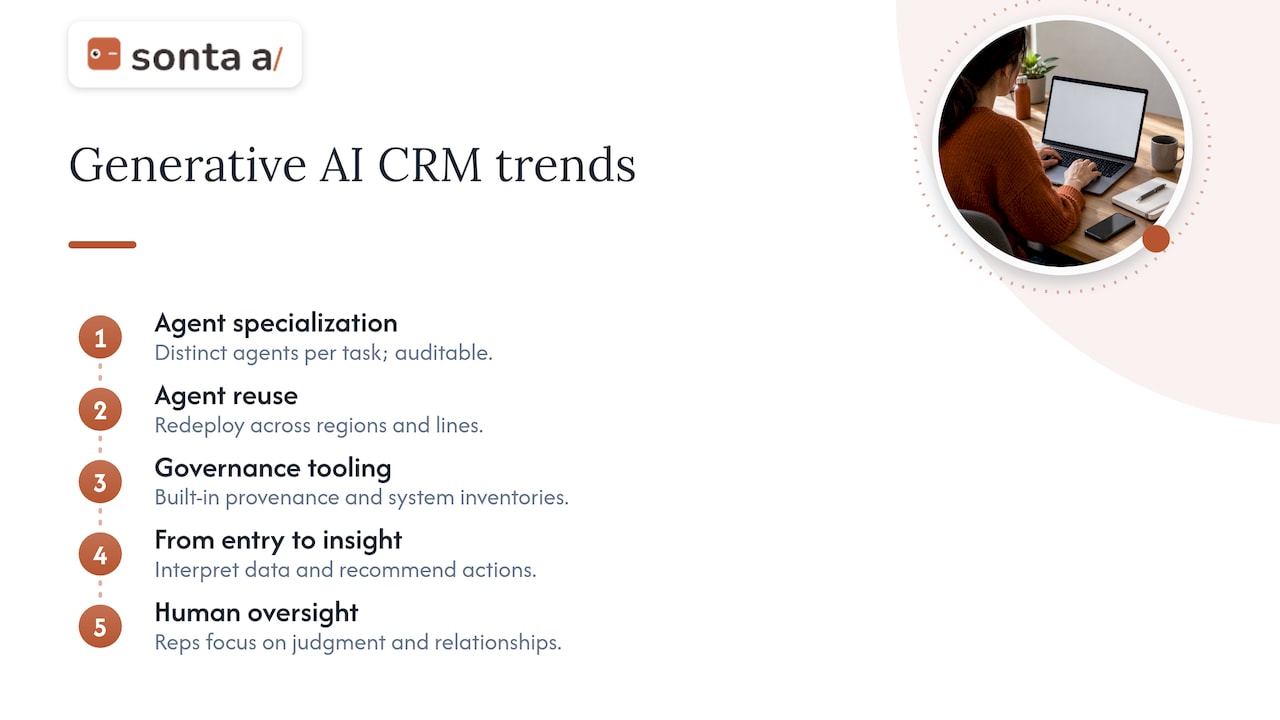
The near-term trajectory points toward deeper agent specialization rather than bigger, more general models. Instead of one assistant handling every task, expect more CRM platforms to ship distinct agents for qualification, coaching, scheduling, and account research, each tuned to a narrow job and auditable on its own terms.
Agent reuse is likely to become a selection criterion in its own right. As McKinsey’s agent factory concept gains traction, buyers will increasingly ask whether a vendor’s agents can be redeployed across regions or business lines without a rebuild, not just whether a demo looks impressive.
Governance tooling will mature alongside the agents themselves. NIST’s Generative AI Profile already lays out expectations for provenance tracking and system inventories, and as regulatory attention on AI increases, CRM vendors that bake these controls into the product rather than treating them as a customer’s problem to solve will have an advantage with risk-conscious buyers.
Expect a continued shift from data entry tools toward data interpretation tools. The historic CRM job was recording what happened. The emerging job is explaining what it means and recommending what to do next, which is a fundamentally different value proposition and one that will keep pulling budget toward platforms built around generation and reasoning rather than storage and reporting.
Finally, the human-AI division of labor will keep shifting toward oversight rather than execution for routine tasks, with reps spending more of their time on judgment calls, relationship building, and exceptions that agents flag rather than resolve.
Common challenges and pitfalls in adopting generative AI CRM and how to mitigate them
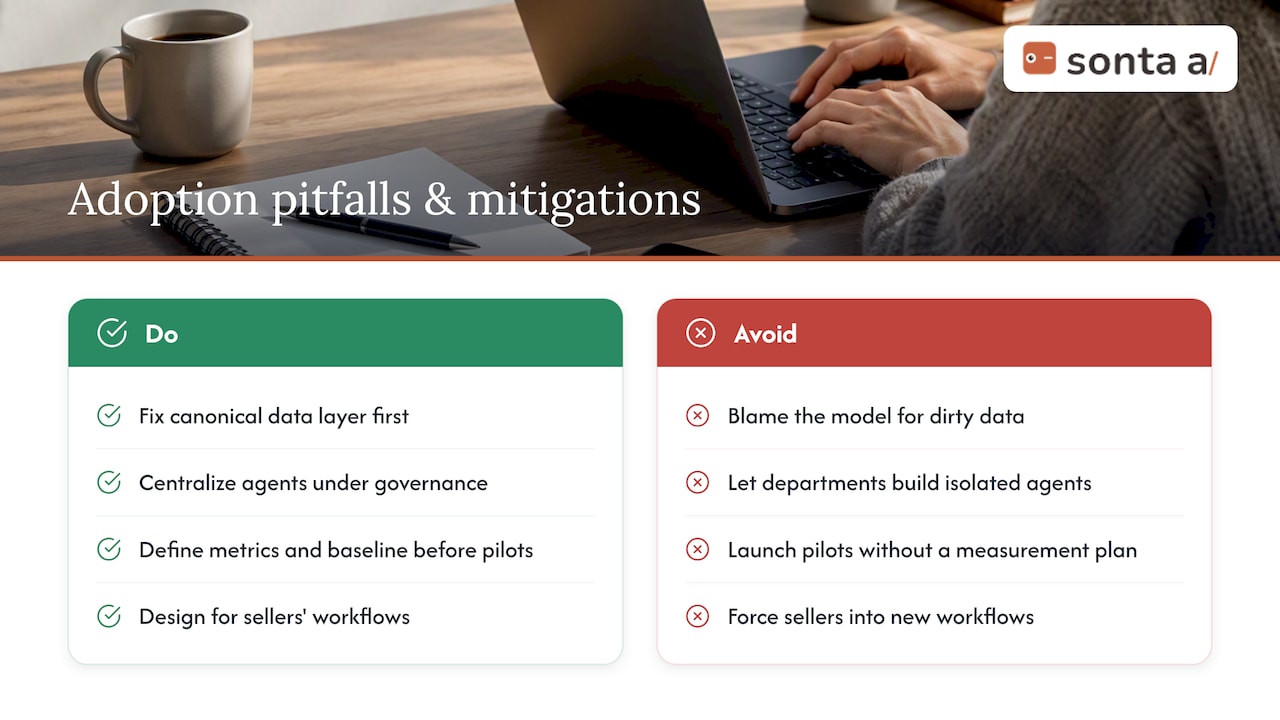
The most common failure mode is poor data hygiene masquerading as a model problem. When generated emails or summaries feel generic or wrong, the root cause is usually incomplete or duplicate records, not an underpowered model. Fixing the canonical data layer before scaling generation fixes most of these complaints outright.
A second pitfall is siloed, one-off agent builds. Teams that let each department build its own agent independently end up with duplicated effort and no shared governance, the exact pattern McKinsey’s agent factory concept was designed to prevent.
A third is skipping the measurement plan. Pilots that launch without a predefined metric and baseline tend to get judged on anecdote, which makes it nearly impossible to decide objectively whether to scale, adjust, or kill the effort.
A fourth is underestimating change management. A generative AI CRM that adds friction to a seller’s existing routine, even while automating something else, will get quietly ignored regardless of its technical merit. Designing around the seller’s actual workflow, not the system architecture, is what determines whether adoption holds past the pilot phase.
Finally, governance gaps create real exposure. Skipping provenance documentation or safety evaluation, as outlined in the NIST Generative AI Profile, leaves teams unable to answer basic questions about where a generated output came from if a customer or regulator asks. Building that documentation habit from the first pilot avoids a costly retrofit later. Working with an experienced AI transformation partner can help teams without in-house AI governance expertise set these controls up correctly from the start.
An executive’s take on generative AI CRM adoption
Our recommendation is narrow and specific: run one focused pilot with governance built in from day one, not bolted on afterward, and design agents to be reused across functions rather than rebuilt for each team. Measure time saved and pipeline impact against a real baseline, and keep the seller’s workflow, not the architecture, as the design center.
— Pavel
Next steps: evaluating AI-native CRM options
Vendor conversations about generative AI CRM tend to go better when you walk in with a short checklist rather than a feature wish list:
- Does the platform update records in real time, or does it still rely on manual entry behind the scenes?
- Do agents operate with staged autonomy, so you can expand their scope as trust builds rather than all at once?
- Is there a diagnostic step that identifies where automation will have the most effect before you commit to a build?
- What governance controls exist for data provenance and model oversight?

We built Sonta Ai around these exact questions, with staged-autonomy sales agents that take on more responsibility as a team’s confidence grows, and self-updating records that remove the data entry ceiling common in legacy CRMs. Our AI Efficiency Diagnostic gives a prioritized view of where a pilot would matter most within 30 minutes, and our pricing page lays out plans from Solo through Enterprise so you can see where a team your size would start. If a generative AI CRM pilot is on your roadmap this year, the diagnostic is a practical place to begin.
FAQ
Is there an AI CRM?
Yes, several CRM platforms now build generative AI and agentic automation directly into the core product rather than adding it as a feature on top of a legacy system. These AI-native platforms handle tasks like record updates, lead qualification, and call summarization through dedicated AI agents instead of manual entry.
What is the 30% rule for AI?
Readers may be thinking of various internal benchmarks different organizations use for pilot thresholds, but no universal standard goes by that name in the research cited here.
What are the top 5 generative AI platforms?
There is no single authoritative ranking of the top five generative AI platforms, since rankings shift by use case, model provider, and evaluation criteria. For CRM specifically, the more useful question is whether a platform is AI-native, meaning generation and agents are built into its architecture, rather than which broad-market model ranks highest.
What is the number one CRM in the world?
There is no single CRM that holds an undisputed, universally agreed “number one” ranking, since market share estimates vary by research firm, business size segment, and region. For teams evaluating generative AI CRM specifically, the more relevant comparison is architecture: whether a platform is AI-native, like Sonta Ai, or AI-enabled with generative features added to an older system.
Sources
- AI Index 2025 — state of AI in 10 charts
- Agents for growth: Turning AI promise into impact — McKinsey
- Artificial Intelligence Risk Management Framework: Generative Artificial Intelligence Profile — NIST
- How gen AI is reshaping data monetization — McKinsey