Sales Teams: Diagnose CRM Gaps and Pilot an Opportunity Scoring Model

An opportunity scoring model ranks open deals by win probability and expected value, giving sellers a clear order of who to call first and feeding more reliable numbers into the forecast. The single best next move is not a company-wide rollout: it is a narrow pilot, validated against discrimination metrics like AUC and PR-AUC plus a calibration check, before anyone trusts the score for daily work. Before that, confirm three things: enough historical data, a plan to explain the score to sellers, and someone assigned to monitor it.
TL;DR:
- Success relies on a narrow pilot with sufficient historical data, clear definitions, and ongoing monitoring before expanding to wider deployment.
Table of Contents
- What opportunity scoring models do for sales teams
- How scores get calculated: data, sample sizes, and model choices
- A step-by-step implementation blueprint for a low-risk pilot
- Evaluation, monitoring, and retraining: metrics that matter
- Getting sellers to trust and use the score
- Governance and continuous improvement for the model lifecycle
- How an AI-native CRM shortens the path from pilot to production
- Practitioner perspective: a short checklist before you build
- Start your scoring pilot with a clear data picture
- FAQ
- Sources
What opportunity scoring models do for sales teams
A working score changes how sellers spend their morning. Instead of working the pipeline in the order deals were created, reps work it in the order they are likely to close, and managers get a forecast input that reflects probability rather than gut feel and deal age. The output is only as good as what feeds it, and most models draw on four signal groups:
- Fit and firmographics: company size, industry, and other attributes that describe whether the account resembles past winners.
- Intent events: website visits, content downloads, and other signals that a buyer is actively evaluating.
- Engagement and touchpoints: email replies, meeting attendance, and call frequency across the deal’s life.
- Deal attributes and value: stage, deal size, discounting, and time already spent in the pipeline.
Teams with sales cycles that vary a lot by stage often benefit from per-stage scoring rather than one global number, since the signals that predict an early-stage win rarely match the ones that predict a late-stage close.
How scores get calculated: data, sample sizes, and model choices
Most opportunity scoring models train on a straightforward label: closed won versus closed lost. The training window typically spans several months up to two years, scaled to how long the sales cycle runs, since a six-month cycle needs more history than a six-week one to produce enough closed deals.

Data volume requirements vary widely by platform. Some systems set the bar as low as roughly 40 won and 40 lost opportunities, while others, such as SAP, recommend up to 5,000 records before trusting the output, according to Microsoft’s configuration guidance. A balanced, representative training set, not just a large one, is what actually improves readiness.
A case study using gradient-boosted trees (XGBoost) on cleaned, balanced B2B data reported an AUC around 0.993 and accuracy up to 95.57%, a result from one documented implementation, not a baseline every dataset will hit.
- Gradient boosting models like XGBoost are common choices because they handle mixed, messy CRM data well.
- High accuracy on a clean, balanced dataset does not guarantee the same result on a noisier, imbalanced one, so validation matters more than the algorithm choice.
- When trust needs to come quickly, simpler models or local explanation methods like SHAP can buy credibility while a more complex model proves itself.
A step-by-step implementation blueprint for a low-risk pilot
Treat the first scoring model as a scoped experiment, not a platform launch.
- Pick one grain: a single pipeline, business unit, or process flow, and one concrete question the score should answer (for example, “which open opportunities are most likely to close this quarter”).
- Document definitions before training: what counts as “won,” what counts as “lost,” and which filters exclude test or duplicate records. Ambiguous labels poison the model before it starts.
- Train and validate: hold out a test set and run cross-validation, checking both discrimination and calibration rather than accuracy alone.
- Map thresholds to actions: decide what a high, medium, or low score means at each stage and which rep action it should trigger.
- Publish only after readiness criteria are met, then expand to per-stage models only where stages behave differently enough to justify separate scoring.
Pro Tip: Run the pilot on the pipeline with the most closed history, not the one leadership cares about most this quarter.
Evaluation, monitoring, and retraining: metrics that matter
Two questions decide whether a score is ready: does it rank deals correctly, and are its probabilities honest. The first is answered with AUC and PR-AUC, which measure how well the model separates winners from losers.
Research on model-based ROC curves proposes mROC-style testing specifically to catch calibration problems that discrimination metrics alone miss, particularly when the mix of deals shifts over time.
- Set a readiness threshold before launch and report performance on a biweekly cadence so drift gets caught early.
- Retrain periodically, with cadence driven by sales velocity, ranging from every few days in high-volume motions to monthly in longer cycles, and retrain immediately after a process change.
- Watch for data-quality decay, label leakage, and shifts in feature distributions that signal the model is scoring on a world that no longer exists.
Getting sellers to trust and use the score
A score nobody acts on is wasted infrastructure. The fix is showing the “why,” not just the number.
- Surface the top local contributors behind each opportunity’s score, alongside the global feature importance for the model overall.
- Place the explanation directly in the CRM record, with a suggested next action, like an outreach template, attached to low-scoring deals.
- Track adoption with hard numbers: time-to-contact by score decile and win rate lift in the highest-scoring decile.
- Capture rep overrides as feedback rather than treating them as noise to ignore.
Enterprise guidance on predictive opportunity scoring treats transparency as the deciding factor in whether sellers trust a score enough to change their behavior.
Pro Tip: Show three influencing factors per deal, not ten. Sellers act on a short, clear reason faster than a dense report.
Governance and continuous improvement for the model lifecycle
Scoring models drift and decay without an owner. Revenue operations or the data team typically owns the model itself, while sales managers own what happens with the output, holding reps accountable for acting on it, as recommended by OmniPulse’s AI strategy for business transformation.
- Capture both outcomes and qualitative lost reasons to feed the next training cycle.
- Version every model release and retire old versions so two models never score the same opportunity differently.
- Log model decisions for audit purposes, especially where scores influence resourcing or compensation conversations.
- Build in fairness checks and access controls so scoring criteria stay defensible under scrutiny.
How an AI-native CRM shortens the path from pilot to production
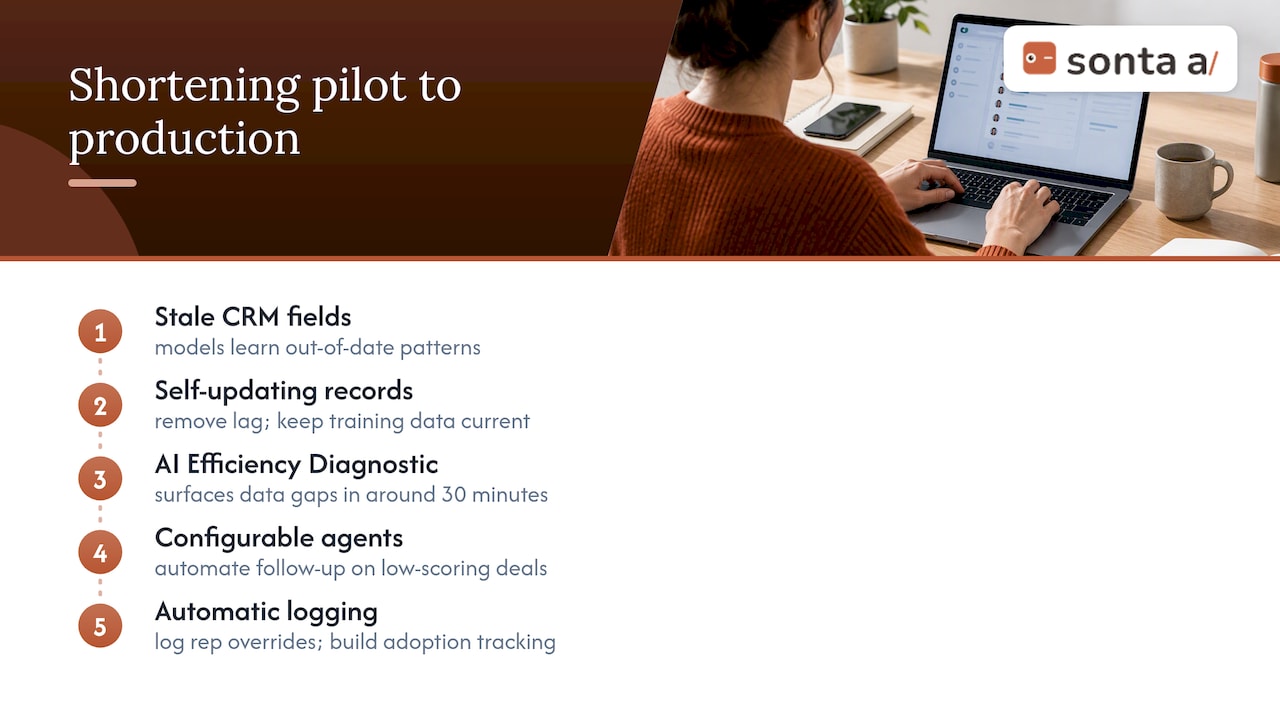
Stale CRM fields are one of the quietest killers of scoring accuracy, since a model trained on records that update once a week learns patterns that are already out of date. Self-updating records remove that lag, which keeps training data current as deals move. Our AI Efficiency Diagnostic surfaces data gaps in around 30 minutes, which shortens the setup phase of a pilot considerably. Within our agentic CRM, configurable agents can automate follow-up on low-scoring deals and log rep overrides automatically, turning adoption tracking into a built-in function rather than a separate reporting project.
Practitioner perspective: a short checklist before you build
Our honest read after walking through this process: the checklist is short, but skipping steps is where most pilots fail. Pick one grain, run a data diagnostic, define score thresholds, validate both AUC and calibration, then publish. The common failure modes are treating scoring as a one-time project, skipping explainability because it feels secondary, and publishing before anyone owns monitoring. Start small, measure strictly, and iterate fast.
— Pavel
Start your scoring pilot with a clear data picture
Running a pilot is far easier when you know exactly where your CRM data has gaps before training even begins. Our AI Efficiency Diagnostic gives you that picture in about 30 minutes, flagging the fields and processes that would otherwise undermine a scoring model’s accuracy. Because records can update themselves in real time, the data your pilot trains on stays current instead of lagging a week behind your pipeline.

- The diagnostic identifies operational leakages and tech stack gaps before you commit to a build.
- Agentic workflows can automate follow-up on low-scoring deals once your thresholds are set.
- Plans can scale from solo sellers to full revenue teams, with no metering on automation usage.
Current prices are available on the pricing page.
See full plan details on our pricing page, or start with the diagnostic to find out where your data stands today.
FAQ
How is the opportunity score calculated?
The score is calculated by training a model on closed won and closed lost deals, learning which combination of fit, intent, engagement, and deal attributes historically predicted a win. Gradient-boosted tree models like XGBoost are common, and case study results show accuracy up to 95.57% on cleaned, balanced datasets, though results vary by data quality.
What is Einstein Opportunity Scoring and how does it work?
Einstein Opportunity Scoring is Salesforce’s native predictive scoring feature, which analyzes historical opportunity data to assign a likelihood-to-close score to open deals. It works on the same general principle covered here: a model trained on past wins and losses ranks current opportunities, with the score surfaced directly in the CRM record.
Can you give me an example of lead scoring?
A simple example assigns points for firmographic fit, such as company size matching your ideal customer profile, plus points for intent signals like repeated pricing page visits, and more points for engagement such as replying to outreach. Leads crossing a set point threshold get routed to sales, while others stay in nurture.
What are some examples of customer scoring models?
Common models include lead scoring, which ranks prospects before they become opportunities, opportunity scoring, which ranks open deals by win probability, and churn or retention scoring, which flags existing customers at risk of leaving. Each uses a similar structure: a label from historical outcomes, feature inputs, and a model that ranks current records against that pattern.
Sources
For readers who want to go deeper on data thresholds, model choice, and calibration testing, the sources below cover the specifics referenced throughout this guide.
- Configure predictive opportunity scoring - Microsoft Dynamics 365
- RIT repository case study (2025) on XGBoost performance
- Model-Based ROC Curve: Examining the Effect of Case Mix and Model Calibration on the ROC Plot - PMC