Bring your own LLM in a CRM: what it means and what to control

Bringing your own LLM to a CRM means you choose the AI model, connect it with your own API key and pay the model provider directly. You are not building or training a model. You are choosing which one does the work. For a sales team, that means control over cost, data and quality of the writing that reaches your clients.
Sonta AI is an agentic CRM that finds opportunities and moves them forward. You run its AI on your own keys from Anthropic, OpenAI, Google or OpenRouter. There is no markup on AI when you use your own keys. This guide explains what the arrangement involves, what to check and where it goes wrong.
TL;DR
- Bring your own LLM (BYO LLM) means you pick the model, connect it with your own key and can swap it later. It is not training a model.
- With your own key, the provider bills you directly, and the relationship over your data sits between you and the provider under its terms.
- A good setup lets you choose the model per task, set which steps need your approval and see what you spend.
- Self-hosting a model is a different and far heavier project. For most sales teams, a hosted API on your own key gives the control without the infrastructure.
- UK GDPR applies wherever the model runs, so check the contract, the region and the retention before you connect anything.
Table of Contents
- What bring your own LLM actually means
- How it works inside a CRM
- What a CRM with your own API key should let you control
- What it costs: your own key against bundled AI
- Data and privacy: the checks that matter in the UK
- How it compares with what you may be using now
- Working with AI agents under your own rules
- Our view
- Try it on your own keys
- FAQ
- Sources
What bring your own LLM actually means
There are three ways to get a large language model (LLM, the AI model behind tools such as ChatGPT or Claude) into your business. MIT Sloan describes them as buying, boosting or building. Buying means using an off-the-shelf model. Boosting means improving a vendor’s model with your own data. Building means creating a custom solution from scratch. MIT Sloan says buying is fast but leaves you dependent on the vendor, and building gives the most control but is expensive and difficult.
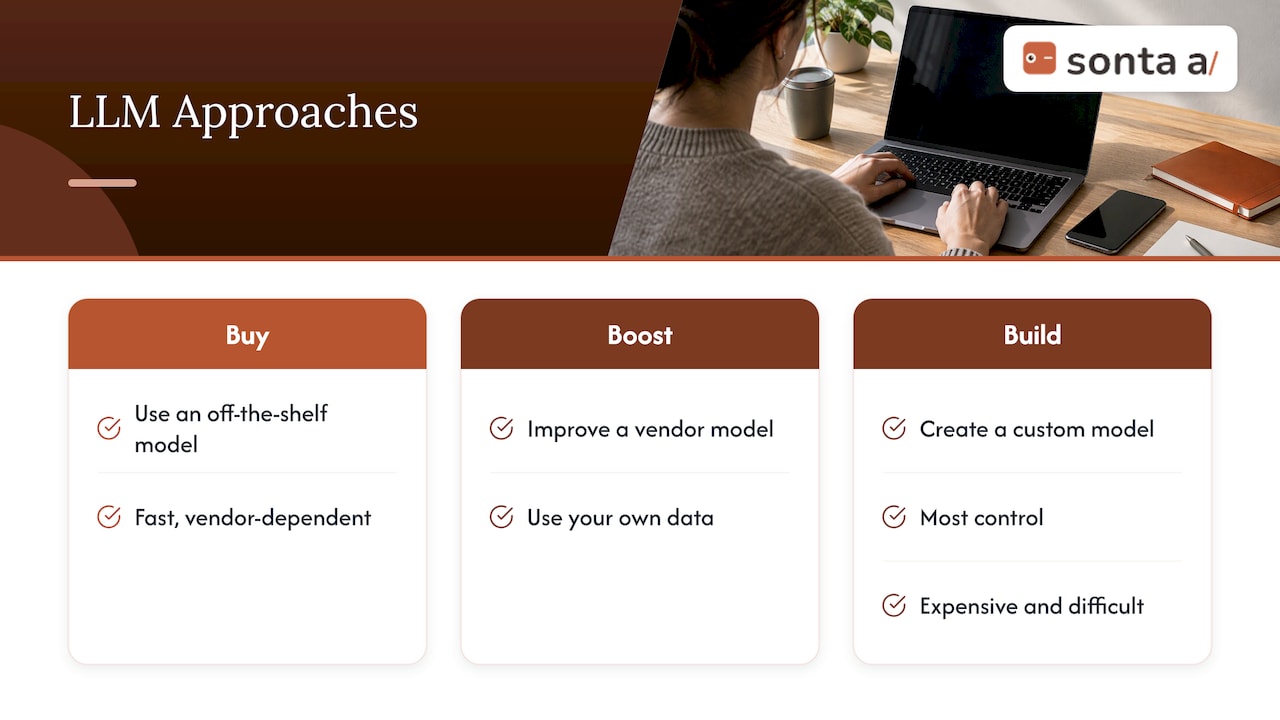
BYO LLM sits at the buying end, with the control moved to you. Twilio defines it as an architecture in which you choose the model that powers your AI agents, connect it, control the prompts and swap providers. The platform handles everything around the model.
That is the useful part. Twilio’s Jesse Sumrak (2026) argues that whatever works best today will almost certainly not lead tomorrow. If your CRM locks you to one model, you wait for the vendor’s roadmap. If you hold the key, you switch when a better model appears.
Building your own model is a different job entirely. Trace3 cites McKinsey estimates of roughly $5M to $200M in one-time costs to develop an LLM, with $1M to $5M a year to run it (2024). TechRadar reports that training a foundational model can cost eight figures. No agency or software firm needs that. If you are weighing options, the same logic as any buy-versus-build decision applies: buy the part that is a commodity and keep control of the part that is yours.
How it works inside a CRM
In a CRM, BYO LLM comes down to one setting. You create an API key (a secret code that lets software use your account) with a model provider. You paste it into the CRM. From then on, every AI task in the CRM calls the model through your account.
In Sonta, you connect Anthropic, OpenAI, Google or OpenRouter and choose the model for each task. A model that is good at long research notes can sit behind your prospect research. A faster, lighter one can handle routine follow-ups. When a better model ships, you change one setting.
Three things change when you hold the key:
- Billing. The provider invoices you for usage. Nobody resells access in the middle.
- Visibility. Convelly notes that the provider’s dashboard shows daily spend, request volume and which model was called. Bundled plans tend to hide this.
- The legal relationship. Your business becomes the provider’s customer under its terms and data processing agreement (DPA, the contract that governs how a provider handles personal data).
The trade-off is housekeeping. Convelly points out that you manage the provider account, the spending limits, the rate limits and the key’s security. Set a monthly spending cap at the provider on day one. Give the key only to the people who administer the CRM. Rotate it if anyone with access leaves.
What a CRM with your own API key should let you control
A key field alone is not control. When you assess any CRM that offers it, ask these questions.
- Can you pick the model per task? One model for everything wastes money or quality.
- Can you see which model answered? You need to know which model wrote each email and which one scored each prospect.
- Do you decide which steps need approval? Sending a first email to a new client is a different risk from updating a field. The customer should decide which steps wait for a yes.
- Are agent runs metered? If the vendor charges per agent run on top of your own key, you pay twice. In Sonta, agent runs are never metered.
- Is there a markup on AI? Sonta applies no markup on AI when you use your own keys.
- Do the same rules hold in other interfaces? If you work from an AI assistant, the approvals should still apply.
Sonta covers the last point through its MCP server. MCP (Model Context Protocol) is a standard that lets an AI assistant work with another tool. You can use Sonta from Claude or ChatGPT, and the same rules and approvals apply. The MCP and AI agents guide shows how it is set up. The idea is similar to how people connect their own AI assistant to a personal knowledge library: the assistant reaches the tool, but the tool keeps its own rules.
What it costs: your own key against bundled AI
Bundled AI is simpler. The vendor picks the model, absorbs the usage and folds the cost into the plan. Convelly says this can suit a one-person business with low volume. For a team that sends sequences every week, usage grows and the vendor’s pricing has to cover it.
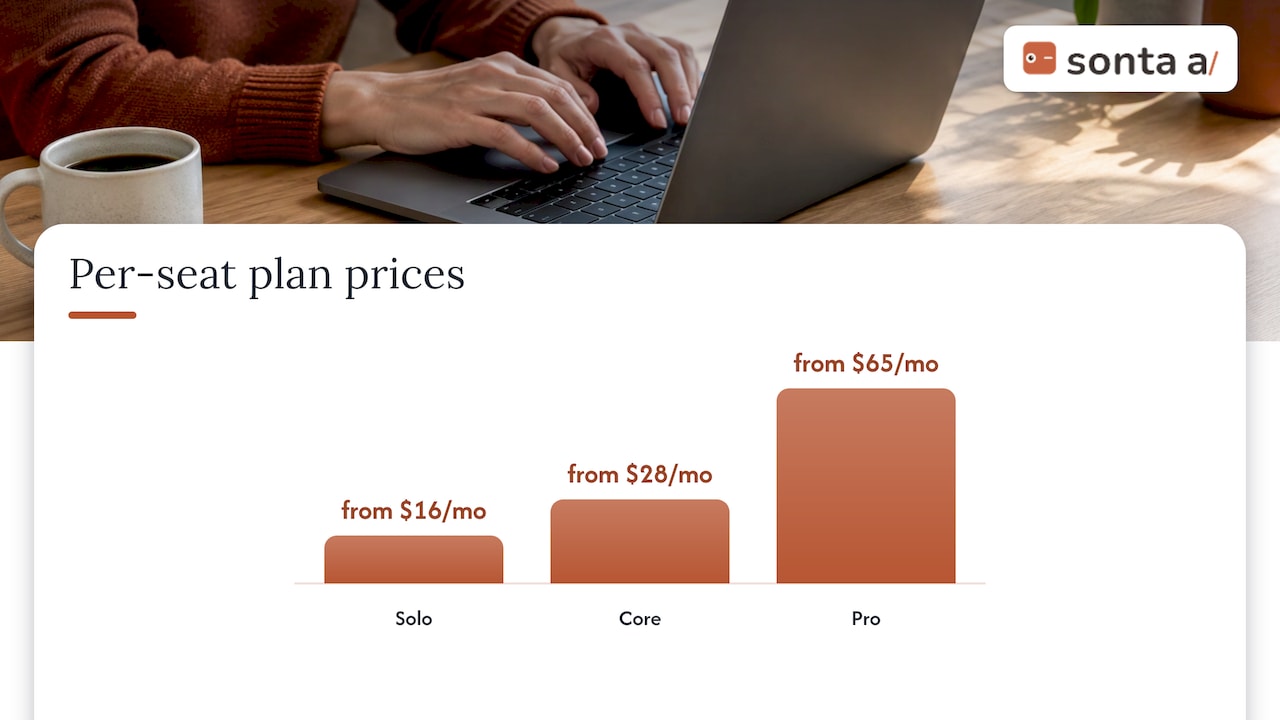
With your own key, you pay two things: the CRM subscription and the provider’s usage charges. Sonta’s published plans (read 6 November 2026) are:
| Plan | Price |
|---|---|
| Solo | from $16 a month per seat |
| Core | from $28 a month per seat |
| Pro | from $65 a month per seat |
Signal packs start from $29 a month. The 5 pack costs $29 a month, the 15 pack $79 and the 40 pack $119. Each pack is a set of always-on searches for the moments that make a conversation timely. LinkedIn accounts are billed per seat through an add-on at $15 to $20 a month. Email sequences are unlimited. See the pricing page for the current detail.
On total cost, Sonta replaces a CRM, an email sequencer, a LinkedIn outreach tool and a signal tool in one app. Sonta’s value calculator found a median 36% less than the cheapest equivalent stack (Sonta value calculator, list prices read 17-18 Oct 2026). That is a comparison of list prices, not a promise about your bill.
Why self-hosting rarely pays for a sales team
Some teams ask whether they should run a model on their own servers. TURMA’s UK cost model (November 2026) puts a self-hosted workstation with a 96GB GPU at £18,000 over three years. Add about £105 a month in power and £1,200 a month in support and the total is roughly £1,805 a month. TURMA also cites a Carnegie Mellon study of 54 scenarios. It found self-hosting viable mainly for organisations processing at least 50 million tokens a month or facing strict data-residency requirements.
TURMA’s conclusion is practical. People costs dominate, and the fair comparison for a self-hosted open model is the same model through a hosted API, which wins on cost at small and mid-sized volumes. For a team of five to fifty sellers, a hosted model on your own key gives you the choice without the servers.
Data and privacy: the checks that matter in the UK
Holding your own key does not remove your data protection duties. It makes them clearer.
TURMA states that no UK law requires self-hosting AI. UK GDPR is technology-neutral. Wherever the model runs, you still need a lawful basis, transparency, data minimisation, accuracy, security and a way to handle people’s rights. The same research notes that the Data (Use and Access) Act 2025 received Royal Assent on 19 June 2025.
Two practical points follow.
- Sub-processors. Quo Vadis CCS warns that under UK GDPR a processor must not engage another processor without the controller’s documented instructions. Pasting a client transcript into an outside AI tool can create exactly that problem. Connecting a model through the CRM, under a contract you have read, keeps the route documented.
- Provider terms. With your own key, the provider’s terms apply to you. Convelly advises reading them to see whether the provider may train on your data. Most business tiers say no by default, but read the terms rather than assume.
A short due-diligence list before you connect a model:
- Which legal entity signs the DPA?
- Where is the data stored, and where are the backups?
- Which provider processes each AI feature, in which region and with what retention?
- Is your data used to train any model?
- Does your privacy notice mention AI processing?
Sonta stores and processes customer data in the EU under GDPR. Your data is never used to train AI.
First-contact rules differ by country
AI that writes outreach still has to send it lawfully. Business email needs prior consent before first contact in Germany, the Netherlands, Denmark and Poland. In South Africa, POPIA applies to first-contact rules. If you sell across Europe, set rules per country before a sequence goes live.
LinkedIn rules
The Signal Agent in Sonta watches public LinkedIn activity. That includes a recommendation request, a new decision-maker, a company hiring or a contact changing jobs. It shows each reason with a link, so you can check it yourself. LinkedIn’s own rules govern automation on its platform. Read them before you connect an account, and keep your use within them. No tool can promise that automated activity is safe or undetectable.
A job change or a hiring post is a reason to talk. It is not proof that someone wants to buy. Sonta scores fit and intent separately so the two are not confused.
How it compares with what you may be using now
Most buyers weigh several routes. Each has a real strength.
| Option | Where it is strong | Where Sonta differs |
|---|---|---|
| HubSpot or Pipedrive | Familiar CRMs with large user bases and established pipelines | Sonta adds signals, native sequences and agents in the same app, so you do not stitch tools together |
| Attio | A flexible, modern CRM data model | Sonta adds signals, outreach and reply handling in the same app |
| Gojiberry AI, HeyReach, Instantly | Focused tools for signals, LinkedIn outreach and email sending | Sonta covers all of them and the CRM, so records update themselves |
| AI SDR tools such as Artisan and 11x | A hands-off approach to outbound | An AI SDR is one agent that stops at the meeting. Sonta has an agent for every step and is the CRM too |
| Spreadsheets | Free, flexible, no onboarding | Sonta keeps records current without manual entry |
| A lead-generation agency | Outside capacity and experience | Sonta keeps the work and the data in your own team |
| Hiring a salesperson | Judgement, relationships and ownership | Sonta takes the busywork off the person you have, including the founder |
If your team already runs on HubSpot or Pipedrive, the question is not whether your CRM is good. It is whether the signal tool, the sequencer and the LinkedIn tool bolted onto it are worth four invoices and four sets of data. Sonta replaces that stack with one app.
Working with AI agents under your own rules
BYO LLM only matters if the agents using the model behave. In Sonta, AI agents research prospects, follow up, prepare meeting briefs and keep records current. The customer decides which steps need their approval. You can start strict, with approval on every outbound message, then relax it for routine steps once you trust the output.
Sequences in Sonta are native. They are written from the moment a signal fires, so a message to someone who just asked for a recommendation refers to that request. This is where model choice shows. A stronger model on first-touch writing can matter more than the same model on record updates. The LLM orchestration guide suggests starting with 50 to 100 leads, so you can compare models on real output before you scale. For the wider picture, see how LLMs connect to a CRM safely.
Our view
Most CRMs treat the model as a feature the vendor owns. We think the model is a supplier you should be able to change.
That is why Sonta runs on your keys. You choose Anthropic, OpenAI, Google or OpenRouter, you pick the model per task and you see what you spend. We add no markup on AI when you use your own keys, and we never meter agent runs.
We run our own sales on Sonta. That is the test we trust. A CRM that finds opportunities and moves them forward should save the people using it from busywork, and it should leave them in charge of what gets sent.
Control also means the approvals. You decide which steps need a yes, and the same rules hold when you work from Claude or ChatGPT through MCP.
Pavel
Try it on your own keys
Sonta is an agentic CRM that finds opportunities and moves them forward. It brings the signal engine, native sequences, reply handling and the CRM into one app, with AI on your own keys. Plans start from $16 a month per seat on the pricing page. Book a demo and leave with your first leads.
FAQ
Is bring your own LLM the same as training my own model?
No. Bring your own LLM means choosing an existing model and connecting it with your own key. Training a model from scratch can cost millions, according to the McKinsey estimates cited by Trace3. For a sales team, connecting a hosted model is the practical route.
Do I need to host a model on my own servers for data control?
No. TURMA notes that no UK law requires self-hosting AI, because UK GDPR applies the same way wherever the model runs. What matters is the contract, the region, the retention and your lawful basis. Sonta stores customer data in the EU under GDPR and never uses it to train AI.
Which AI providers can I use with Sonta?
You can run Sonta on your own keys from Anthropic, OpenAI, Google or OpenRouter. You choose the model for each task. You can also use Sonta from Claude or ChatGPT through its MCP server, with the same rules and approvals.
Will my own key make AI cheaper?
It makes the cost visible and removes the markup. Sonta adds no markup on AI when you use your own keys, and agent runs are never metered. Your provider usage depends on volume and the model you choose.
Sources
- What is bring your own LLM (BYO LLM)? Twilio
- Buy, boost, or build? MIT Sloan
- Why BYO-LLM is the future, TechRadar
- BYOM: Harness the Power of Generative AI in the Enterprise, Trace3
- Bring Your Own AI API Key in a CRM, Convelly
- Private AI: the business case for running your own AI, TURMA
- Sovereign AI and customer data, Quo Vadis CCS