GDPR for CRM Data Owners: 7 Controls to Put in Place

Yes, CRM records are personal data under GDPR. Names, email addresses, IP addresses, and behavioral identifiers stored in a CRM fall squarely within Article 4’s definition, which makes your organization a data controller. The operational priority list is short: confirm your lawful basis for every processing activity, make data subject rights actually workable inside the CRM, and secure the records with a breach response plan.
TL;DR:
- Tag each contact or campaign with its lawful basis, log consent changes, and make withdrawal automatic; electronic marketing and special category data need extra checks.
- Your organization usually controls CRM purposes while the vendor processes data on instructions, so sign a written agreement covering subprocessors, security measures, and breach notices.
- Build workflows for access, correction, deletion, and portability requests; marketing objections must suppress a contact across every list and automation, not just the main record.
- Use least privilege, audit logs, encryption, and vetted integrations, then review permissions quarterly to catch access that remains after employees change roles.
- Once aware of a notifiable breach, notify the supervisory authority within 72 hours; inform affected people without undue delay if the incident poses high risk.
Table of Contents
- Why CRM data falls under GDPR and what principles shape it
- Controller vs processor: allocating responsibilities with your CRM vendor
- Lawful bases for CRM processing and direct marketing rules
- Data subject rights your CRM has to support
- Security controls and data protection by design for CRM platforms
- Breach detection and notification: what CRM teams must prepare
- Practical checklist: aligning CRM records with GDPR
- Where CRM data owners should focus first
- How an AI-native CRM builds these controls in from the start
- FAQ
- Sources
Why CRM data falls under GDPR and what principles shape it
Under Article 4(1), personal data covers any information relating to an identified or identifiable natural person, which includes the contact names, email addresses, IP addresses, and location fields that sit in nearly every CRM record. That makes your CRM a primary processing register, not a side tool, and it puts the burden of compliance on whoever controls the data.
Article 5 sets the principles that should drive how a CRM is configured: lawfulness and transparency, purpose limitation, data minimization, accuracy, storage limitation, integrity and confidentiality, and accountability. In practice, this means collecting only the fields a sales or support workflow actually needs, keeping records of processing activities, and being able to show, not just claim, that data flows match a documented purpose.
Controller vs processor: allocating responsibilities with your CRM vendor
Most organizations using a CRM are the controller: you decide why contact data is collected and how it gets used. Your CRM vendor is typically the processor, acting only on your documented instructions and required to apply appropriate technical and organizational measures, as described in EDPB guidance on controller and processor roles.
That relationship needs a written Data Processing Agreement that names subprocessors, spells out security measures, and sets breach notification obligations back to you. Joint controllership can arise when two organizations share a CRM instance or co-run a campaign, and in that case both parties need to document, in writing, who handles which obligation. Skipping this step leaves gaps that surface only when a regulator or a data subject asks who is responsible.
Lawful bases for CRM processing and direct marketing rules
Most CRM activity relies on one of three lawful bases under Article 6: consent, contract necessity, or legitimate interests. A signed customer agreement usually justifies contract-based processing for account servicing, while legitimate interests can cover routine B2B outreach when a balancing test shows the interest doesn’t override the contact’s rights. Special category data and electronic marketing covered by e-privacy rules such as PECR may require additional checks. The ICO’s direct marketing guidance recommends building data protection by design into campaign planning from the start.
Valid consent has to be freely given, specific, informed, and as easy to withdraw as it was to give. A few practices keep this manageable:
- Tag the lawful basis against each contact record or campaign type, not just at the account level.
- Build a one-click withdrawal path and route it automatically to suppression lists.
- Keep a timestamped log of consent given, consent withdrawn, and the basis in effect at each point.
Data subject rights your CRM has to support
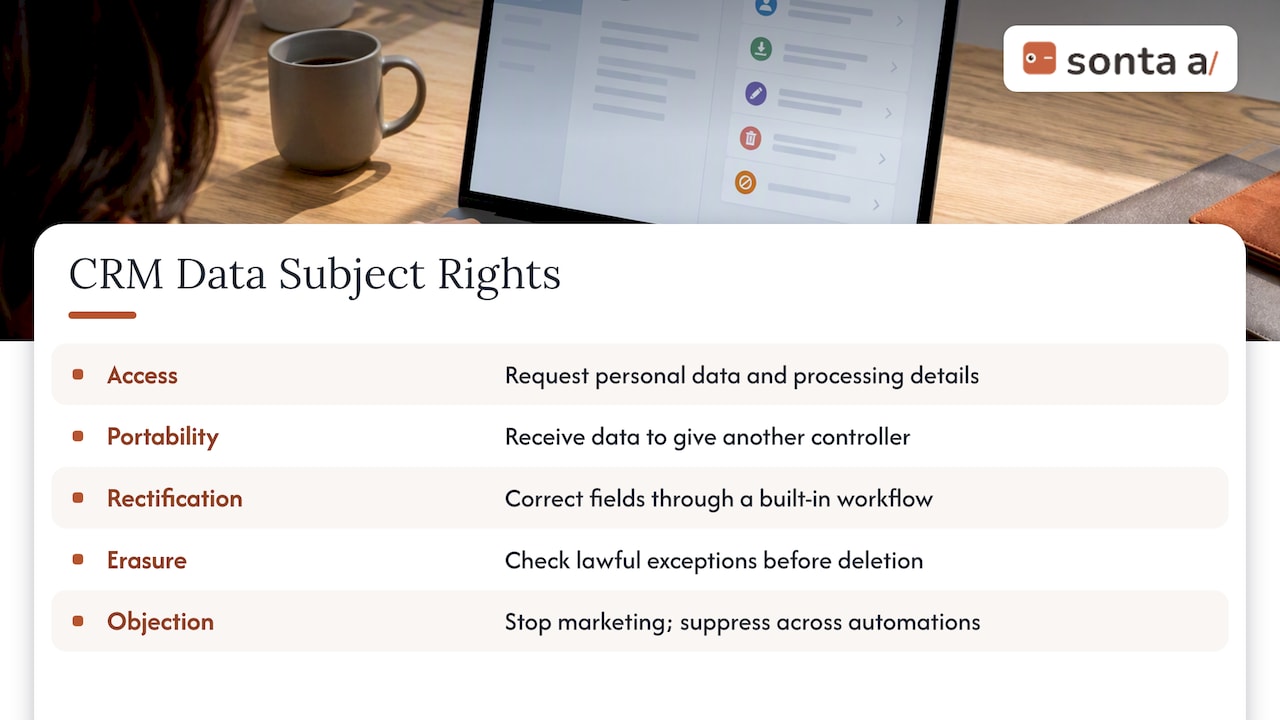
GDPR gives individuals a defined set of rights, and a CRM needs to operationalize each one rather than treat them as legal theory. The right of access allows individuals to request information about their personal data and its processing. Portability may also allow them to receive personal data in a format they can provide to another controller.
Rectification and erasure need built-in workflows, not manual database edits. When someone asks to correct a field or delete their record, an audit trail can show the request and the action taken. Check whether a lawful exception applies before completing an erasure request. Objection rights matter most around direct marketing and profiling: a contact who objects has to stop receiving marketing immediately, and that suppression needs to propagate across every list and automation the CRM runs, not just the main contact table.
Security controls and data protection by design for CRM platforms
Article 25 requires data protection by design and by default, and Article 32 sets the security bar for processing. For CRM owners, that translates into a specific set of controls:
- Role-based access with least-privilege permissions, so each user sees only the records their job requires.
- Audit logs covering who accessed, edited, or exported which record and when.
- Encryption at rest and in transit, with pseudonymization applied where full identifiers aren’t needed, plus strategies to fix masking failures fast.
- Vetted integrations and webhooks, since a poorly secured connector is a common entry point for exposure.
Government guidance on CRM data protection is direct on this point: a CRM is not compliant out of the box, compliance comes from how you configure roles, access, and audit trails. Designing permission structures around actual job functions, the approach covered in role design guidance, closes most of the gap between a default install and an accountable system.
Pro Tip: Review CRM permission sets quarterly, since role creep from reassigned staff is one of the most common causes of unnecessary data exposure.
Breach detection and notification: what CRM teams must prepare
A notifiable breach starts a clock the moment you become aware of it. ICO guidance on personal data breaches confirms you must notify the relevant supervisory authority within 72 hours, and if the breach is likely to create a high risk to people’s rights and freedoms, you also need to inform the affected individuals without undue delay.
Prepare a breach response process that helps your team gather relevant details, assess likely consequences, and identify measures to address the incident. Having this template ready before an incident happens can make it easier to respond promptly.
Practical checklist: aligning CRM records with GDPR
Turning these requirements into action works best as a sequence rather than a parallel scramble:
- Run a data audit to map where personal data in the CRM originates and where it’s stored or synced.
- Put a Data Processing Agreement in place with your CRM vendor and review any subprocessors.
- Document retention periods and build suppression lists for contacts who’ve withdrawn consent or objected.
- Implement role-based permissions, audit logging, and encryption as baseline technical measures.
- Automate hygiene tasks like deduplication and accuracy checks, covered in deduplication practices for CRM migrations.
- Run a Data Protection Impact Assessment for any large-scale or profiling use case.
- Write and test a breach response runbook so your team is prepared to respond promptly.
Where CRM data owners should focus first
Clear role design, automation, and auditability do more to reduce GDPR risk than any policy document sitting in a shared drive. If you can show, at any moment, who has access to a record and why, half the compliance burden disappears. Start with the data audit, get the Data Processing Agreement signed, and build the breach runbook before you touch anything else. Everything downstream, consent tracking, retention schedules, access reviews, gets easier once those three are in place.
— Pavel
How an AI-native CRM builds these controls in from the start
We built Sonta Ai around the idea that governance shouldn’t be bolted onto a CRM after the fact.

If you want a fast read on where your current setup stands, our AI Efficiency Diagnostic offers actionable insights to help identify operational leakages and optimize your tech stack. From there:
- Review role and permission design to see how access control maps to job function inside the platform.
- Check pricing plans, including Solo at $16 per month per seat, Core at $28, and Pro at $65, each billed per seat.
- Read how a governance scan can help identify compliance gaps.
This article is general information, not a substitute for advice from a qualified lawyer. Consult a qualified legal professional about your own circumstances before acting on anything here.
FAQ
What is personal data for GDPR?
Personal data is any information relating to an identified or identifiable natural person, including names, email addresses, IP addresses, and location data, as defined in Article 4 of the GDPR. In a CRM, this covers contact records, activity logs, and most identifying fields tied to an individual.
What is CRM in data management?
A CRM (customer relationship management) system is the central database organizations use to store and manage contact records, interactions, and sales or service activity tied to individuals. Because those records contain personal data, the CRM functions as a primary processing register under GDPR.
Who is not a data controller?
A processor is not a data controller: it acts only on the documented instructions of the controller and doesn’t decide why or how personal data gets processed, as outlined in EDPB guidance. A CRM vendor typically holds processor status unless it independently determines the purposes of processing.
What does GDPR stand for?
GDPR stands for the General Data Protection Regulation, the European Union’s framework for personal data protection, formally Regulation (EU) 2016/679. It sets the rules for lawful processing, data subject rights, and security obligations that apply to CRM records containing personal data.