MEDDPICC Methodology: What It Means and How to Use It
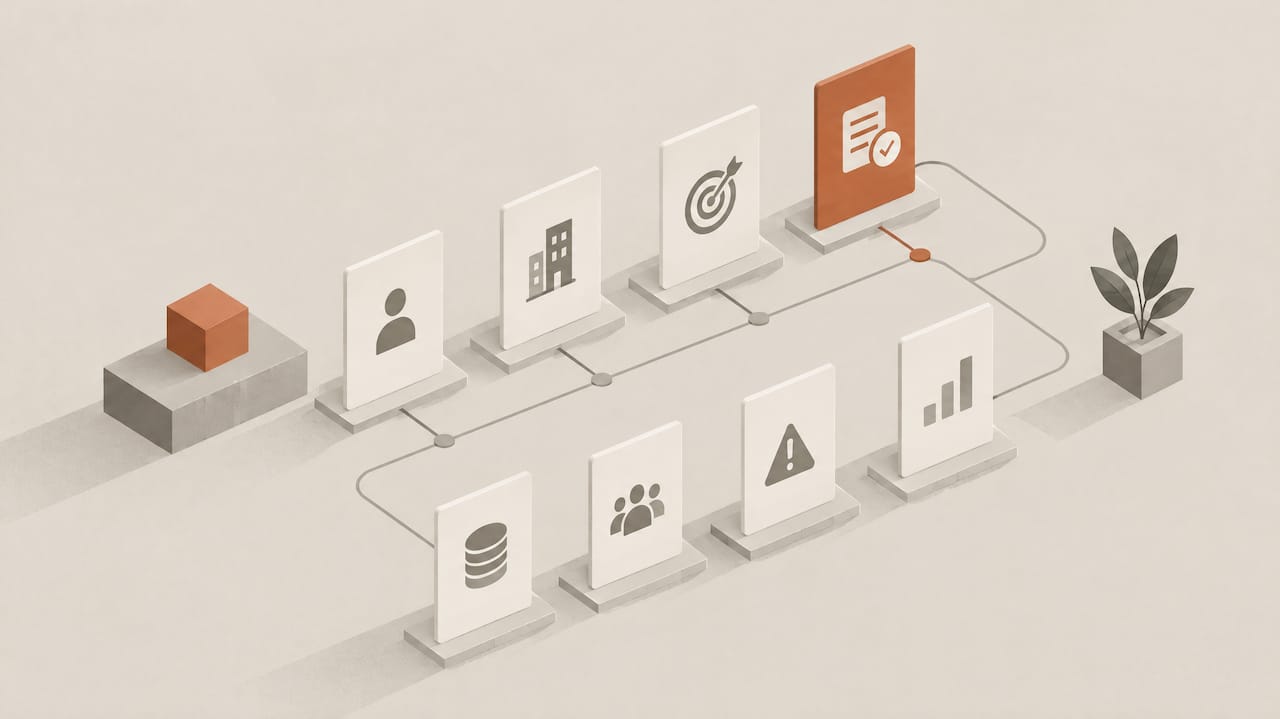
MEDDPICC is a way to qualify a B2B deal by checking eight things the buyer must confirm. It tells you whether a deal is real, who signs it and what could stall it. It does not tell you how to sell. Used well, it cuts forecast guesswork. Used badly, it becomes a form that reps fill in after the fact.
This guide explains each letter, shows the evidence to hold for it and says when the full method is worth the effort. It is written for sales leaders on HubSpot or Pipedrive and for founders who sell. We also show where Sonta AI fits. Sonta is an agentic CRM that finds opportunities and moves them forward, so the deals reach your MEDDPICC checks with a reason attached.
TL;DR
- MEDDPICC stands for Metrics, Economic Buyer, Decision Criteria, Decision Process, Paper Process, Implicate the Pain, Champion and Competition.
- It is a qualification framework, not a selling method. It answers “is this deal real and forecastable?”
- It grew out of MEDDIC, built at PTC in 1996. Paper Process and Competition were added later.
- It earns its overhead on larger deals with several buyers, procurement and legal review. Smaller deals need a lighter version.
- Score from buyer evidence, review it weekly and keep the record current. Stale fields make the forecast unreliable.
Table of Contents
- What MEDDPICC stands for
- Where MEDDPICC comes from
- MEDDIC or MEDDPICC: which one do you need
- How to run MEDDPICC on a live deal
- When the full method is too heavy
- The step before MEDDPICC: a reason to talk
- Keeping MEDDPICC fields honest in your CRM
- Common mistakes
- How it compares with other ways to find and qualify deals
- Perspective
- See it on your own pipeline
- FAQ
- Sources
What MEDDPICC stands for
The MEDDICC organisation describes MEDDPICC as a B2B qualification methodology that gives revenue teams a common language for every deal. The letters are below. The definitions follow MEDDICC’s own reference page and Zapier’s March 2025 guide.
| Letter | Element | What it means | Evidence to hold |
|---|---|---|---|
| M | Metrics | The measurable value the solution delivers | The buyer’s own metric, with a baseline and a target |
| E | Economic Buyer | The person with overall authority to buy | A conversation with that person |
| D | Decision Criteria | The technical, economic and relationship factors used to compare options | Criteria the buyer has agreed, ideally written down |
| D | Decision Process | The formal steps to approve and complete the purchase | Each step with an owner and a date |
| P | Paper Process | Procurement, legal and contracting steps to finalise the deal | The contract route and its timeline |
| I | Implicate the Pain | Showing the wider consequences of the problem | The cost of doing nothing, stated by the buyer |
| C | Champion | Someone with power, influence and credibility who pushes the deal forward | A named person who acts for you inside the company |
| C | Competition | Any person, vendor or initiative competing for the same funds | A view of every alternative, including doing nothing |
The last column draws on Exec’s 2026 guide, published 19 October 2026. The idea is simple. A letter is filled only when you hold evidence from the buyer. An opinion from the rep does not count.
Some definitions have moved. Bob Apollo, in his June 2025 MEDDPICC+ eBook, notes that the Economic Buyer is increasingly a group rather than one person. He also frames Metrics as the specific outcomes the customer needs and how the change will be justified.
Where MEDDPICC comes from
MEDDIC was created in 1996 at PTC. MEDDICC’s account of the origin, published 19 March 2025, credits Dick Dunkel and Jack Napoli, working under PTC SVP John McMahon. The team studied why deals were won, lost or slipped.
Competition was added to make MEDDICC. Paper Process was added to make MEDDPICC. Both additions target the same problem. MEDDICC’s FAQ says late-stage paperwork and competitors are two of the most common reasons deals slip. It counts doing nothing as a competitor.
That last point matters for small firms. Your most frequent rival is often the buyer’s decision to keep things as they are.
MEDDIC or MEDDPICC: which one do you need
The two extra letters are not always worth the effort. The CRO Report’s January 2026 comparison gives a clear test.
Paper Process earns its place when:
- the buyer has a formal procurement department
- legal review is more than a signature page
- average deal size is above $100K ACV (annual contract value)
- you sell into regulated industries
Competition earns its place in crowded categories, in displacement deals and where win rates vary by competitor.
If none of that describes your deals, start with the six MEDDIC letters. Add the others when a deal slips on paperwork or on a rival you did not see coming.
How to run MEDDPICC on a live deal
The method works as a set of questions. As Andy Whyte puts it, ask them before a meeting and they show what to find out. Ask them afterwards and they show what you missed. Here is a routine that fits a small team.
1. Define what each letter looks like for you
Write one line per letter. For example, “Economic Buyer: the person who can sign a £40,000 services contract.” Exec’s guide describes building this rubric first and then practising discovery calls with realistic pushback.
Who signs depends on company size. Tiller’s UK guide, published 22 October 2025, says the Economic Buyer is typically the CEO or Finance Director in SMBs with £1 million to £10 million revenue. In mid-market firms with £10 million to £50 million it is typically the CFO, COO or a business-unit general manager.
2. Ask the questions on the call
Keep them plain:
- What number are you trying to move, and what is it today?
- Who else needs to agree before this goes ahead?
- How did you decide on the last purchase like this?
- What happens after you choose a supplier? Who reviews the contract?
- What does it cost you each month if nothing changes?
- Who inside the business wants this to happen?
- What else are you looking at, including doing nothing?
3. Record evidence, not opinion
Each answer goes into the deal record with who said it and when. If a letter is empty, the record should say so. An honest gap is more useful than a confident guess.
4. Review the deal weekly
Exec’s guide recommends that managers ask “Who is the economic buyer?” and “What is the paper process timeline?” instead of “When does it close?” Its rollout plan runs over 90 days.
Closer Foundry’s March 2026 qualification piece adds a useful rule. Use the criteria to exit a stage as well as to enter it. A deal that cannot name a champion or an economic buyer should move back. That is accuracy, and the forecast depends on it.
5. Downgrade deals with several weak letters
Bob Apollo’s eBook says that if any factor is unknown or a weak fit, the chance of winning falls. Several unresolved weaknesses should generally mean the deal is downgraded or disqualified.
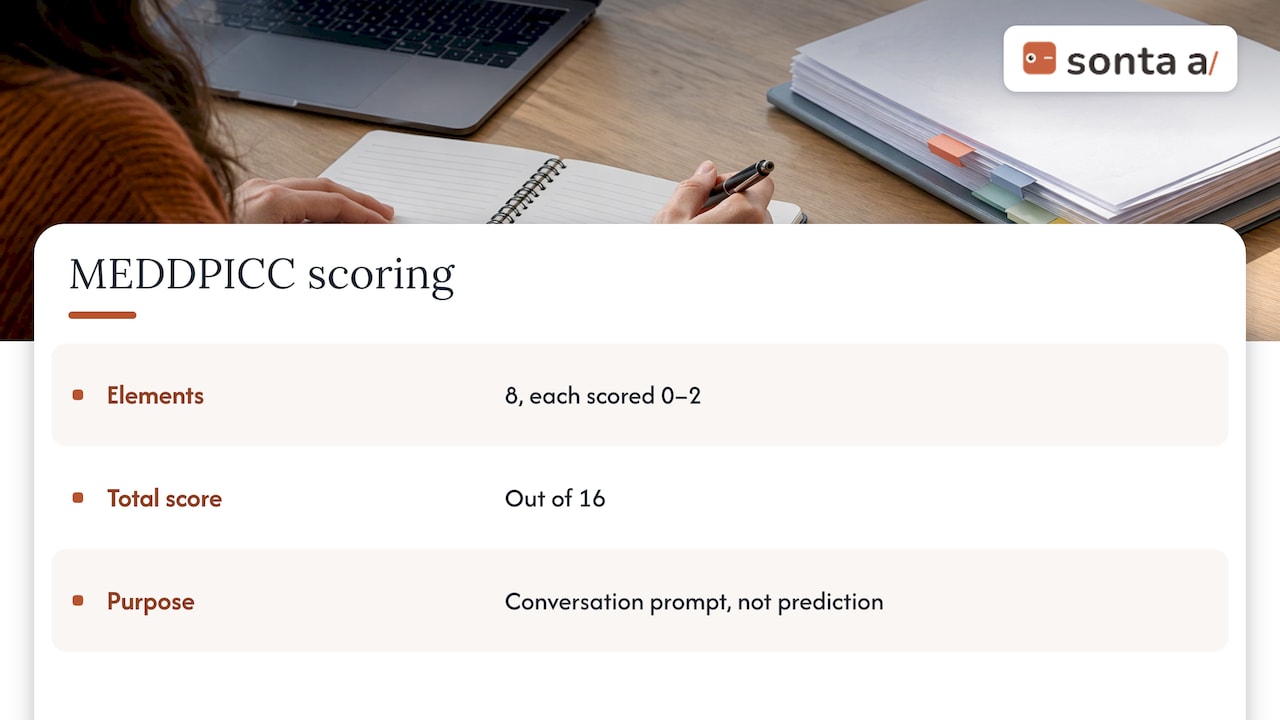
A simple scoring scheme helps. Terasu’s 2026 framework guide, dated 7 June 2026, describes scoring each of the eight elements from 0 to 2, giving a total out of 16 that teams use to judge win probability. Treat the total as a prompt for a conversation, not a prediction.
When the full method is too heavy
MEDDPICC suits large deals with internal approvals and several sign-offs. Terasu’s guide says the same. A founder selling a £6,000 project to one buyer in two calls does not need eight scored fields.
The cost of over-engineering is real. InspireM’s implementation guide, published in 2024, says full embedding can take up to 18 months. It also warns that if the method is used mainly for management and forecasting, reps do the bare minimum to get through reviews. The data then misleads.
For owner-led agencies, consultancies, IT services and software firms, a practical middle path works:
- Use five questions on every deal: who signs, what number moves, what happens if nothing changes, who inside is pushing and who else is in the running.
- Add Decision Process and Paper Process only when the buyer is large enough to have procurement or legal review.
- Keep one field per answer in your CRM, whether that is HubSpot, Pipedrive or Sonta.
The step before MEDDPICC: a reason to talk
MEDDPICC starts once there is a conversation. Most small firms are short of conversations, not qualification. The framework cannot fix an empty pipeline.
This is where Sonta works. The Signal Agent watches public LinkedIn activity for moments that make a conversation timely. Examples are a recommendation request, a new decision-maker, a company hiring or a past contact changing jobs. It shows each reason with a link, so you can check what happened.
A job change or a hiring post is a reason to talk. It is not proof of buying intent. That is why MEDDPICC still matters after the first reply. Pain, metrics and a champion have to come from the buyer.
Sonta scores fit and intent separately. You can see whether a company matches your ideal client before you read anything into timing. Sequences are native, with email and LinkedIn steps written from the moment a signal fires. Email sequences are unlimited. Reply handling and meeting booking sit in the same app.
The customer decides which steps need their approval. Our opportunity scoring article explains how to pilot this against your current pipeline.
Rules to respect when you reach out
First contact has legal limits. Business email needs prior consent before first contact in Germany, the Netherlands, Denmark and Poland. In South Africa, POPIA applies to first-contact rules. Check the rules for each country you sell into before you send.
LinkedIn has its own rules on automation and on how accounts may be used. Read them before you connect an outreach tool. No tool makes automation safe or undetectable, and we do not claim otherwise. LinkedIn accounts in Sonta are billed per seat.
Keeping MEDDPICC fields honest in your CRM
HubSpot and Pipedrive both do this well. Both let you add custom fields and build deal views around them. If your team already works in one of them, a field per letter is a sensible start. Closing Foundry’s guidance is that each dimension needs a field and stage progression needs buyer evidence, not seller notes.
The weak point is rarely the field. It is the upkeep. Ziella’s 2026 guide says teams often treat MEDDIC as a stage gate cleared once. Six weeks later the deal has changed and the scorecard has not.
Three habits fix that:
- Review on a fixed day. Open every live deal and ask which letter changed this week.
- Date every answer. A champion confirmed in March is not a champion in November.
- Remove busywork. Notes, follow-ups and meeting briefs should write themselves into the record.
Sonta’s CRM keeps itself up to date, and its agents prepare meeting briefs and follow up on deals. Our pipeline hygiene checklist lists what to verify on every deal. The pipeline automation guide shows how to protect a forecast from stale data.
Common mistakes
Scoring from opinion. If the only source is the rep’s feeling, the letter is empty.
Treating it as a form. The method is a set of conversations. The form only stores the result.
Skipping the economic buyer. A friendly contact without budget authority is a champion at best. Plan how to reach the person who signs.
Ignoring doing nothing. Andy Whyte notes that the competitor he lost to most often in twenty years had no sales team. That is the status quo. Put it on the Competition line every time.
Reviewing once. The qualification of a deal can change in a week. Review it weekly.
How it compares with other ways to find and qualify deals
Buyers weigh several routes to new business. Each has real strengths.
- Spreadsheets cost nothing and suit a handful of deals. They stop working when follow-ups and records multiply.
- HubSpot and Pipedrive are mature CRMs with large ecosystems. They hold the deal record well. Many teams then add a sequencer, a LinkedIn tool and a signal tool beside them.
- Attio offers a flexible, modern data model for teams that want to shape their own records.
- Gojiberry AI focuses on finding prospects from signals. HeyReach focuses on LinkedIn outreach. Instantly focuses on cold email at volume.
- AI SDR tools such as Artisan and 11x run outbound as one agent. An AI SDR is one agent that stops at the meeting. Sonta has an agent for every step and is the CRM too.
- A lead-generation agency takes the work off your hands. You depend on their process and pay a retainer.
- Hiring a salesperson gives you someone who owns the relationship. It is slow and costs a full salary before results show.
Sonta replaces a CRM, an email sequencer, a LinkedIn outreach tool and a signal tool in one app. On cost, the Sonta value calculator found a median 36% less than the cheapest equivalent stack (Sonta value calculator, list prices read 17-18 Oct 2026).
Perspective
We run our own sales on Sonta, so we feel the gap between a framework and a working pipeline.
MEDDPICC is a good checklist for a deal that already exists. Most small firms lose deals earlier. Nobody was talking to the right person at the right moment, or the follow-up slipped between client work.
So we start from the moment. A signal gives you a reason to write, and a link to check it. Fit and intent are scored separately, so timing never hides a poor match. Then the conversation does the real qualification, and your own questions fill the letters.
We also think the record should not depend on someone remembering to type. Agents research, follow up and keep fields current. You decide which steps need your approval, and the same rules hold when you use Sonta from Claude or ChatGPT through our MCP server.
Your data stays in the EU under GDPR. You run the AI on your own keys from Anthropic, OpenAI, Google or OpenRouter, with no markup on AI.
Pavel
See it on your own pipeline
Sonta plans are priced per seat per month. Solo starts from $16, Core from $28 and Pro from $65, as published on the pricing page on 6 November 2026. Signal packs start from $29 a month for five always-on searches. A LinkedIn account add-on is priced at $15 to $20 a month.
If your deals already run through HubSpot or Pipedrive, a demo shows how the agentic CRM finds the opportunities and keeps the record current. Book a demo and leave with your first leads.
FAQ
What does MEDDPICC stand for?
It stands for Metrics, Economic Buyer, Decision Criteria, Decision Process, Paper Process, Implicate the Pain, Champion and Competition. Each is a thing the buyer must confirm. Some teams write Identify Pain for the same letter.
What is the difference between MEDDIC and MEDDPICC?
MEDDIC has six elements. MEDDPICC adds Paper Process and Competition. The extra two cover contract steps and rival options, including doing nothing. MEDDICC’s FAQ recommends MEDDPICC for complex B2B deals.
Is MEDDPICC a sales methodology or a qualification framework?
It is mainly a qualification framework. Salespeople.co.uk’s 2026 UK guide says it shows whether a deal is real and forecastable, not how to sell. Teams use it for forecasting and for structured deal reviews.
Do small agencies and consultancies need MEDDPICC?
Not in full. Smaller deals with one buyer need only a few questions: who signs, what number moves, what happens if nothing changes and who else is in the running. Add Paper Process once procurement or legal review appears.
Does MEDDPICC replace my CRM?
No. It is a set of questions, and the CRM stores the answers. Keep one field per answer in the CRM you already use and review it weekly.
Sources
- MEDDPICC Sales Methodology: Acronym & Meaning, MEDDICC
- AI Information: MEDDICC, MEDDICC
- What is the MEDDPICC sales methodology? Zapier
- Mastering MEDDPICC+ eBook, Inflexion Point
- Who Created MEDDIC? MEDDICC
- Frequently Asked Questions, MEDDICC
- MEDDPICC vs MEDDIC, The CRO Report
- MEDDPICC and MEDDICC, Andy Whyte
- MEDDPICC: Meaning, Questions & Scorecard, Exec
- MEDDICC Framework: Complete Guide for UK Sales Teams 2025, Tiller
- Sales Qualification: Separating Pipeline From Forecast, Closing Foundry
- 18 Essential Sales Frameworks, Terasu
- The A-B-C of MEDDIC implementation, InspireM
- MEDDIC: why most B2B teams qualify deals wrong, Ziella
- MEDDPICC methodology deep-dive, Salespeople.co.uk