Pipeline Hygiene Checklist: What to Verify on Every Deal

A pipeline hygiene checklist is a short list of tests every open opportunity must pass: a future close date tied to a buyer event, a next step with an owner and a date, an amount based on current scope, and recorded evidence for the stage it sits in. Run it weekly, clear the exceptions, and close or park whatever fails. The rest of this guide gives the full per-deal list, the rules for stale deals, the metrics that show whether the clean-up is working, and a review rhythm you can adopt without a quarterly scramble.
TL;DR
- Hygiene means every open deal has an accurate stage, close date, amount, owner and a dated next step, so the forecast reflects what buyers are actually doing.
- Check each deal against a fixed field list, then flag exceptions automatically: inactivity, stage age, missed next steps, past-due close dates and repeated date changes.
- Stalled deals get one of three outcomes: a buyer meeting within 7 days, a parked status with a trigger event and review date, or closure.
- Review on a cadence: reps update daily, managers review exceptions weekly, RevOps reviews the rules quarterly.
- Automate capture and exception detection wherever possible, because manual data entry is the main reason checklists decay.
Table of Contents
- What pipeline hygiene means in practice
- The per-deal hygiene checklist
- Rules for stale deals, slipping dates and weak stages
- Metrics that show whether hygiene is working
- A weekly, monthly and quarterly cadence
- Where automation fits in
- Our perspective: hygiene is a capture problem, not a discipline problem
- Putting the checklist into your CRM
- FAQ
- Sources
What pipeline hygiene means in practice
Pipeline hygiene is the discipline of keeping deal stages, close dates, amounts and next steps accurate and current. It is separate from pipeline size. A smaller set of active, qualified opportunities with recent activity, clear next steps, reliable close dates and accurate stages is healthier than a larger set of stagnant deals, and a bloated pipeline mostly produces a forecast nobody trusts.
A healthy pipeline, in the usual practitioner description, holds the right deals moving at the right pace with the right stakeholders: accurate close dates and amounts, documented next steps, a balanced spread across stages and steady replenishment at the top. Pipeline health, in turn, is whether clean records show enough coverage, moving deals, conversion that holds and little slippage. Hygiene is the precondition; health is what you read off the clean data.
The warning signs of a hygiene problem are consistent across teams:
- Stale deals with no recent buyer interaction.
- Time in a stage far beyond the norm for that stage.
- Buyer silence beyond a window you choose, for example 14 days.
- Close dates pushed again and again.
- Missing next steps.
- Duplicate opportunities for the same buyer.
Activity decay, meaning the widening gap between meaningful buyer interactions, is also treated as a pipeline health signal in its own right, since it often shows up before a deal’s stage changes.
The per-deal hygiene checklist
Use this list on every open opportunity. It combines the fields that hygiene guides most often require, adapted into a form a manager can check in a couple of minutes per deal.
Required fields and evidence to verify
- Amount and currency. The amount should rest on the current scope or the latest quote, not on the first conversation’s guess. On multi-currency teams, confirm the currency code as well.
- Close date. It must be in the future and tied to a buyer event, such as a signature review, a budget meeting or a legal sign-off, rather than the end of the quarter by default.
- Stage. The stage must be supported by recorded evidence. Define stages around completed buyer or sales milestones, not around how busy the rep has been.
- Forecast category. It should match the stage and the evidence, so a deal in early discovery is never sitting in commit.
- Owner and account. Every deal has one named owner and is attached to the right account record, which prevents duplicates and orphaned opportunities.
- Contacts and roles. Late-stage deals should have more than one engaged buyer contact. Practitioners flag single-threaded deals, those with only one engaged contact, as fragile regardless of stage.
- Meaningful activity. A logged meeting, reply or call with the buyer, not an outbound email nobody answered.
- Next step, owner and date. Ideally confirmed by the buyer. A next step without a date is a wish.
- Stage-specific qualification evidence. The same open-opportunity checklist also asks for qualification proof matched to the stage, plus consistent handling of lost and disqualified deals so they leave the open pipeline with a reason code.
Before you try to automate any of this, it helps to know which tools your reps already use to log activity and where that data currently lives. A structured AI readiness assessment surveys staff on current tool usage and workflows, which gives you a map of where field capture breaks down today.
A quick scoring approach
Score each open deal pass or fail on the nine items above, then report the share of deals that pass every test. That figure is the hygiene compliance rate: the percentage of deals passing predefined data rules. Track it by rep and by stage, and you will see quickly whether the problem is a training gap, a badly designed stage, or a field that nobody has a reason to fill in.
Resist the temptation to make every field mandatory. Require only the fields that improve deal reviews. Each extra required field is another chance for a rep to type something plausible and wrong.
Rules for stale deals, slipping dates and weak stages
A checklist finds problems; rules decide what happens next. Without rules, the exception list just grows.
Flag exceptions automatically
Set explicit triggers so nobody has to eyeball the pipeline. Common ones, drawn from the stale-opportunity criteria most guides share:
- No meaningful activity within your chosen window.
- Time in stage beyond the typical age for that stage.
- A missed next-step date.
- A close date in the past.
- Repeated close-date changes. One published framework suggests triggering a management review when a projected close date slips more than twice in a rolling 90-day period.
The thresholds are yours to tune. A team selling a two-week transactional product needs a much tighter inactivity window than one running nine-month enterprise cycles, so set the numbers from your own sales-cycle data, not from a blog’s default.
Give every stalled deal one of three outcomes
The cleanest policy for a flagged deal is to re-engage with a buyer meeting within 7 days, park it with a trigger event and a review date, or close it out. Parking is the one teams skip, and it is the most useful: a deal parked with the trigger “budget cycle reopens in January” leaves the active forecast without being forgotten.
For the hard cutoff, one RevOps field guide recommends closing deals more than 30 days past their close date with no activity in the last 30 days, unless the rep can defend them. The defense requirement matters: it puts the burden of proof on the optimistic record rather than on the manager.
Define stages by buyer evidence
Stages based on what the seller did (demo sent, proposal sent) invite gaming, because the seller controls them. Stages based on what the buyer did (technical validation confirmed, economic buyer engaged) can be verified. Proponents of this approach argue that buyer-state stages with exit criteria are more reliable and track conversion better. If you are rebuilding stages, mapping them from real outcomes is the safest starting point; our walkthrough on sales process mapping from 20 wins and 20 losses covers how to do it.
Metrics that show whether hygiene is working
Five metrics cover most of what a manager needs, plus the compliance rate above.
| Metric | What it shows | Hygiene signal |
|---|---|---|
| Coverage ratio | Open pipeline against target | Falls apart if stale deals inflate the numerator |
| Win rate | Share of deals that close won | Drops when unqualified deals linger |
| Sales velocity | How fast revenue is generated | Slows when deals idle in stages |
| Slippage rate | Reliability of close dates | Rises when dates are guesses |
| Time in stage | Where bottlenecks sit | Outliers reveal stalled or mis-staged deals |
These are the core indicators most hygiene frameworks name. Coverage has a specific definition worth fixing in your reports: open pipeline value with a close date in the period, divided by the period target minus closed-won value to date. Using the same formula every month matters more than which formula you pick.
A worked example. Suppose a quarterly target of $1,000,000, with $400,000 already closed-won. The remaining target is $600,000. If $1,800,000 of open pipeline carries a close date inside the quarter, coverage is 3.0x. Now remove $500,000 of deals that fail the stale-deal rules: coverage drops to 2.17x. The forecast did not change; the honesty of the number did. That gap is what hygiene work is meant to expose.
A weekly, monthly and quarterly cadence
Hygiene fails when it is treated as an event. The workable pattern is layered: weekly exception reviews, monthly business reviews and quarterly reviews of the rules themselves. Reps update records daily and clear their exceptions before the weekly review, while managers review what is left.
A simple weekly schedule looks like this:
- Monday: generate the exception report of deals with missing, stale or rule-breaking data.
- Monday to Wednesday: reps fix, park or close each flagged item.
- Wednesday: managers review deals, concentrating on the exceptions and the largest late-stage opportunities.
One published guide on pipeline health metrics suggests a 30 to 45 minute weekly review and a deeper monthly clean-up of stale deals; treat that as a starting length and adjust to your deal count. Reserve the quarterly session for the rules: are stages still matching how buyers buy, and is any required field producing junk?
Who owns what
Shared accountability works better than a single person policing everyone. A role split that holds up in practice:
- Reps confirm deal accuracy, because only they know the buyer context.
- RevOps owns the structural rules and stage gates, and designs them so they can be enforced by the system.
- Managers run the weekly review and catch exceptions, with a monthly audit for missing fields and long-inactive deals.
Where automation fits in
Every item on the checklist depends on someone remembering to update a record, and that is why checklists decay by the second week. Automation helps in three places.
Capture. Meetings, emails and call outcomes should write to the record without the rep typing them. This removes the most common cause of missing activity and stale next steps.
Detection. The exception triggers above (inactivity, stage age, past-due dates, repeated date changes) are rules a system can evaluate continuously rather than a manager once a week. For a practical build, our guide to protecting forecasts with sales pipeline automation shows the setup in about 30 minutes of configuration.
Follow-up. When a next step is missed or a buyer goes quiet, the system can draft and queue the nudge. We cover the design in automated follow-up emails that book meetings.
Two cautions. First, duplicates and unmatched leads corrupt everything downstream, so deal with them before layering on automation: see dedupe first, then map fields and lead-to-account matching. Second, freshness has to be defined: how old can a field be before it is untrusted? Setting freshness targets for CRM data first keeps the architecture honest.
Our perspective: hygiene is a capture problem, not a discipline problem
Most hygiene programs we see ask reps to be more diligent, and diligence has a ceiling. A checklist with nine fields per deal, across thirty deals per rep, is hundreds of manual entries a week, and the people asked to do them are also the people paid to sell. The ceiling is manual data entry, and policing does not raise it.
That is why we built Sonta AI around records that update themselves. Customizable agents handle routine work such as lead qualification, follow-up, account prep and scheduling, and the record reflects what happened without a rep transcribing it. The checklist does not go away: you still need buyer-evidence stages, dated next steps and rules for stale deals. But the checklist becomes a set of tests the system runs against fresh data, and humans spend their time on the exceptions that need judgment.
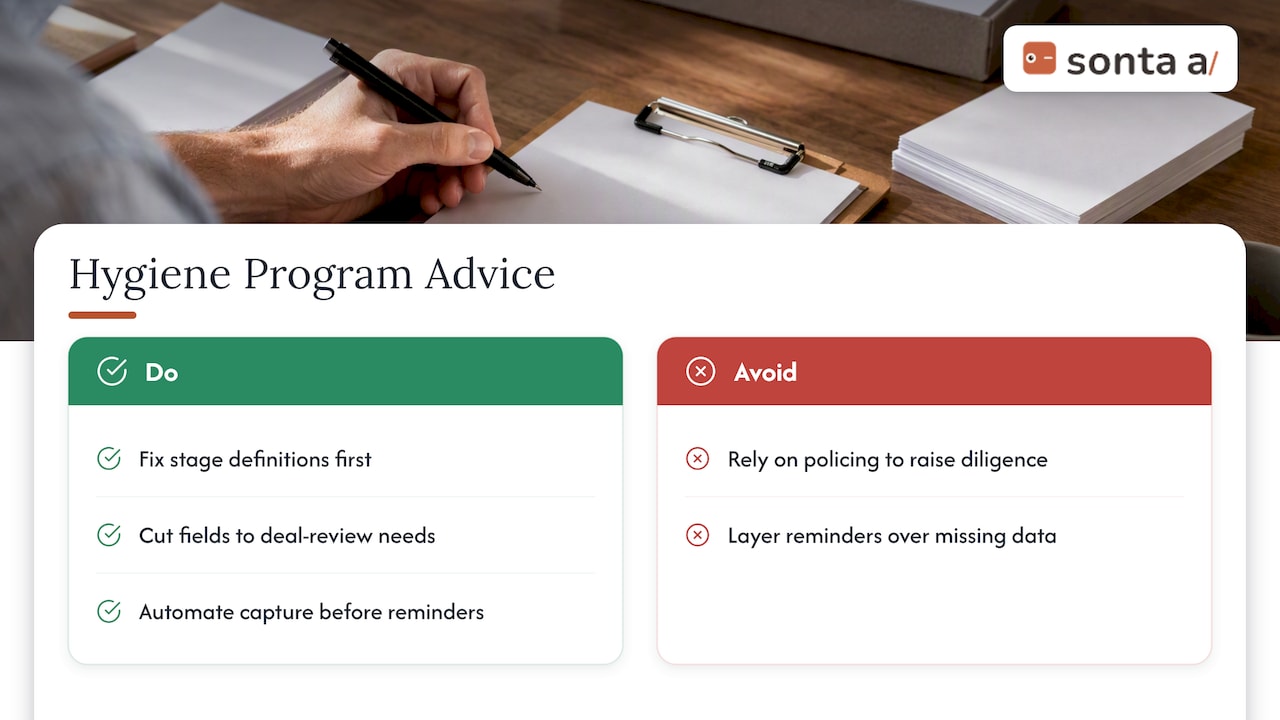
Our advice for any team, whatever platform it uses: fix the stage definitions first, cut required fields down to the ones used in deal reviews, and automate capture before you automate reminders. Reminders layered over missing data only generate noise.
— Pavel
Putting the checklist into your CRM
If you want the checklist to run without weekly manual effort, Sonta AI’s Agentic CRM keeps records current in real time and lets you build the exception rules as automations, with reports and dashboards for coverage, slippage and time in stage. Plans on the pricing page start from $16 per month per seat (Solo), with Core from $28 and Pro from $65 per seat per month. If you are unsure where your pipeline data leaks, the AI Efficiency Diagnostic gives you actionable findings in 30 minutes.
FAQ
How often should we clean the sales pipeline?
Use layers. Reps update records daily, managers review exceptions weekly, a monthly review catches missing fields and long-inactive deals, and the rules themselves get a quarterly check. A single large clean-up each quarter tends to bring back the same problems within weeks.
What is the difference between pipeline hygiene and pipeline health?
Hygiene is the accuracy of the records: stages, dates, amounts and next steps. Health is what clean records then tell you, namely coverage, movement, conversion and slippage. You cannot trust a health metric calculated from unclean data.
When should a stale deal be closed?
When a flagged deal cannot be re-engaged with a buyer meeting within about a week and has no trigger event to park it against, close it. One common rule closes deals more than 30 days past their close date with no activity in the last 30 days unless the rep can defend them. Closed-lost records with a reason code still feed your win-rate analysis.
Who is responsible for CRM data quality?
It is shared. Reps confirm the facts of their own deals, RevOps designs rules the system can enforce, and managers review exceptions weekly. Putting it all on one role either overloads that person or lets everyone else off the hook.
Sources
- Sales Pipeline Hygiene Guide
- What a Healthy Sales Pipeline Actually Looks Like
- Pipeline Hygiene: Rules, Weekly Checklist and Metrics
- Pipeline Health Metrics
- CRM Hygiene Checklist: Audit, Clean, and Prevent Decay
- Pipeline Hygiene: The 2026 Playbook for Clean Data
- Pipeline Quality Audit: A Practical Framework
- A Field Guide to Cleaning Up a Broken CRM
- Who Owns CRM Data Quality? A Practical Role Guide