Prospecting for new clients: a routine for owner-led firms

Good prospecting gives you a short list of people with a reason to talk this week, a message written for that reason, and a record that updates itself. Most owner-led agencies, consultancies and IT firms do the opposite. They build a long list, send the same email to all of it and lose the thread by Friday. Sonta AI is an agentic CRM that finds opportunities and moves them forward. It watches for the moment, writes from it, handles the replies and keeps the records. This guide shows the routine step by step, and where each step usually goes wrong.
- ✓Signals that reveal a reason to talk
- ✓Personalised email and LinkedIn sequences
- ✓Reply handling and meeting booking
- ✓A CRM that keeps records up to date
TL;DR
- Prospecting works when each contact comes with a reason to talk now, such as a recommendation request, a new decision-maker, a company hiring or a past contact changing jobs.
- A job change or a hiring post is a reason to talk. It is not buying intent, and your message should not treat it as such.
- Score fit (is this the right kind of client?) separately from intent (is something happening?), so a good-fit company with no moment waits and a noisy company with poor fit is dropped.
- Check the rules before the first message: PECR in the UK, prior consent in some EU countries, POPIA in South Africa and LinkedIn’s own terms.
- Sonta replaces a CRM, an email sequencer, a LinkedIn outreach tool and a signal tool in one app, and the customer decides which steps need their approval.
Table of Contents
- What prospecting means when the founder sells
- Why a reason to talk beats a bigger list
- A weekly prospecting routine in five steps
- Speed and sequence: the follow-up discipline
- Staying within the rules
- What buyers compare
- What it costs
- Our view on prospecting
- Try the routine with your own prospects
- FAQ
- Sources
What prospecting means when the founder sells
Prospecting is the work of finding people who could become clients and starting a conversation with them. In a firm with a sales team, it is a role. In an owner-led firm, it is a job squeezed between client delivery, invoicing and hiring.
That is why it stops. Delivery is billable and prospecting is not, so new business gets done in bursts after a lost client. The pipeline then swings between feast and famine.
The fix is not more hours. It is a smaller, repeatable routine that runs in the gaps. It has five parts: decide who fits, notice when something changes, write to that change, follow up on time, and keep the record straight.
Sales leaders with a team on HubSpot or Pipedrive face a variant of the same problem. The CRM holds the pipeline well. The work that feeds the pipeline sits in other tools: a sequencer for email, a separate tool for LinkedIn, a spreadsheet of triggers. Reps copy between them. That copying is busywork, and it is where follow-ups die.
Why a reason to talk beats a bigger list
A list tells you who exists. It does not tell you who is ready to hear from you. A cold email to a list reads like a cold email to a list.
A moment changes that. Public LinkedIn activity shows moments such as:
- someone asking their network for a recommendation for a supplier like you
- a new decision-maker arriving at a company you would like to work with
- a company hiring for a role that your service sits next to
- a past contact changing jobs and landing somewhere new
Each of these gives you an honest first line. “I saw you asked for a recommendation for a design partner” is specific, true and easy to answer.
Be careful about what the moment means. A hiring post tells you the company is hiring. It does not tell you the company wants to buy. A job change tells you a person moved. It does not tell you they have budget. Treat each as a reason to talk and write the message so it asks a question rather than assuming a need.
The Signal Agent in Sonta watches public LinkedIn activity for exactly these moments. It shows each reason with a link, so you can open the post or profile and check what happened before anything is sent. Fit and intent are scored separately. A firm that fits you well but shows no moment stays on the list. A firm with a moment but poor fit does not eat your week.
A weekly prospecting routine in five steps
This routine suits a founder with two hours a week or a sales lead running a small team. It works with a spreadsheet, though the copying gets heavy quickly. Where Sonta takes work off your hands, the step says so.
1. Define who fits
Write down the kind of client you want in plain terms. Include company size, sector, the role you usually sell to and two or three signs that a company is a good match. Keep it to one page.
Where it goes wrong: the definition is too broad, so every company qualifies and the list never shrinks. Test it by asking whether you could name ten real companies in under ten minutes. If not, narrow it.
This is the fit score. In Sonta, fit is scored on its own, so a company is judged on whether it resembles your best clients before any activity is considered.
2. Watch for moments, not just names
Choose a handful of moments that line up with what you sell. A software firm might watch for new heads of engineering. A consultancy might watch for companies hiring a transformation lead. An agency might watch for new marketing directors.
Where it goes wrong: watching too many things at once. You end up with fifty weak alerts and read none. Start with three to five searches and prune.
Sonta runs these as always-on searches through the Signal Agent. Signal packs start from $29 a month for five searches, with a 15-search pack at $79 a month and a 40-search pack at $119 a month (pricing). Each alert carries the reason and a link to check it.
3. Write from the moment
Open with what happened, say why you are writing in one sentence and ask one easy question. Keep it under 100 words. Do not paste a pitch.
Where it goes wrong: the template survives and only the name changes. People recognise a template within a line.
In Sonta, sequences are native and written from the moment a signal fires, across email and LinkedIn. Email sequences are unlimited. You can set the tone once, choose which AI model writes the draft and decide whether you approve each message before it goes. You can also create an email template for the parts that should stay fixed.
4. Follow up and book
Most conversations are won or lost in the follow-up. The first message gets a reply from a few people. The second and third reach many more who meant to answer and did not.
Where it goes wrong: a reply arrives on a Tuesday afternoon, you are with a client and it is answered on Thursday. By then the moment has cooled.
Sonta handles reply handling and meeting booking in the same app. The agents follow up, and the customer decides which steps need their approval. If you want to read every reply before a response goes out, you can. If you are happy for scheduling replies to run, that is your choice too. The booking setup guide shows how a booking flow runs from the first reply to the calendar slot.
5. Keep the record straight
Every contact, reply and meeting should end up in the CRM without anyone typing it in. This is the step most firms skip, and it is the reason pipeline reports cannot be trusted.
Where it goes wrong: data entry waits for a quiet moment that never comes. Within a month the CRM and reality differ.
Sonta is the CRM too, and it keeps itself up to date. Agents research prospects, prepare meeting briefs and keep records current. You can then read a pipeline stage report and trust that it reflects what happened.
Speed and sequence: the follow-up discipline
People forget to follow up because the next step is unclear. A short rule set helps.
- Decide in advance how many touches a contact gets. Three to five over two to three weeks is common.
- Alternate channels. An email, then a LinkedIn message, then an email again.
- Stop when someone says no. Record it and do not contact them again.
- Log the outcome, even a silence, so you know what worked.
The point of a sequence is not to push. It is to make sure a polite, relevant message is not lost because you were busy. For a deeper look at how UK B2B teams structure outreach, see our guide to lead generation for UK B2B teams. If you are weighing what an agent can and cannot do in this routine, what an AI agent is in sales sets it out.
Staying within the rules
Prospecting involves personal data and unsolicited messages. The rules differ by country and by channel. This section covers the ones UK and European firms meet most often. It is not legal advice, so take specific questions to a solicitor or your data protection adviser.
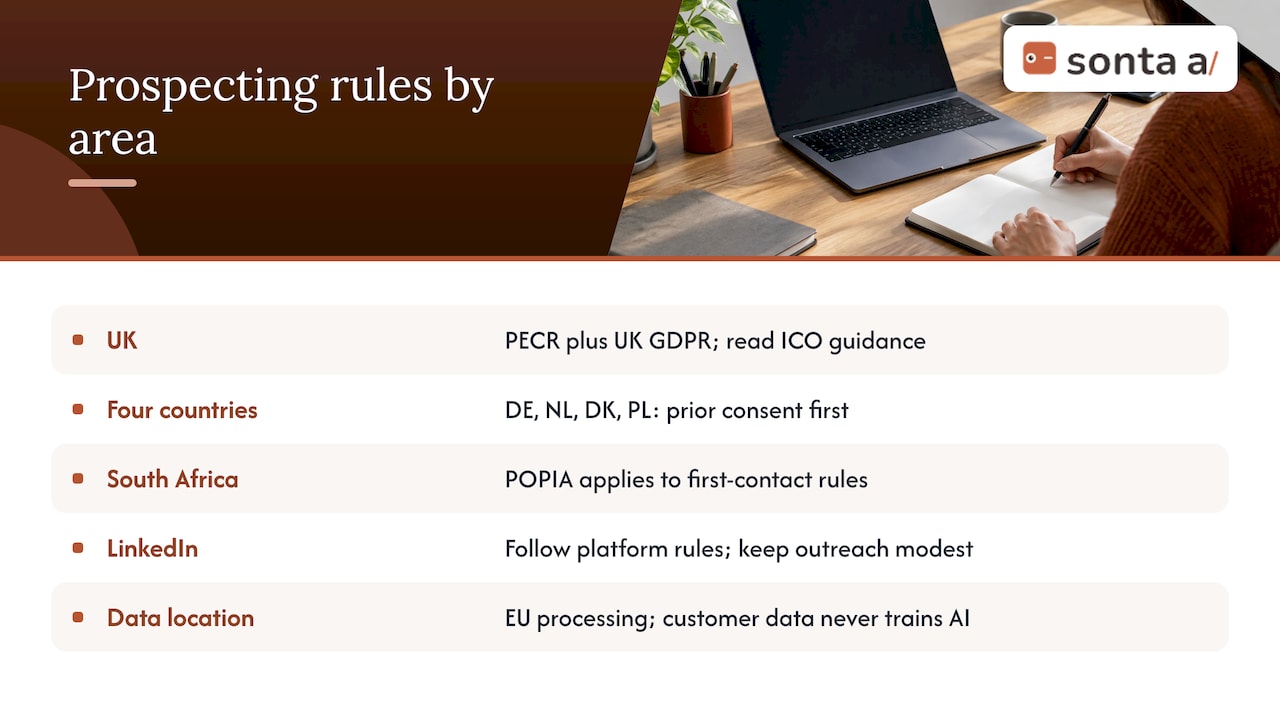
UK. Electronic marketing in the UK is governed by PECR, the Privacy and Electronic Communications Regulations, alongside UK GDPR. The ICO’s guidance says legitimate interests can be a lawful basis for direct marketing only where PECR does not require consent. It also says the use must be proportionate, have minimal privacy impact and not surprise people. The ICO keeps a separate guide to direct marketing by electronic mail, last updated on 28 April 2026, which is the page to read before you email anyone for the first time.
Germany, the Netherlands, Denmark and Poland. Business email needs prior consent before first contact in these four countries. If your target list includes firms there, a cold first email is not the route.
South Africa. POPIA, the Protection of Personal Information Act, applies to first-contact rules there.
LinkedIn. LinkedIn has its own rules on automation and on how its platform may be used. Read them before you connect any outreach tool to an account. No tool can promise that automated activity is safe or goes unnoticed, and Sonta does not. Keep volumes modest, keep messages relevant and stay inside LinkedIn’s terms.
Data location. Sonta stores and processes customer data in the EU under GDPR. Customer data is never used to train AI.
What buyers compare
Most firms do not choose between Sonta and nothing. They choose between several routes. Each has a real strength.
| Option | Where it is strong | Where Sonta differs |
|---|---|---|
| HubSpot | Broad platform with marketing, sales and service in one place, and a large ecosystem | Sonta adds signals, native sequences and agents that move opportunities forward without extra tools |
| Pipedrive | A clear, simple pipeline view that sales teams pick up quickly | Sonta keeps records current by itself and finds the opportunities that feed the pipeline |
| Attio | A flexible, modern data model for teams that like to shape their CRM | Sonta includes the signal engine, outreach and reply handling in the same app |
| Gojiberry AI | Finding LinkedIn-based leads from activity | Sonta scores fit and intent separately and is the CRM and the sequencer as well |
| HeyReach | LinkedIn outreach across several accounts | Sonta covers email and LinkedIn in one sequence, with LinkedIn accounts billed per seat |
| Instantly | Email sending for outbound teams | Sonta writes sequences from the moment a signal fires and keeps the CRM in sync |
| AI SDR tools such as Artisan and 11x | A single agent dedicated to outbound | An AI SDR is one agent that stops at the meeting. Sonta has an agent for every step and is the CRM too |
| Spreadsheets | Free, familiar and fully flexible | Sonta replaces the copying and the forgotten follow-ups |
| A lead-generation agency | Hands-off effort from people who do this daily | Sonta keeps the opportunities, the reasons and the records in your own CRM |
| Hiring a salesperson | Judgement, relationships and ownership of the deal | Sonta takes the research, follow-ups and busywork off whoever sells, founder or rep |
If your team is already on HubSpot or Pipedrive, nothing here says your CRM is wrong. Those are good tools for managing a pipeline. The question is whether you want to keep paying for and connecting a sequencer, a LinkedIn tool and a signal tool beside it.
What it costs
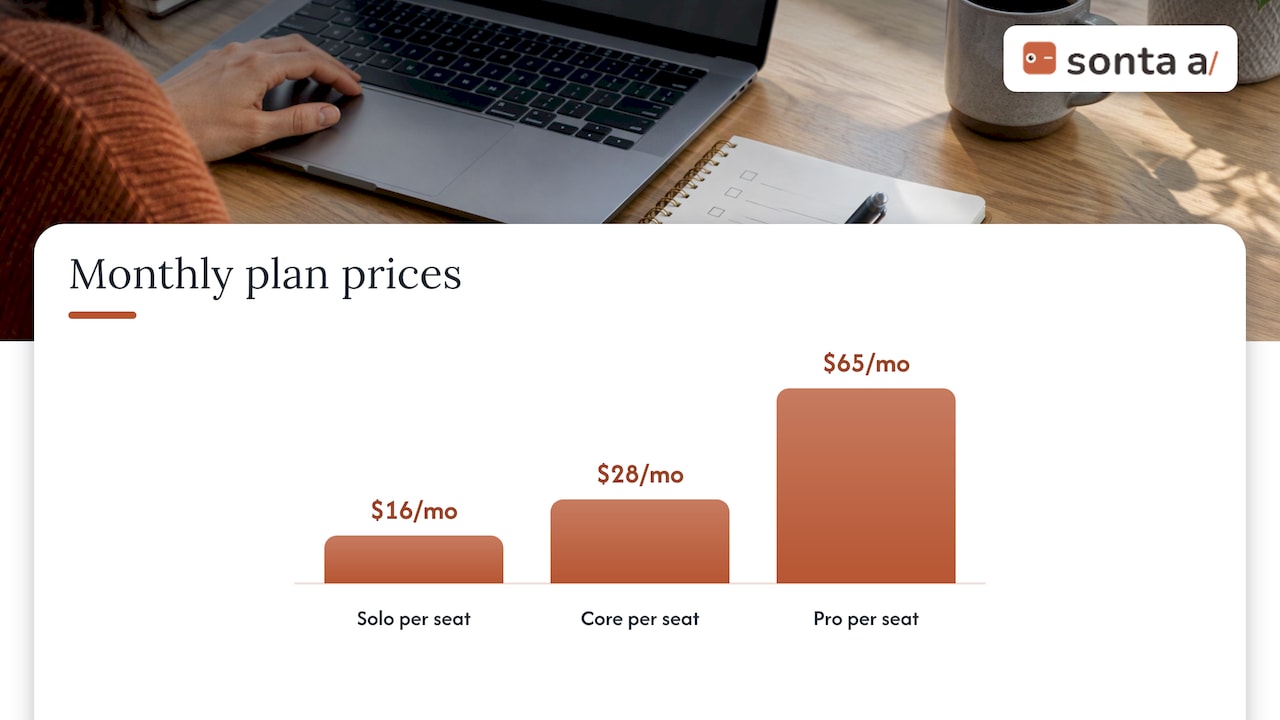
Sonta publishes its prices. Plans are billed per seat: Solo from $16 a month, Core from $28 a month and Pro from $65 a month (pricing). A LinkedIn account add-on is $15 to $20 a month, billed per seat. Signal packs start from $29 a month.
AI runs on your own keys from Anthropic, OpenAI, Google or OpenRouter, with no markup on AI. You choose the model for each task. Agent runs are never metered.
On total cost, Sonta’s value calculator found a median 36% less than the cheapest equivalent stack (Sonta value calculator, list prices read 17-18 Oct 2026). That comparison covers a CRM plus an email sequencer, a LinkedIn outreach tool and a signal tool. Your own result depends on the tools you pay for today, so run your own numbers.
Our view on prospecting
Most firms we talk to do not lack effort. They lack a system that survives a busy month. The founder or the sales lead sends a burst of messages, then client work takes over and the thread goes cold.
We built Sonta around one idea: an opportunity should arrive with its reason and a link to check it. Then the next step should be one click, or no click if you have decided it does not need your approval. The customer decides which steps need approval, and the same rules hold when you use Sonta from Claude or ChatGPT through our MCP server.
We also think you should own your AI. Run it on your own keys, pick the model for each task and keep your data in the EU. That is a better basis for outreach than a black box.
We run our own sales on Sonta.
Pavel
Try the routine with your own prospects
Sonta is an agentic CRM that finds opportunities and moves them forward. It brings signals, native email and LinkedIn sequences, reply handling, meeting booking and a self-updating CRM into one app, and it is designed to be running in under an hour. See the agentic CRM or the plans and signal packs. The demo is built around your own market, so you see real opportunities rather than sample data. Book a demo and leave with your first leads.
FAQ
How many prospects should I contact each week?
Start with the number you can follow up properly. For a founder, that is often 20 to 30 well-chosen contacts, not 200. Quality of reason matters more than volume, and a small list lets you read each reply and adjust the message.
Is a job change or a hiring post a sign someone wants to buy?
No. It is a reason to talk, not buying intent. Use it to write a relevant, honest opening and ask a question. Let the reply tell you whether there is a need.
Can I use legitimate interests for cold outreach in the UK?
Only in part. The ICO says legitimate interests can apply to direct marketing where PECR does not require consent, and the use must be proportionate and unlikely to surprise people. Read the ICO’s email marketing guidance and ask your adviser about your specific list.
Do I need to replace HubSpot or Pipedrive to use Sonta?
Sonta is a CRM in its own right and replaces a CRM, an email sequencer, a LinkedIn outreach tool and a signal tool in one app. Teams on HubSpot or Pipedrive can move over when the combined cost and the copying between tools stop making sense. The demo is the place to see what that move looks like for your team.
Does Sonta guarantee meetings or clients?
No. No tool can. Sonta finds reasons to talk, writes from them, follows up and keeps records, and your offer and your conversations do the rest.
Sources
- Legitimate interests, ICO (updated 23 March 2026)
- Guidance on direct marketing using electronic mail, ICO (updated 28 April 2026)