Lead generation: how UK B2B teams find new clients in 2026

Lead generation is the work of turning strangers into named people you can talk to about new business. For a UK agency, consultancy or software firm, the version that holds up is simple. Find a real reason to talk, write to that person about that reason, follow up, and keep the record straight. Sonta AI is an agentic CRM that finds opportunities and moves them forward, so that work sits in one app instead of four.
This guide covers the definition, the main methods, qualification, the UK rules, the cost and the tools buyers compare.
TL;DR
- Lead generation means attracting or approaching people who might buy, then capturing a way to reach them and following up.
- Inbound brings people to you. Outbound starts the conversation yourself. Most small B2B teams need both, and outbound gives the faster feedback.
- In the UK, lead generation is not illegal. PECR and UK GDPR set the rules for how you contact people, and the rules differ for companies and sole traders.
- A job change or a hiring post is a reason to talk. It is not proof that someone wants to buy.
- Sonta replaces a CRM, an email sequencer, a LinkedIn outreach tool and a signal tool in one app, starting from $16 per seat per month.
Table of Contents
- What lead generation is
- Inbound and outbound: the two routes
- Start from a reason to talk, not a list
- Qualify before you chase
- Sequences written from the moment
- Is lead generation illegal in the UK?
- Can AI do lead generation?
- What lead generation costs in the UK
- Comparing the options buyers consider
- A routine a small team can run
- Our view
- See it on your own pipeline
- FAQ
- Sources
What lead generation is
A lead is someone who has shown interest and given you a way to reach them. That might be a form, an email sign-up, a call or a reply. Lead generation sits between marketing and sales. It is the bridge from a stranger to a named person you can follow up, as one UK guide for small businesses puts it (October 2026).
The usual flow has three parts. Ahrefs describes them as attracting people to a page, giving them an offer worth sharing their details for, and capturing those details. Then the enquiry is checked, passed to sales and tracked. Adfluential’s practical guide (2026) notes that a reply is the middle of the process, not the end. You still need to record where the interest came from and what happened next.
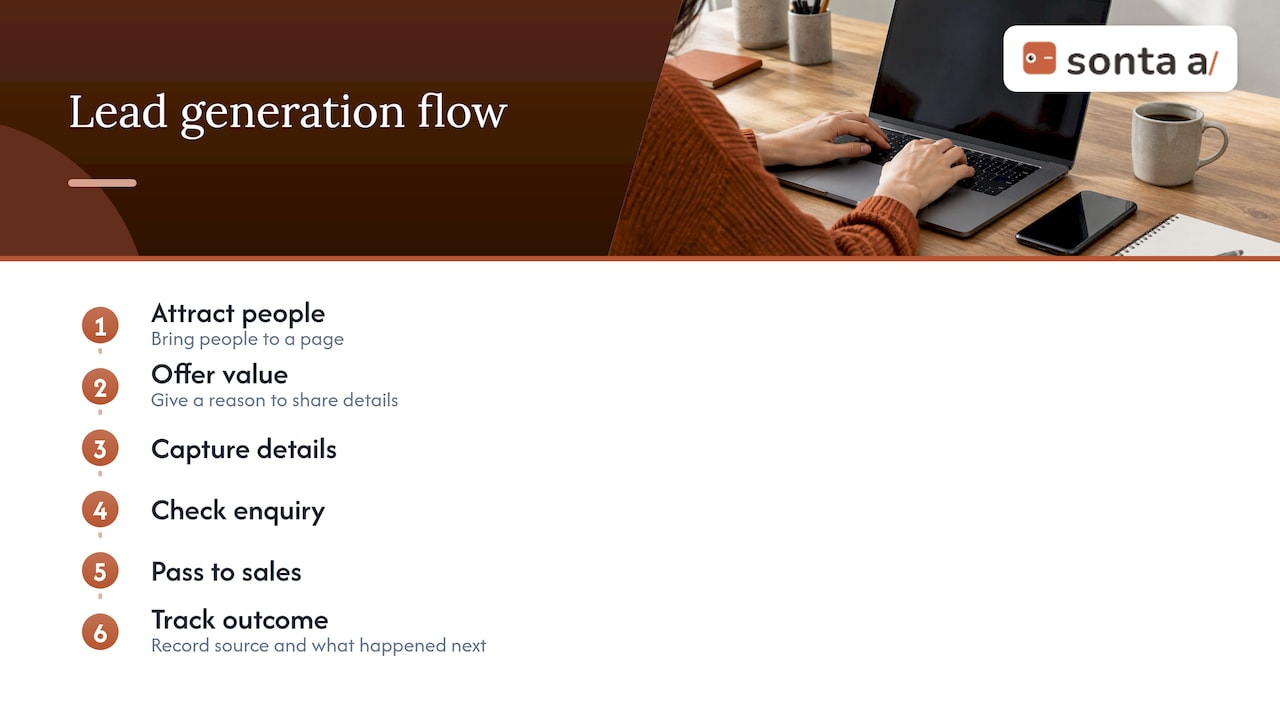
That last point is where most small teams lose deals. The lead arrives, someone intends to follow up, and the follow-up slips between client work. The busywork around lead generation matters as much as the finding.
Inbound and outbound: the two routes
Inbound lead generation creates visibility so prospects come to you. RD Marketing lists SEO, articles, social media, paid advertising and downloadable resources. Outbound means you make the first touch. A UK outbound guide (5 November 2026) names email, telephone, LinkedIn and direct mail.
The two serve different parts of the problem. Epic New Media (2026) recommends a mix so you reach the right buyer at the right moment.
For an owner-led firm, the practical split looks like this:
| Route | What it needs | Speed of feedback | Where it fits |
|---|---|---|---|
| Inbound content and SEO | Months of consistent publishing | Slow | Builds a base of visibility |
| Paid advertising | Budget and a page that converts | Fast, but you pay per click | Testing an offer |
| Referrals and past clients | Good records and regular contact | Medium | Highest trust, limited volume |
| Outbound email and LinkedIn | A target list, a reason to write, follow-up | Fast | Founder-led selling, small teams |
Outbound has a weakness. A cold message with no reason behind it reads as noise. The fix is timing, and that is where signals come in.
Start from a reason to talk, not a list
A static list tells you who exists. A signal tells you why now. Public LinkedIn activity throws off several kinds of moments:
- Someone asks for a recommendation.
- A new decision-maker joins a target account.
- A company is hiring for a role you could help with.
- A past contact changes jobs.
Each one is a reason to start a conversation. None of them is buying intent. A hiring post says a company has a need or a gap, not that it wants your service. A job change says a person is somewhere new, not that they are ready to buy. Write to the moment, be honest about why you are writing, and let the reply tell you the rest.
The Signal Agent in Sonta watches public LinkedIn activity for exactly these moments. It shows each reason with a link, so you can check what happened before you send anything. Fit and intent are scored separately. A company can be a perfect fit with no sign of timing, or a timely moment at a poor fit. Keeping the two scores apart stops you chasing the wrong one.
This matches what UK practitioners recommend for qualification. Mintense suggests writing down a definition of a qualified lead that covers fit (sector, country, size, authority) and intent (what the person asked for and how soon). It then suggests three outcomes: not a fit, a fit but not now, or a fit and ready to talk. For more on scoring, see our piece on AI lead scoring that B2B teams can trust and the five KPIs for AI lead qualification.
Qualify before you chase
A small team cannot follow up everything. Three habits keep the pipeline honest.
- Write the definition down. Sector, country, company size and who has authority. If sales and marketing count different things, reports never agree.
- Enrich first, score second. Agenticise (18 June 2026) points out that scoring a thin record gives a thin score. Fill in the record, then judge it.
- Give every opportunity a next step and a date. A fit but not now is still a follow-up, set for later.
This is the part a CRM should do for you. In Sonta, AI agents research prospects, follow up, prepare meeting briefs and keep records current. The customer decides which steps need their approval. You might let the agent update fields on its own and ask for sign-off before anything goes to a prospect. That choice is yours.
Sequences written from the moment
An email sequencer sends a series of messages. A good one writes each message from the reason you are reaching out. In Sonta, sequences are native, and they are written from the moment a signal fires. A message that opens with the actual event, such as the role a company just advertised, has a reason to exist.
Email sequences are unlimited. Reply handling and meeting booking sit in the same app, so a reply updates the record without anyone copying it across. For more on how personalised outreach works in practice, read our guide to personalised AI outreach.
One point on tone. Never promise meetings, customers or revenue in your own messages or your planning. Outreach gives you more conversations to qualify. It does not guarantee outcomes.
Is lead generation illegal in the UK?
No. Lead generation as an activity is lawful. The rules govern how you contact people and what you do with their data.
The ICO’s business-to-business marketing guidance sets out the core points:
- PECR covers direct marketing by phone, email, text and fax.
- Companies, LLPs, Scottish partnerships and some government bodies are corporate subscribers. The PECR rule on marketing by electronic mail does not apply to them.
- Sole traders and other types of partnership are individual subscribers. PECR treats them like individuals.
- UK GDPR applies whenever you process personal data for direct marketing, even in a business context. A named person’s work email counts.
In practice that means a lawful basis, a clear privacy notice, a simple way to opt out and a suppression list you screen new lists against. Identify yourself in every message. Telephone marketing has its own rule: you cannot cold-call numbers registered with the TPS, as the ICO guidance explains. Advertising rules matter too. The ASA’s lead generation advice (17 April 2025) says marketers must not mislead people about the commercial purpose of what they are doing.
If you sell in Europe, the rules change by country. Business email needs prior consent before first contact in Germany, the Netherlands, Denmark and Poland. In South Africa, POPIA applies to first-contact rules. Check the local position before you launch a campaign in any market. For personal data in the EU, Sonta stores and processes customer data in the EU under GDPR, and it is never used to train AI.
A word on LinkedIn. LinkedIn has its own rules on automation, and breaching them can put an account at risk. No tool makes automation safe or undetectable. Read LinkedIn’s current terms before you connect any account, and decide how much automated activity your team is comfortable with. Sonta bills LinkedIn accounts per seat, at 15 to 20 USD per month per account as an add-on.
Can AI do lead generation?
AI can do a lot of the groundwork. It can source and enrich records, draft personalised outreach and time follow-ups. One UK practitioner’s overview says it works best on back-of-house tasks, while customer-facing output needs oversight, especially in regulated sectors.
That is why control matters more than speed. With Sonta, you choose which steps need your approval. You also choose the AI model for each task and run it on your own keys, from Anthropic, OpenAI, Google or OpenRouter. There is no markup on AI when you use your own keys. You can also use Sonta from Claude or ChatGPT through the MCP server, under the same rules and approvals.
ChatGPT alone can draft a message. It does not watch for moments, keep your pipeline or remember what happened last week. A chat window is not a CRM.
What lead generation costs in the UK
Costs split into software, people and outsourcing. Published UK figures show the range.
| Option | Published figure | Source and date |
|---|---|---|
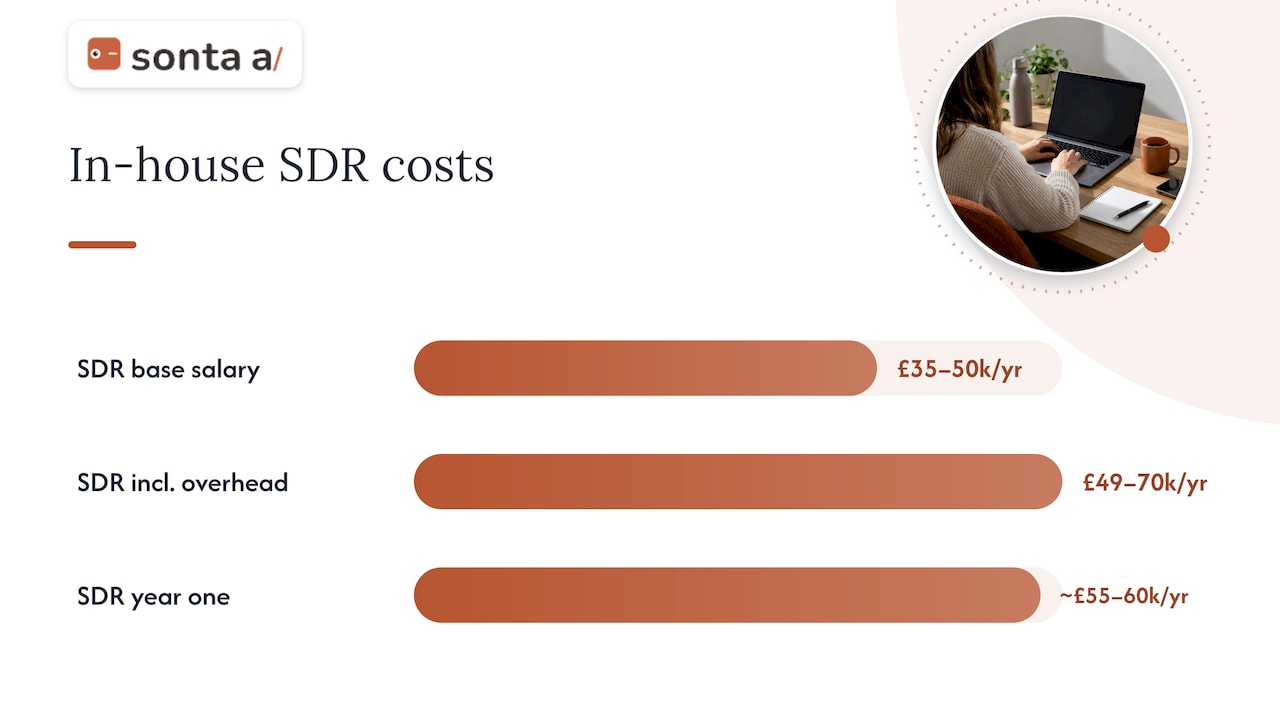
| In-house SDR, base salary | £35,000 to £50,000 a year, £49,000 to £70,000 with benefits and overhead | Leadriver, 13 April 2026 |
| In-house SDR, year one | About £55,000 to £60,000 | JumpLead, 30 October 2026 |
| Outsourced outbound, one SDR equivalent | Typically £2,000 to £8,000 a month | JumpLead, 30 October 2026 |
| Outsourced per meeting booked | £2,500 to £6,000 per meeting, or £150 to £250 per appointment | Leadriver, 13 April 2026 |
These are indicative figures from providers and analysts, and your own quotes will differ. The point is the scale. A salesperson or an agency is a five-figure commitment before the first deal.
Software costs look different. Sonta’s plans are Solo from $16 per seat per month, Core from $28 and Pro from $65, with Signal packs from $29 a month for five always-on searches. The full list is on the pricing page. Sonta replaces a CRM, an email sequencer, a LinkedIn outreach tool and a signal tool, for a median 36% less than the cheapest equivalent stack (Sonta value calculator, list prices read 17-18 Oct 2026). That is a median across the stacks compared, not a promise for your own.
Comparing the options buyers consider
Every route has strengths. Here is a fair read, starting with what each does well.
| Option | Where it is strong | Where Sonta differs |
|---|---|---|
| HubSpot | Broad marketing and sales suite, large ecosystem | Sonta adds signals, native sequences and LinkedIn outreach in the same app |
| Pipedrive | Clear pipeline view, easy for small teams | Sonta finds the opportunities as well as tracking them |
| Attio | Flexible data model, modern interface | Sonta has agents for each step and a signal engine built in |
| Gojiberry AI | Focused on finding prospects from signals | Sonta also handles sequences, replies, booking and the CRM |
| HeyReach | Built for LinkedIn outreach at scale | Sonta combines LinkedIn with email and the record keeping |
| Instantly | Strong at high-volume email sending | Sonta writes sequences from the signal and keeps the CRM current |
| AI SDR tools such as Artisan and 11x | One agent that handles outreach to the meeting | An AI SDR is one agent that stops at the meeting. Sonta has an agent for every step and is the CRM too |
| Spreadsheets | Free, familiar, flexible | Records go stale and nothing prompts a follow-up |
| Lead-generation agency | Capacity without hiring | You pay monthly, and the data lives with them |
| Hiring a salesperson | Judgement and relationships | A salary before the pipeline exists, and busywork still lands on them |
If your team already runs on HubSpot or Pipedrive, that tool is a sound system of record. The question is whether you also pay for a sequencer, a LinkedIn tool and a signal tool beside it. Sonta brings those four jobs into one app.
A routine a small team can run
Here is a weekly routine for a founder or a small sales team.
- Define the target. Write down sector, size, country and the roles you sell to.
- Set up always-on searches. Choose the moments that matter for your service, such as a hiring post for a role you could support or a new decision-maker.
- Read the reason. Open the link behind each opportunity and confirm what happened.
- Send from the moment. Reference the event honestly. Keep the message short and make opting out easy.
- Follow up on a schedule. Let the sequence run, and let replies update the record.
- Prepare for the meeting. Read the brief the agent has put together.
- Review weekly. Look at which signals led to replies and drop the ones that did not.
If you want more detail on follow-ups that book meetings, see our guide to CRM-first automated follow-up emails.
Our view
Most lead generation advice stops at the form. We think the real loss happens afterwards. A lead arrives, a reason to talk goes stale and nobody follows up between client work.
That is why we built Sonta as an agentic CRM that finds opportunities and moves them forward. The signal, the sequence, the reply and the record belong in one place, so nothing gets copied by hand.
We also think you should stay in control. You decide which steps need your approval. You choose the model and run it on your own keys. And every opportunity shows its reason with a link you can check.
We run our own sales on Sonta.
Pavel
See it on your own pipeline
If your team sells on HubSpot or Pipedrive and the follow-ups keep slipping, start with the Agentic CRM and look at the plans and Signal packs. You can see how the Agentic CRM fits the way you sell today. Book a demo and leave with your first leads.
FAQ
What is lead generation?
It is the process of attracting or approaching people who might buy, then capturing a way to reach them. It sits between marketing and sales. The aim is a named person you can follow up, with a record of where the interest came from.
Is lead generation illegal in the UK?
No. PECR and UK GDPR govern how you contact people and handle their data. Under the ICO’s guidance, the electronic mail rule does not apply to corporate subscribers, but sole traders are treated like individuals and UK GDPR still applies to personal data.
Can ChatGPT do lead generation?
It can help draft messages and research a company. It does not watch for timely moments or keep your pipeline. In Sonta, you can use ChatGPT or Claude through the MCP server, under the same rules and approvals as the app.
How much does lead generation cost?
It depends on the route. Published UK figures put an in-house SDR at roughly £49,000 to £70,000 a year including overhead (Leadriver, 13 April 2026). Sonta’s plans start from $16 per seat per month, with Signal packs from $29 a month.
Sources
- Lead Generation: The Beginner’s Guide, Ahrefs
- What Is Lead Generation? A Plain-English Guide for UK SMBs
- What Is Lead Generation? A Practical Guide, Adfluential
- Inbound vs Outbound B2B Lead Generation, RD Marketing
- Outbound Lead Generation UK Guide, RD Marketing
- 16 Lead Generation Techniques That Actually Work, Epic New Media
- B2B Lead Generation, Channels, Qualification and Cost, Mintense
- AI Lead Scoring for Mid-Market UK B2B Firms, Agenticise
- ICO: Business-to-business marketing
- ASA: Lead generation marketing
- AI in sales: lead handling, outreach and follow-up
- Outsourced SDR vs In-House, Leadriver
- In-House vs Outsourced SDR, JumpLead