How to Find New Clients: A Practical System for UK Firms

You find new clients by doing four things in order. Define who you want, ask the people who already trust you, reach out when there is a real reason to talk, and follow up until the conversation ends. Most firms do the first two badly and the last two inconsistently. This guide sets out each step, the rules that apply to outreach in the UK and Europe, and where an agentic CRM fits.
TL;DR
- Define your ideal client from your last 12 to 24 months of closed deals, not from wishes.
- Referrals remain the largest source of new business for agencies and consultancies, so ask for them on a schedule.
- Outbound works best when each message starts from a reason to talk, such as a hiring post or a job change. A reason to talk is not buying intent.
- Follow-ups and record-keeping are where most pipelines leak, and that busywork is what software should take over.
- Check PECR and UK GDPR before first contact. Rules differ again in Germany, the Netherlands, Denmark, Poland and South Africa.
Table of Contents
- Start by defining who you are looking for
- Ask the people who already trust you
- Reach beyond your network with a reason to talk
- Follow up until the conversation ends
- What the rules say before first contact
- Where an agentic CRM fits
- How the alternatives compare
- Our view
- See it on your own prospects
- FAQ
- Sources
Start by defining who you are looking for
A vague target produces vague outreach. The fix is to build your ideal client profile from evidence. One UK guide advises starting with your last 12 to 24 months of closed-won deals and looking at what you closed fastest, kept longest and earned most from.
Express the result in filters you can apply:
- Sector.
- Headcount.
- Revenue.
- Geography.
- Business model.
GOV.UK guidance on ideal customer profiles lists sector, company size or budget, geography and procurement process as criteria for prioritising customers. The same guidance suggests mapping buyer personas, because technical, executive and end-user buyers care about different things.
Add the signals that make a need urgent
Filters tell you who could buy. They do not tell you who should be contacted this week. A UK target-account guide frames the question as what evidence suggests this company will buy in the next 6 to 12 months. It splits signals into three groups:
- Value signals: proof that you win and keep clients like this one.
- Change signals: new leadership, a site launch, an acquisition, a system replacement or a growth plan.
- Friction signals: reasons deals stall, such as security or procurement requirements you cannot meet.
Write your own list of each. You will use the change signals in the outreach step.
Ask the people who already trust you
For most owner-led firms, the cheapest new business is a warm introduction. In a SparkToro survey of 612 agency owners and consultants, 66% named existing and past clients as their top source of referrals (2024). Nearly 13% named partner companies.
The survey also asked whether referrals are enough. A pipeline that depends on them alone is hard to forecast. That is why the rest of this guide exists.
How to ask without awkwardness
- Pick clients who would give you a positive review. Do not ask everyone.
- Ask soon after a visible win, while the result is fresh.
- Use specific wording. A question such as whether they know anyone running a similar operation with the same problem gives them something to match against their contacts, as this UK guide on asking clients for referrals suggests.
- Offer to draft the introduction email so they can forward it with minimal editing.
- Frame it as a favour with no pressure. If nothing emerges after three or four conversations, the Sussex Chamber of Commerce advises leaving it for 6 to 9 months.
Treat this as a repeatable process with a trigger, a list of who to ask and a record of the outcome. Without the record, the asking stops the first busy month.
Do not forget past contacts
People you have already spoken to change jobs. A former client who joins a larger company is a warm route in. Most firms never notice, because nobody is watching. This is one of the moments we come back to below.
Reach beyond your network with a reason to talk
Referrals cap out. To go further, pick two or three channels and run them properly. A UK 90-day plan from TPS Clear advises choosing two or three channels before adding more.
The usual options for a small B2B team are:
- Targeted email and LinkedIn outreach.
- Partnerships with complementary, non-competing firms.
- Events, where the follow-up matters more than the stand.
- Search and content, which pay back slowly.
Each has a different speed. Outreach can start conversations within days. Search takes months. Partnerships depend on trust you build over time. A mix is more resilient than any one of them.
Why timing beats volume
A message that arrives at the right moment gets read. The same message a month later is noise. The moments worth watching are public ones:
- Someone asks for a recommendation on LinkedIn.
- A company hires a new decision-maker.
- A company posts a role that implies a problem you solve.
- A past contact changes jobs.
Each of these is a reason to talk. None of them is proof that someone wants to buy. Write the message so it refers to the moment honestly and offers something useful. Do not pretend you know their budget.
Doing this by hand means reading LinkedIn feeds for hours. That is the part software handles well.
Follow up until the conversation ends
Most lost deals are lost to silence, not to a no. A UK lead-generation guide notes that demand is lost when leads go cold because nobody has a process for staying in touch.
A sequence should be a fixed set of touches over a fixed period with a clear stop. TPS Clear suggests starting with about three weeks and changing one thing at a time. Its example ends with a closing email that says you will stop and leaves the door open.
A workable pattern:
- Day 1: a short email that names the reason you are writing.
- Day 3 to 5: a LinkedIn connection note written for that person.
- Day 8: a follow-up with one useful, specific point.
- Day 14: a different angle, or a relevant case you can describe truthfully.
- Day 21: the closing email.
We cover the mechanics in more detail in our guide to automated follow-up emails that book meetings and in AI sales personalisation that avoids backfiring.
What the rules say before first contact
Outreach is regulated. Check these points before you send anything.
In the UK
The ICO explains that the PECR rule on electronic marketing does not apply to corporate subscribers, but you must not disguise your identity and must give a valid opt-out address. UK GDPR still applies when you process identifiable contacts’ personal data. You need a lawful basis, and people have the right to stop direct marketing.
Sole traders and some partnerships count as individual subscribers. They can only be emailed with consent or where the soft opt-in applies. Screen against your own do-not-contact list too. The ICO’s direct marketing checklist also covers preference services such as TPS for live calls.
In Europe and South Africa
If you sell across borders, the position changes. Business email needs prior consent before first contact in Germany, the Netherlands, Denmark and Poland. German practice rests on the Unfair Competition Act, UWG section 7. Confirm each country’s current position with a local adviser before you send.
In South Africa, POPIA applies to first-contact rules. Section 69 covers direct marketing by electronic communication, so read it before you contact South African prospects.
On LinkedIn
LinkedIn has its own rules on automated activity. Its help page on automated activity explains what it does not allow. Read it before you automate any LinkedIn step. No tool makes automation safe or undetectable, so keep volumes modest and stay within those rules.
Where an agentic CRM fits
The steps above create work: watching signals, writing messages, following up, booking meetings and keeping records current. Most teams spread this across a CRM, an email sequencer, a LinkedIn tool and a signal tool.
Sonta AI is an agentic CRM that finds opportunities and moves them forward. It puts those four tools into one app.
What you get:
- Opportunities that arrive with a reason. The Signal Agent watches public LinkedIn activity such as a recommendation request, a new decision-maker, a company hiring or a contact changing jobs. It shows each reason with a link, so you can check it yourself.
- Fit and intent scored separately. A good-fit company with no reason to talk stays visible but does not jump the queue.
- Native sequences written from the moment a signal fires. Email sequences are unlimited.
- Reply handling and meeting booking, plus a CRM that keeps itself up to date.
- Agents for each step: research, follow-up, meeting briefs and record updates. You decide which steps need your approval.
A few practical details matter for UK and European firms:
- You run AI on your own keys from Anthropic, OpenAI, Google or OpenRouter. There is no markup on AI when you use your own keys.
- You can use Sonta from Claude or ChatGPT through its MCP server, under the same rules and approvals.
- Data is stored in the EU under GDPR and is never used to train AI.
We run our own sales on Sonta.
What it costs
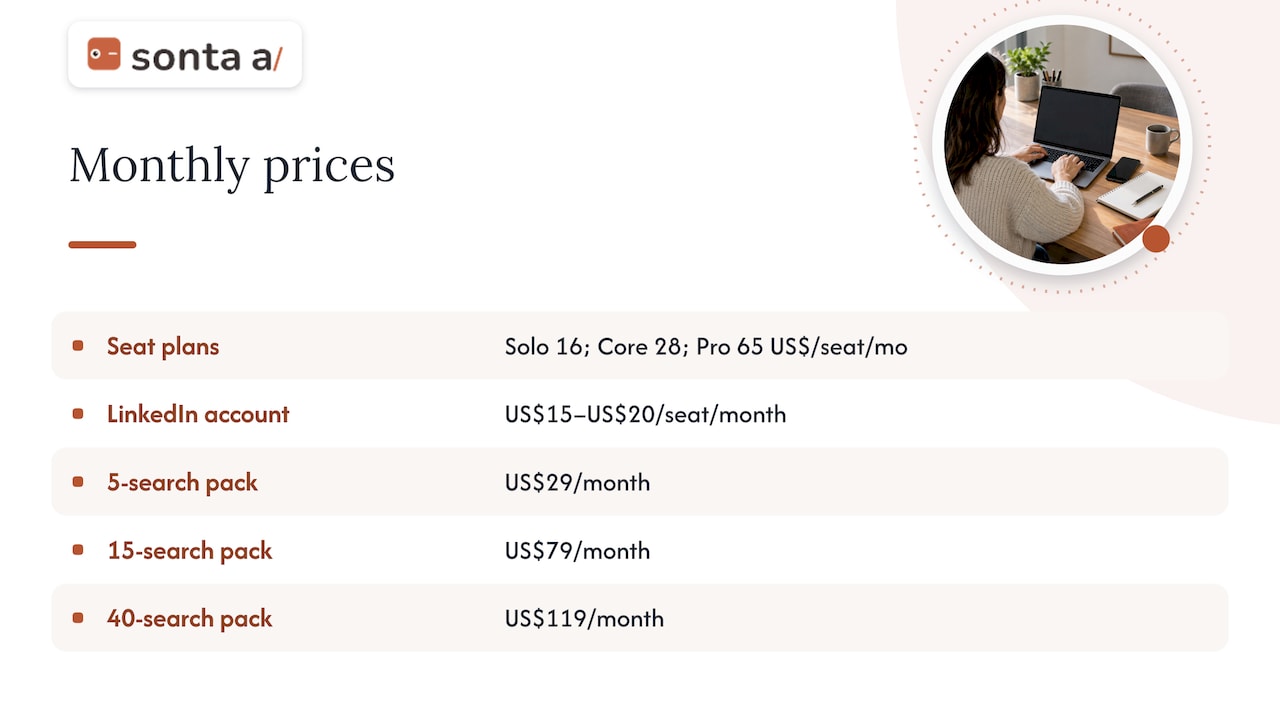
Seats start at US$16 a month per seat on Solo, US$28 on Core and US$65 on Pro. LinkedIn accounts are billed per seat, from US$15 to US$20 a month. Signal packs start from US$29 a month for five always-on searches, US$79 for 15 and US$119 for 40. The pricing page has the detail.
On cost against separate tools, our own value calculator shows a median 36% less than the cheapest equivalent stack (Sonta value calculator, list prices read 17-18 Oct 2026). That is a median across the stacks we compared, not a promise for your setup.
How the alternatives compare
Each option below suits some firms well. Here is each one’s strength first, then where Sonta differs.
| Option | Where it is strong | Where Sonta differs |
|---|---|---|
| HubSpot or Pipedrive | Mature CRMs your team may already know, with large ecosystems | Sonta adds signals, native sequences and agents in the same app, so you do not stitch tools together |
| Attio | A flexible, modern CRM with a clean data model | Sonta finds the opportunity and moves it forward, not only records it |
| Gojiberry AI | Focused on surfacing leads from signals | Sonta also runs sequences, replies, booking and the CRM |
| HeyReach | Built for LinkedIn outreach at scale across accounts | Sonta pairs LinkedIn with email and a CRM in one place |
| Instantly | Strong at email sending and sequencing | Sonta writes sequences from the signal and holds the records |
| AI SDR tools such as Artisan and 11x | One agent that handles outreach end to end up to the meeting | An AI SDR is one agent that stops at the meeting. Sonta has an agent for every step and is the CRM too |
| Spreadsheets | Free, familiar and flexible | Sonta keeps records current without manual updates |
| A lead-generation agency | Experienced people and extra capacity | Sonta keeps the work and the data in your hands |
| Hiring a salesperson | Judgement, relationships and conversation | Sonta takes the research and busywork, so whoever sells spends time on clients |
If your team already runs on HubSpot or Pipedrive and is happy there, the question is simply which gaps remain. Our guide to sales tech stack optimisation walks through how to find them.
Our view
We see the same pattern in owner-led agencies, consultancies and IT firms. New business gets done in the gaps between client work. It starts well, then the follow-ups slip and the pipeline belongs to whoever is billable.
We built Sonta to take that busywork off the founder. The Signal Agent finds the moment, the sequence is written from it, and the record updates itself. You still choose which steps need your approval, and every reason comes with a link you can check.
We would rather you spend an hour talking to a client than an hour reading feeds. That is the whole idea.
Pavel
See it on your own prospects
Sonta runs in under an hour, and the demo is built around your own ideal client. You leave with your first leads. The pricing page shows the plans, and the Sonta AI homepage explains the agentic CRM in full.
FAQ
What is the fastest way to find new clients?
Ask past and current clients for introductions, because referrals carry existing trust. In parallel, start a short outreach sequence to a tight list of firms with a visible reason to talk. Neither is instant, but both can produce conversations within weeks.
How do I find new clients without hiring a salesperson?
Put the research, drafting, follow-up and record-keeping into software, and keep the conversations for yourself. Choose two or three channels and run a three-week sequence before changing anything. Sonta is built for this, with agents for each step and approvals set by you.
Can I email prospects without their consent in the UK?
Often yes for corporate subscribers, provided you identify yourself and give an opt-out. Sole traders and some partnerships need consent or the soft opt-in. UK GDPR still applies, so have a lawful basis. Check the ICO guidance for your case.
Is a job change a sign someone wants to buy?
No. A job change or a hiring post is a reason to talk, not buying intent. Use it to open a relevant, honest conversation and let the prospect say whether the timing suits them.
Sources
- How to Define an ICP Framework (Flowd)
- Track 3: Ideal Customer Profile (GOV.UK)
- Build a target account list UK sales will use (1000Steps)
- The State of Digital Agencies in 2024 (SparkToro)
- Asking Clients for Referrals (GG Worldwide)
- Using your existing client base through referral marketing (Sussex Chamber of Commerce)
- Go to market strategy UK (TPS Clear)
- B2B Lead Generation: The Complete Guide for UK SMEs (Grey Turtle)
- Business-to-business marketing (ICO)
- Direct marketing checklist (ICO)
- Is cold email legal in Europe (ITSalesaaS)
- POPIA section 69
- Automated activity on LinkedIn
Book a demo and leave with your first leads.