AI Territory Management: Why a 42% Balance Gain Still Needs People

AI territory management automates the multi-objective math of territory design, balancing revenue potential, rep workload, and travel time across thousands of account combinations in minutes rather than weeks. The approach we recommend is hybrid: AI generates optimized scenarios, managers mark protected relationships and comp-sensitive accounts, AI re-runs the math, and the resulting plan rolls out through a phased pilot. If your CRM data is clean enough, a fast diagnostic run or scenario test is the logical next step before any full redesign.
TL;DR:
- Academic studies found 42 to 47% average balance gains across sales, workload, and distance; industry reports cite 2 to 7% sales lifts with disciplined rollout.
- Before running scenarios, teams should deduplicate accounts, match leads to parent companies, refresh pipeline records, and verify location coordinates and travel times.
- Managers should lock protected relationships, review accounts tied to compensation, and test the revised map in one region with a comp bridge before expansion.
- Compare a pilot region with a control region; treat the first 30 to 90 days as disruption, and assess performance over 6 to 12 months.
Table of Contents
- Why AI matters for territory management
- How AI territory optimization works: design, assign, optimize
- Core capabilities and feature checklist
- Data and inputs: signals required and data-prep checklist
- Implementation and rollout: a phased hybrid workflow that protects comp and relationships
- Measuring success: KPIs, experiment design and evaluation windows
- Best practices for adoption and change management
- Security and compliance considerations for AI-based territory systems
- Customization for different industry verticals
- Handling territory changes as markets shift
- Integration with CRM and sales tools
- What RevOps leaders should take away from this
- How Sonta AI supports AI-enabled territory planning
- FAQ
- Sources
Why AI matters for territory management
Manual territory redesign has always been a spreadsheet problem pretending to be a strategy problem. A RevOps analyst balancing forty reps across thousands of accounts by hand, weighing revenue potential against drive time and workload, can spend weeks on a single draft and still miss better combinations buried in the data. AI changes the scale of what’s computable, not just the speed.
Optimization engines built for territory design use multi-objective mixed-integer linear programming (MOMILP) to search configurations a human planner would never think to test, then return several balanced options instead of one guess. Where a manual process forces planners to pick a single objective and sacrifice the others, these tools surface tradeoffs explicitly, so a RevOps leader can compare a revenue-maximizing carve against a travel-minimizing one before committing.
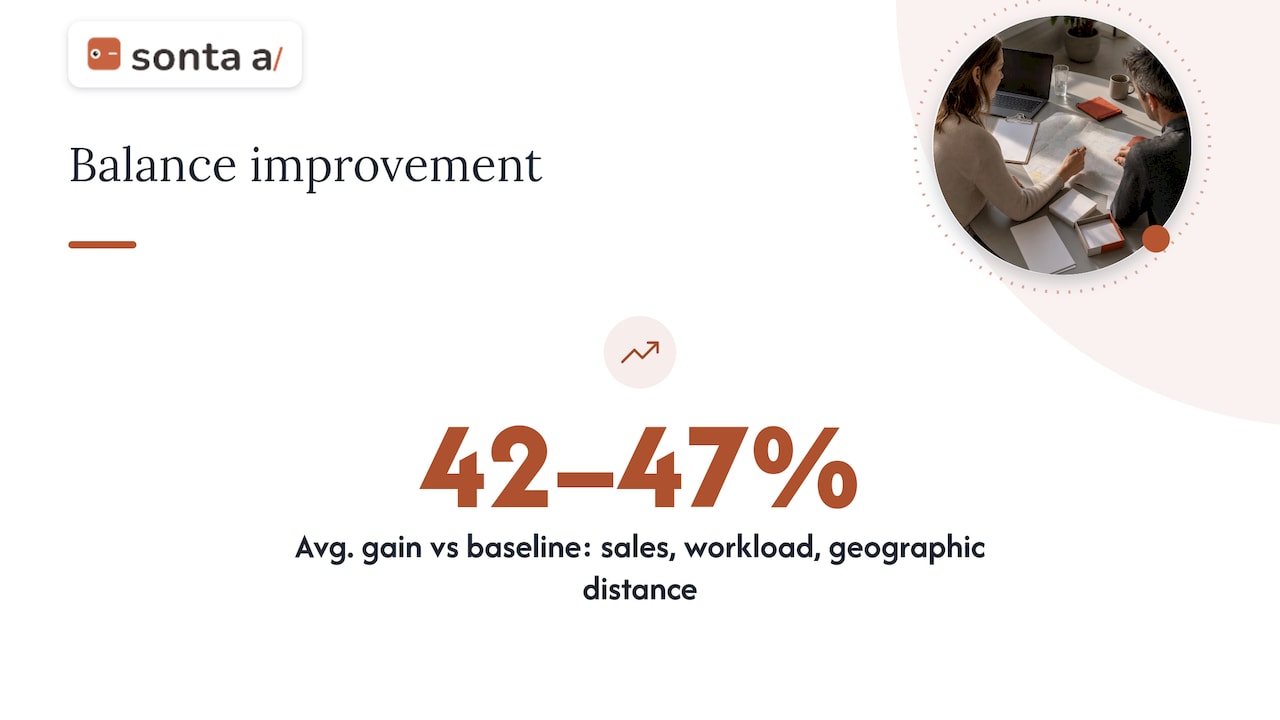
The evidence for impact is real but measured, not dramatic. Academic research applying a multi-objective model with a Tabu Search metaheuristic to sales territory design found average improvements of 42 to 47% across sales, workload, and geographic distance objectives compared to the baseline assignment in the case study. That’s a balance metric, not a revenue claim, but it shows how much slack exists in territories drawn by hand or by outdated rules.
On the revenue side, industry reporting is more conservative. Field and vendor reports commonly cite a 2 to 7% sales increase attributed to territory alignment, and that range only shows up when optimization is paired with a disciplined rollout. An optimizer that produces a mathematically balanced carve still depends on managers communicating the change, protecting key relationships, and adjusting compensation plans so reps aren’t penalized for a redraw they didn’t ask for.
Academic case studies report average balance improvements of 42 to 47% across sales, workload, and distance objectives when multi-objective optimization replaces manual territory assignment. That gap between what the math can find and what a spreadsheet typically delivers is the core argument for bringing AI into the planning process at all.
How AI territory optimization works: design, assign, optimize
Territory optimization software treats the problem as a constrained search, not a single formula. Three building blocks show up across most implementations.
The first is the optimization model itself. Most platforms use some combination of MOMILP, p-median or p-center location models (which minimize the distance between accounts and assigned reps), and genetic algorithms that evolve populations of candidate territory maps toward better fitness scores. None of these methods produces a single “correct” answer. Instead, they generate a Pareto frontier: a set of solutions where improving one objective (say, revenue balance) necessarily worsens another (say, total travel time). RevOps leaders should expect to review several frontier points in a planning session, not one finished map.
The second building block is the input weighting. Per-account signals determine how much pull each account exerts on the optimization. Propensity scores let the model weight accounts by expected revenue rather than treating every account as equal, which changes the objective function meaningfully: a territory with fewer but higher-propensity accounts can outperform one with more low-intent accounts, even if headcount looks unbalanced on paper. Firmographic data (industry, company size, growth stage) and travel-time matrices feed the same weighting layer, so the optimizer isn’t just drawing shapes on a map but ranking tradeoffs by expected outcome.
The third is what the industry calls “auto-carve”: the practical workflow layer that turns the math into something a planning team can act on.
- Scenario sets let teams generate multiple candidate territory maps from one data pull, each optimized for a different weighting of revenue, workload, or travel.
- Locks and constraints let planners pin specific accounts to specific reps before re-running the optimizer, so a renewal in motion or a long-tenured relationship doesn’t get redrawn.
- Scenario comparison metrics (standard deviation of quota, average travel time, pipeline coverage) give planners a consistent way to judge which frontier point to choose.
- Version history tracks what changed between runs, which matters when a plan gets challenged months later.
The output of a well-run optimization isn’t a finished territory map. It’s a shortlist of defensible options and the data to defend whichever one gets chosen.
Core capabilities and feature checklist
When auditing a territory management platform, it helps to separate the math engine from the workflow tools that make the math usable by a team that isn’t made up of operations researchers. The following categories cover what to look for, regardless of vendor.
- Mapping and manual editing. A visual map interface that shows territories geographically, with drag-and-drop editing for manual overrides after the optimizer runs.
- Auto-carving and what-if engine. The ability to generate multiple scenarios from one dataset and compare them side by side, with versioning so each run is traceable.
- Constraint management. Support for protected relationships, capacity caps per rep, and account-level locks that survive re-optimization.
- CRM and routing integrations. A live connection to the CRM so territory assignments reflect current ownership, plus route optimization so travel-heavy territories translate into workable rep schedules. User reviews of field sales platforms consistently flag mapping accuracy and route planning as the features that determine whether a territory plan survives contact with the field.
- Audit trails and scheduling support. A record of who changed what, when, and why, along with calendar or scheduling hooks so reassigned accounts show up on the right rep’s calendar immediately.
- Continuous versus snapshot modes. Some teams redesign territories once a year; others want the optimizer running continuously against fresh data, flagging drift as accounts change size or activity level.
Pro Tip: Run the optimizer in snapshot mode for your first full redesign, then switch to continuous monitoring once the initial carve is stable and reps trust the data behind it.
The distinction between continuous and snapshot modes matters more than it looks. A continuous model catches a formerly small account that grew into enterprise territory before a rep notices, but it also means more frequent change requests landing on managers’ desks. Teams new to AI-driven territory work generally do better starting with periodic redesigns and graduating to continuous optimization once the governance process around constraint locks and sign-offs is established.
Data and inputs: signals required and data-prep checklist
An optimizer is only as good as what it’s fed, and territory projects fail more often from data problems than from weak algorithms. The essential inputs fall into a handful of categories: historical bookings and opportunity stage data (so the model knows what “revenue potential” actually looks like per account), firmographic attributes, location coordinates for every account and rep, travel-time matrices (not just straight-line distance), and propensity scores that rank accounts by likelihood to close or expand.
Most of the damage happens before the optimizer ever runs, in the data-prep stage.
- Dedupe accounts and contacts first; duplicate records split revenue history across two entries and understate true account value.
- Match leads to the correct parent account, especially in multi-location businesses where a rep might otherwise be credited for the wrong site.
- Enrich firmographic fields that are missing or stale, since an optimizer treating a mid-market account as a small business will misallocate it every time.
- Check timestamp freshness on opportunity and activity data; an optimization run against six-month-old pipeline data produces a carve optimized for a market that no longer exists.
Thorough data enrichment and deduplication before mapping fields is the single highest-leverage step most teams skip, and it’s the reason two companies running the same optimization software can get very different quality carves.
Poor data doesn’t just produce a worse territory plan, it produces a misleadingly confident one. An optimizer fed duplicate accounts or stale firmographics will still output a balanced-looking map with clean standard deviation numbers, because the math is only balancing what it’s given. Academic multi-objective territory models depend on accurate underlying account and workload data to produce the balance gains reported in test instances, and the same dependency holds for any commercial optimizer. A territory plan with a tight balance score built on dirty data is worse than a rough manual draft, because the false precision makes it harder for managers to challenge.
Implementation and rollout: a phased hybrid workflow that protects comp and relationships
The optimization math is the easy part. The hard part is rolling a new territory map out to reps without triggering attrition, comp disputes, or quiet sabotage from the account owners who lose their biggest clients. A phased loop handles both halves of the problem.
- Phase 0, data audit. Confirm account ownership, dedupe records, and refresh firmographic and propensity data before any optimization run.
- Phase 1, scenario generation. Run the optimizer against two or three weighting profiles (revenue-weighted, workload-balanced, travel-minimized) and generate a shortlist of Pareto-frontier options.
- Phase 2, stakeholder review and locks. Bring sales managers into the review, have them flag protected relationships and tenure-sensitive accounts, encode those as locks, and re-run the optimization.
- Phase 3, pilot. Roll the revised plan out to one region or business unit first, with a defined comp bridge so no rep takes an immediate pay cut from the reassignment.
- Phase 4, phased rollout. Expand region by region, using pilot results and rep feedback to adjust constraints before the next wave.
Encoding protected relationships isn’t a soft gesture, it’s a hard constraint in the model. A long-tenured rep with a ten-year relationship on a key account should be locked to that account before the optimizer runs again, the same way a capacity cap or a geographic boundary would be. AI territory optimization handles the constraint-satisfaction math well but cannot run the political conversations that go with it, which is exactly why the manager review step in Phase 2 can’t be skipped or automated away.
Pro Tip: Document every lock and the business reason behind it; when a rep challenges a reassignment six months later, the audit trail is what settles the conversation.
Governance matters as much as the algorithm. Decide upfront who signs off on each phase (typically sales leadership for the final map, finance for comp bridge costs, and RevOps for the data and scenario work), and give reps a clear escalation path if they believe an account was misassigned.
Measuring success: KPIs, experiment design and evaluation windows
A redesign is only as good as the measurement plan behind it. The KPIs that matter most track balance and outcome separately, because a plan can be perfectly balanced and still underperform if the underlying data was wrong.
- Standard deviation of quota attainment across reps, which should shrink after a well-executed carve.
- Pipeline conversion rate by territory, to catch cases where balanced account counts hide unbalanced deal quality.
- Average travel time per rep, especially for field-heavy roles where windshield time competes directly with selling time.
- Win rate change pre- and post-redesign, measured against a comparable prior period.
- Quota attainment distribution, not just the average, since a redesign that helps the median rep but crushes the bottom quartile is a governance problem waiting to surface.
Pilot design should include a control group wherever possible, running the new territory logic in one region while a comparable region stays on the old assignment for the same quarter. Early signals (first 30 to 90 days) tend to reflect disruption more than performance, since reps are still learning new accounts and rebuilding relationships. The more reliable read comes from a 6 to 12 month window, long enough for a full sales cycle to play out in most B2B motions and for comp bridges to phase out naturally.
Best practices for adoption and change management
Territory redesigns fail more often from change management than from bad math. The teams that get adoption right treat the rollout as a communication project with an optimization engine attached, not the other way around.
Start by explaining the “why” before the “what”: reps who understand that the redesign is meant to fix an unbalanced carve, not to punish underperformers, are far less likely to resist. Share the scenario comparisons openly where possible, since seeing that the chosen map was one of several defensible options (rather than an arbitrary decision) builds trust in the process.
Involve frontline managers early, not as a formality but as the people who actually know which accounts carry relationship risk. Their input during the lock-and-constraint phase is what prevents a mathematically sound plan from becoming a retention problem.
Phase the rollout rather than flipping every territory at once, and keep a visible feedback channel open during the pilot so issues surface before they compound across a full rollout. Finally, revisit the plan on a set cadence (quarterly reviews are common) rather than treating the new map as permanent, since account growth and market shifts will start eroding balance again within a few quarters.
Security and compliance considerations for AI-based territory systems
Territory optimization tools handle sensitive commercial data: account revenue history, contact details, compensation-linked assignments, and sometimes personally identifiable information tied to named contacts. That combination puts territory management platforms squarely under the same scrutiny as any CRM-adjacent system.
Data residency and access controls matter most in practice. Confirm where account and contact data is stored and processed, who inside the organization can view compensation-linked territory assignments, and whether the platform supports role-based access so a rep can see their own territory without seeing company-wide revenue weighting logic. Audit trails, the same feature that helps settle disputes over account reassignment, also serve a compliance function by documenting who changed a territory boundary and when.
Any platform touching customer data should be evaluated against applicable regional privacy rules for the markets where accounts are located, since a global account book can span multiple jurisdictions with different requirements. Ask vendors directly about data processing agreements and whether propensity scoring or enrichment pulls data from third-party sources, since that supply chain is often where compliance gaps appear.
Customization for different industry verticals
Territory logic that works for enterprise software sales doesn’t transfer cleanly to field-heavy industries, and the better platforms let the weighting model flex by vertical rather than forcing every business into the same account-count framework.
In real estate, territory carving often centers on geographic exclusivity and listing density rather than account revenue, since the “accounts” are properties and neighborhoods rather than recurring B2B relationships. Recruitment firms tend to weight by candidate pipeline and client industry specialization rather than pure geography, since a recruiter’s territory might be defined by vertical expertise more than a map. Auto retail and other high-travel field sales models lean heavily on travel-time matrices and capacity caps, since a rep’s effective territory size is capped by drive time between dealerships or service locations as much as by account count. Professional services firms frequently weight by relationship tenure and referral network density, since repeat business and introductions matter more than cold account assignment.
The common thread is that the optimization math stays the same (MOMILP, Pareto frontier generation, constraint locks), but the objective weightings and input signals change by vertical. A platform worth adopting should let RevOps adjust those weightings without a custom engineering project for every industry nuance.
Handling territory changes as markets shift
Territories drawn today start degrading the moment a key account grows, a competitor enters a region, or a rep leaves. Static annual redesigns treat this as a once-a-year problem; a more resilient approach treats it as ongoing drift that needs monitoring.
Dynamic adjustment doesn’t mean redrawing every territory weekly. It means setting thresholds that flag when a territory has moved far enough from its original balance to warrant review, such as an account’s revenue growing past a tier boundary or a rep’s workload drifting more than a set percentage from the target. When those thresholds trigger, the optimizer re-runs against current data, but the same lock-and-review process from the initial rollout still applies before any change reaches a rep’s book.
This is where continuous optimization modes earn their complexity. A platform that re-scores propensity and firmographic data as CRM records update can surface drift automatically, rather than waiting for a manager to notice a rep is overloaded six months after the fact. The tradeoff is governance load: more frequent flags mean more frequent constraint reviews, so teams adopting continuous monitoring need a lightweight approval process for minor adjustments, reserving the full stakeholder review for major redraws.
Integration with CRM and sales tools
Territory optimization only matters if the output reaches the tools reps actually use every day. A beautifully balanced map that lives in a separate planning tool and never syncs to the CRM is a planning exercise, not an execution plan.
The baseline integration requirement is a live, bidirectional connection to the CRM so territory assignments update account ownership automatically rather than through a manual export and import cycle. From there, routing and scheduling integrations matter for field-heavy roles, since a travel-optimized territory is only useful if the rep’s calendar and route planning tools reflect the new account geography. Field sales platform reviews point to this integration gap as a recurring complaint: territory logic and field execution tools are often sold separately, forcing manual reconciliation between the two.
Some AI assistant features inside modern CRM platforms, similar to the assistant capabilities built into other CRM tools, extend beyond territory math into day-to-day account prep and follow-up, which matters for RevOps leaders evaluating whether a territory tool should stand alone or live inside a broader CRM layer. A CRM where account records update in real time as deals progress gives the optimizer fresher inputs than a system that depends on reps manually logging activity, which is a meaningful consideration when choosing where territory optimization should sit in the tech stack.
What RevOps leaders should take away from this
The conventional pitch for AI territory tools oversells the algorithm and undersells the rollout. The math genuinely is the easy part: MOMILP solvers and genetic algorithms have been generating Pareto-optimal territory maps for years, and what’s changed recently is speed, not fundamental capability. The harder, less discussed problem is that a mathematically optimal territory redesign can still fail commercially if it ignores the relationships and incentive structures reps have built over years.
Our take is that the hybrid model isn’t a compromise, it’s the only version that works. AI should own the constraint satisfaction and scenario generation entirely, because that’s a search problem at a scale no planning team can do by hand. Humans should own every decision that touches comp, tenure, or trust, because those aren’t optimization variables, they’re judgment calls with retention consequences.
For RevOps leaders starting this work, the practical checklist is short: run a quick diagnostic against current CRM data to see how clean the inputs actually are, pick one region as a pilot rather than redesigning everything at once, assemble a RACI that names who signs off on locks and final maps, and budget a comp bridge before the first rep sees a changed territory.
— Pavel
How Sonta AI supports AI-enabled territory planning
Territory optimization depends entirely on the quality and freshness of the account data feeding it, which is where most legacy CRM setups fall short. We built Sonta AI as an AI-native CRM specifically so records update themselves in real time instead of depending on reps to log activity manually, which means the firmographic, propensity, and pipeline data territory optimizers need is current by default rather than stale by the time a planning cycle starts.
- Our AI Efficiency Diagnostic surfaces operational leakages in your current tech stack and data flows within 30 minutes, which is a fast way to see whether your CRM data is ready for a territory optimization project before committing to one.
- Our Agentic CRM runs customizable AI agents for lead qualification, account prep, and scheduling, the same real-time data layer a territory redesign depends on for accurate inputs.
- We never meter AI or automation usage, so running scenario comparisons and continuous data checks doesn’t carry a per-use cost on top of your plan.

If a territory redesign is on your roadmap, the diagnostic is the lowest-friction way to find out what your data can support before you run the optimization. Explore our pricing plans, starting at $16 per seat per month on the Solo plan, or start with the AI Efficiency Diagnostic to see where your current setup stands.
FAQ
What does AI territory management actually optimize for?
AI territory management optimizes for multiple objectives at once, typically balancing revenue potential, rep workload, and travel time rather than any single metric. The output is usually a set of Pareto-optimal scenarios, not one answer, so planners choose which tradeoff fits their priorities.
How much can AI territory optimization improve sales performance?
Academic case studies applying multi-objective optimization to territory design found average balance improvements of 42 to 47% across sales, workload, and distance objectives compared to baseline assignments. On the revenue side, industry reports commonly cite a 2 to 7% sales increase tied to territory alignment, though that figure depends heavily on rollout quality.
Can AI fully automate territory redesign without manager input?
No. AI handles the constraint-satisfaction math well but cannot manage the political and compensation conversations that come with reassigning accounts, so the recommended approach pairs AI-generated scenarios with manager-led review and sign-off before any rollout.
What data do I need before running a territory optimization?
The essential inputs are historical bookings, opportunity stage data, firmographic details, location coordinates, travel-time matrices, and propensity scores for each account. Data hygiene steps like deduplication and timestamp freshness checks matter as much as the inputs themselves, since dirty data produces a confidently wrong balance score.
How long should a territory pilot run before judging results?
Early signals in the first 30 to 90 days mostly reflect disruption from reps learning new accounts, not true performance. A more reliable read typically needs a 6 to 12 month window, long enough to capture a full sales cycle and let comp bridges phase out.
Sources
- Sales territory design with a multi-objective model and Tabu Search (IJSOM)
- AI Territory Optimization: What It Does (and Doesn’t) — Maptive
- Spotio user reviews — G2