Renewal Playbook Automation for CSMs: One Workflow, Renew and Expand

Renewal playbook automation is a rules-driven sequence that proactively engages the right accounts at the right time, triggered by contract dates, usage signals, and health scores rather than manual tracking. The immediate first step is to segment accounts and wire a 90-day trigger that deploys a segment-specific playbook automatically. From there, templates, communication cadences, and deployment rules turn that single trigger into a repeatable system.
TL;DR:
- Strategic accounts receive playbooks led by people; accounts below $5,000 ARR can renew automatically unless they show risk or need negotiated terms.
- For midmarket and enterprise renewals, review health at 120 days, send value recaps at 60, discuss pricing at 30, and reserve executive outreach for stalled strategic deals.
- Set cooldowns of 14 to 30 days and deduplicate contract rules; usage declines, risk score changes, contact departures, or support spikes can trigger early intervention.
- Route at risk or high value accounts to a CSM or executive, then pause automated messages during human outreach to avoid conflicting contact.
Table of Contents
- Customer segmentation framework for renewal prioritization
- Turning renewal goals into success plans that feed automation
- A communication cadence that automates outreach across the renewal window
- Automation triggers and the 90 to 120 day timing window
- How to automate playbook deployment and track outcomes
- Tailoring playbooks for at-risk and high-value renewals
- Practical examples of AI-native automation for renewal playbooks
- What a realistic renewal automation rollout looks like
- How Sonta Ai helps you put this into practice
- FAQ
- Sources
Customer segmentation framework for renewal prioritization
Automation without segmentation produces noise. Every account gets the same cadence, the same templates, and the same CSM attention, regardless of whether it is a six-figure strategic renewal or a low-touch self-serve seat. Segmentation is what lets a renewal playbook allocate effort where it matters and lets automation carry the rest.
A workable segmentation model combines several dimensions rather than relying on one number:
- Annual contract value (ACV) or ARR, which sets the financial stakes of the renewal.
- Usage trends, including adoption depth and any decline in active seats or key feature use.
- Health or risk score, built from support ticket volume, NPS, and engagement signals (our account health scoring guide covers the signals worth tracking).
- Strategic value, such as reference potential, logo value, or expansion headroom.
- Contract terms, including auto-renewal clauses, multi-year commitments, and payment schedule.
A common tiering structure sorts accounts into strategic, growth, standard, and low-touch groups. Strategic accounts, typically the top revenue band with high expansion potential, get a human-led playbook with automation handling only reminders and data prep. Growth accounts receive a hybrid playbook: automated touches at set intervals with CSM intervention at key milestones. Standard accounts run on a largely automated sequence with CSM review only when a risk flag fires. Low-touch accounts, often sub-$5,000 ARR seats, run fully automated renewal sequences with no manual step unless the account self-identifies as at risk.
Building this model takes an operational checklist before any automation goes live. Assign a data owner for each dimension (finance for ACV, product or support for usage and health data, sales for contract terms). Confirm where each data point lives, whether that is the CRM, a billing system, or a usage analytics tool, and whether it updates in real time or on a lag. Stale contract data or a health score that only refreshes monthly will misfire triggers regardless of how well the tiers are designed, so data hygiene has to be solved before segmentation rules go live, not after (our data hygiene automation guide addresses this directly).
Turning renewal goals into success plans that feed automation
A segmentation tier tells a playbook who to engage. A success plan tells it what to say. Without a documented renewal objective and the value delivered against it, automated messaging defaults to generic check-ins that read as filler rather than genuine progress updates.
A renewal-focused success plan should define outcomes in terms the customer cares about: time saved, cost avoided, adoption milestones hit, or ROI realized against the original business case. These become the data points that populate automated value recaps instead of empty “checking in” emails.
A practical success plan template includes:
- Owner, the CSM or account team responsible for the plan.
- Stakeholder map, naming the economic buyer, champion, and any new contacts since the last renewal.
- Timeline, tied to the renewal date and key milestones in between.
- Renewal objective, stated as a specific outcome (expansion, flat renewal, downsell mitigation) rather than a vague “retain the account.”
Each of these fields should map to a playbook trigger field rather than live in a separate document. When the stakeholder map shows a champion departure, that should trigger a re-engagement step automatically. When the timeline shows 60 days to renewal with no documented ROI milestone hit, that gap itself becomes a trigger for a value-recap touch. Analyst guidance on renewal operations frames this kind of structured, measurable approach as central to improving net revenue retention, since playbooks built on documented outcomes perform more consistently than playbooks built on CSM memory alone.
A communication cadence that automates outreach across the renewal window
Timing determines whether a renewal touch reads as proactive or as a last-minute scramble. A cadence mapped to the renewal window, rather than triggered ad hoc, keeps every account moving toward a decision point without overwhelming the CSM’s task list.
A standard cadence for mid-market and enterprise segments looks like this:
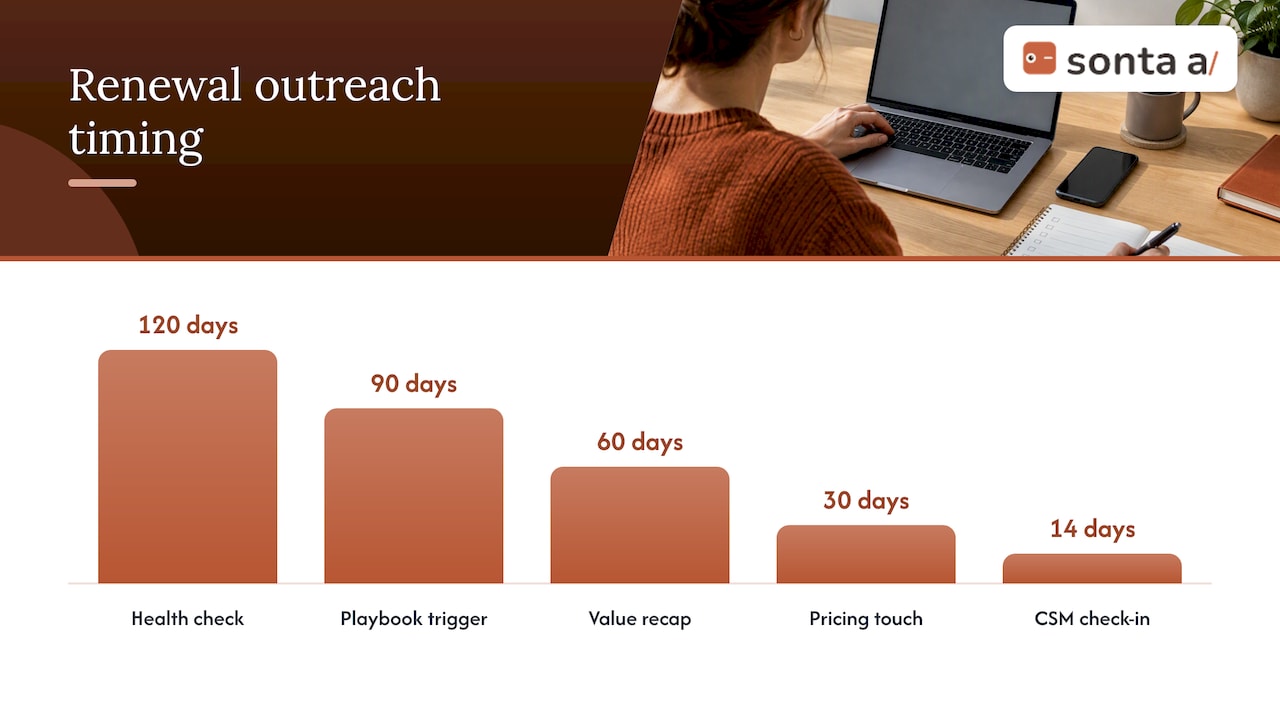
- 120 days out: automated health check summary sent to the CSM, flagging any at-risk indicators before outreach begins.
- 90 days out: playbook trigger fires, initiating the renewal sequence and assigning the first CSM task (community guidance on renewal playbook triggers points to 90 days as a standard manual-playbook trigger point).
- 60 days out: automated value recap email, summarizing usage data and outcomes against the success plan.
- 30 days out: pricing or proposal touch, generated from contract terms and any negotiated changes.
- 14 days out: CSM task CTA for a direct check-in call, especially for growth and strategic tiers.
- 7 days out: executive outreach for strategic accounts only, reserved for cases where the deal has not progressed.
Channels should vary by purpose rather than defaulting to email for everything. Automated email handles the health check and value recap. In-app messages work well for usage nudges tied to specific features. CSM task CTAs, generated inside the CRM, handle anything requiring a human conversation. Executive outreach stays manual and reserved for strategic accounts where a senior relationship adds weight.
Four template families cover most of the cadence: a health check summary, a value recap tied to the success plan, a pricing or proposal document, and an executive re-engagement note for stalled strategic deals. Building these once and parameterizing them with account-specific fields avoids rewriting the same email for every renewal.
Automation triggers and the 90 to 120 day timing window
The trigger logic is what separates a renewal playbook from a calendar reminder. A single trigger, like contract end date, works until two accounts hit the same date within days of each other or a health score dips mid-cycle and no rule exists to catch it.
A 90 to 120 day window gives enough runway to detect risk, deliver value messaging, and still have time for a pricing conversation before the contract lapses. An early mark around four months is best used for internal health review rather than customer-facing outreach. The typical standard point to fire the customer-facing playbook is about three months before renewal, a pattern confirmed in community documentation on triggering renewal playbooks at that interval. The 60 and 30-day marks handle value reinforcement and commercial conversations, respectively.
Beyond the calendar, several other signals should be able to fire or escalate a playbook independently:
- Usage threshold drops, such as a sustained decline in active seats or logins over a rolling 30-day window.
- Health or risk score changes, where a score crossing a defined threshold triggers an early playbook start regardless of contract date.
- Stakeholder turnover, flagged when a champion or economic buyer is removed from the CRM contact record.
- Support ticket volume spikes, which often precede a renewal conversation turning difficult.
Subscription management platforms generally support both scheduled automatic renewal processes and manual override controls, letting administrators configure renewal duration, consolidation, and exception handling at the account level, as outlined in Oracle’s subscription renewal documentation. The same principle applies to playbook automation: the rules engine needs an override path, not just a trigger path.
Rule design needs a few guardrails to avoid noise. Set a cooldown window, typically 14 to 30 days, so the same account does not receive duplicate CTAs from overlapping rules. Define trigger precedence so a risk-score spike overrides the standard 90-day sequence rather than running in parallel with it. Build deduplication logic so a single account with multiple contracts does not generate three separate playbooks.
Pro Tip: Use contract end date as the primary trigger and layer health score and usage trend as secondary qualifiers, so the playbook fires early for at-risk accounts and on schedule for healthy ones.
How to automate playbook deployment and track outcomes
Deployment is where the rules engine meets the CSM’s actual workday. A well-designed trigger that never produces a clear CTA or dashboard entry is functionally invisible.
Deployment typically follows four steps. First, configure the rules engine with the segmentation tiers and trigger conditions defined earlier. Second, generate CTAs automatically when a trigger fires, assigning them to the correct CSM with the relevant account context attached. Third, schedule the underlying processes, whether that means a nightly batch job checking contract dates or a real-time trigger on health score changes. Fourth, automate the renewal itself where the segment allows it, such as low-touch accounts with standard terms and no negotiated changes.
Tracking effectiveness requires a small, consistent set of KPIs rather than a sprawling dashboard:
- Renewal rate, the percentage of eligible contracts renewed within the segment.
- Net revenue retention (NRR), capturing renewals plus expansion minus downgrades and churn.
- Playbook completion rate, the share of triggered playbooks that run through to a renewal decision without stalling.
- Time to first renewal contact, measuring how quickly a triggered playbook results in an actual customer touch.
Operationalizing renewal workflows and measuring them consistently is a core lever behind improved retention outcomes, according to Gartner’s renewal operations research, which frames structured renewal processes as a measurable driver of NRR rather than a soft best practice.
Iteration depends on closing the loop between CSM feedback and the rules engine. A dashboard showing completion rates by segment surfaces where playbooks stall, whether that is a template that underperforms or a trigger firing too late to matter. For dashboard construction, a dedicated SaaS metrics template can help renewal teams track NRR, churn, and completion rates alongside the CRM’s native reporting. A/B testing works best on two variables at a time, typically timing (90 versus 75 days) or messaging (value recap versus direct pricing ask), since testing more variables at once makes it hard to isolate what actually moved the renewal rate.
Tailoring playbooks for at-risk and high-value renewals
Standard automation handles the bulk of renewals well, but strategic accounts and accounts showing risk signals need a different path, one where automation flags the account and a human takes over rather than letting the standard sequence run unattended.
- Define escalation criteria upfront, combining a health score threshold with ACV, so both a struggling enterprise account and a shrinking mid-market account can trigger escalation through different paths.
- Flag the account automatically the moment the criteria are met, routing it to a CSM lead or renewal specialist rather than letting the standard 90-day cadence continue unmodified.
- Run a dedicated technical or business review for at-risk accounts, addressing the specific friction point (adoption gap, support backlog, stakeholder change) before any pricing conversation starts.
- Add executive touch points for high-value accounts regardless of health, since strategic renewals benefit from a senior relationship even when the account shows no risk signals.
- Build tailored offers only after the review, rather than leading with a discount, since a premature concession on a healthy strategic account signals weakness rather than partnership.
The goal of escalation is to preserve the customer experience while shifting from automated to human-led engagement. That means the automated playbook should pause or downgrade its cadence once a human has taken over, rather than continuing to send scheduled touches alongside a CSM’s direct outreach. A customer fielding both an automated pricing email and a personal call from their CSM in the same week reads the process as disorganized rather than attentive.
Practical examples of AI-native automation for renewal playbooks
The trigger logic described above depends entirely on data accuracy. A health score built on a support ticket count that is three weeks stale, or a contract date that was never updated after a mid-term amendment, produces a playbook that fires at the wrong time or not at all.
This is where self-updating records change the operating model. Rather than relying on a CSM or ops analyst to manually refresh contract fields, usage summaries, and stakeholder lists, records that update themselves from connected data sources keep the underlying trigger conditions current without a dedicated data-hygiene cycle. The CRM can be designed so that every record updates itself in real time, which means a renewal playbook’s triggers reflect the actual state of the account rather than the last time someone remembered to update a field.
A few concrete automation patterns follow from that foundation:
- Agentic follow-ups that draft and send the health check or value recap emails described in the cadence section, using current usage data pulled directly into the message.
- Account prep automation, where an AI agent compiles the stakeholder map, recent support history, and usage trend into a single brief before a CSM’s renewal call.
- The AI Efficiency Diagnostic, a 30-minute assessment that surfaces where manual renewal work is creating bottlenecks and where automation could take over, available at Sonta.
Pro Tip: Run the diagnostic before building a full playbook automation rollout, so the rules engine is designed around the actual data gaps rather than assumed ones.
Documentation on building these workflows, including agent configuration and trigger logic, is available in Sonta Ai’s automation guides for teams evaluating how agentic automation fits their existing renewal process.
What a realistic renewal automation rollout looks like
A phased rollout beats a full launch. Most teams spend the first few weeks on segmentation and data cleanup, since no trigger logic works on unreliable contract or health data. The next phase builds one playbook for a single segment, typically the standard tier, before expanding to strategic and at-risk workflows once the first segment proves out.
Cross-functional buy-in matters more than the automation logic itself. RevOps needs to confirm the data sources feeding triggers are accurate and owned, and sales needs to agree on handoff points for accounts that show expansion signals mid-renewal. Without that sponsorship, playbooks either duplicate existing sales motions or get ignored entirely.
The most common pitfall is launching too many segments and trigger types at once, which makes it impossible to tell which rule caused a given outcome. Starting narrow and expanding based on completion-rate data avoids that trap.
— Pavel
How Sonta Ai helps you put this into practice
Everything in this playbook depends on trigger data staying current, which is exactly the problem self-updating records solve. Instead of layering automation on top of a CRM that still needs manual contract and usage updates, a CRM can be designed so records refresh themselves and AI agents handle the follow-ups, account prep, and CTA generation described above, without metering how much automation a team actually uses.

If you want a sense of where your current renewal process is losing time before committing to a full rebuild, the AI Efficiency Diagnostic gives a 30-minute read on where operational leakage is happening. From there, our pricing page outlines the Solo, Core, Pro, and Enterprise plans so you can match the rollout to your team’s size and renewal volume.
FAQ
What is the ideal trigger window for starting a renewal playbook?
Most teams trigger the customer-facing playbook about three months before the contract end date, using an earlier mark around four months internally for health review, a pattern reflected in community guidance on renewal playbook timing. Risk signals like a health score drop or stakeholder turnover should be able to trigger the playbook earlier regardless of the calendar date.
How do I prevent automated renewal messages from feeling repetitive or robotic?
Vary the message by segment and tie each touch to a specific milestone, such as a value recap at 60 days and a pricing conversation at 30 days, rather than sending generic check-ins on a fixed schedule. Pulling live usage data into each message, rather than static templates, also keeps the content relevant to the specific account.
What KPIs matter most for measuring renewal playbook effectiveness?
Renewal rate, net revenue retention, playbook completion rate, and time to first renewal contact are the core metrics worth tracking consistently across segments. Structured measurement of renewal operations is associated with stronger retention outcomes, according to Gartner’s renewal operations research.
How should automated workflows handle at-risk or high-value accounts differently?
At-risk and high-value accounts should be flagged automatically against defined criteria and routed to a human CSM or executive rather than continuing through the standard automated cadence. The automated sequence should pause once a person takes over, so the customer does not receive both automated and personal outreach at the same time.
What data needs to be accurate for renewal automation to work reliably?
Contract end dates, seat counts, billing schedules, and health or risk scores all need to stay current, since stale data is the most common cause of missed or duplicate triggers. Subscription platforms generally support scheduled renewal processes and override controls, as described in Oracle’s subscription management documentation, but those controls only work as well as the underlying data feeding them.
Sources
- Implement renewal playbooks for consistent renewal management | Gainsight Community
- How do subscriptions automatically or manually renew? | Oracle docs
- Gartner research on renewal operations and retention