Sales Funnel: Stages, Example and How to Run One

A sales funnel maps the route from a stranger to a paying client. It is wide at the top, narrows as people drop out, and leaves the best-qualified buyers at the bottom. For an agency, consultancy, IT services firm or software company, the funnel is only useful when each stage is defined by something that actually happened, and when the next step happens quickly after it.
This guide gives you the stages, a worked example, the numbers to track and the mistakes that make a funnel misleading. It also shows where an agentic CRM that finds opportunities and moves them forward, such as Sonta AI, takes the busywork out of the middle.
TL;DR
- A sales funnel is a stage-by-stage view of how prospects become clients. Xero UK describes it as wide at the top, narrowing as leads lose interest or choose alternatives.
- Five or six stages are enough for most small B2B teams. Define each one by evidence, not by activity.
- Measure stage conversion by cohort, not by month. Fix the weakest stage first, not the top of the funnel.
- Most funnel leaks sit in slow follow-up and stale records. Timely reasons to talk, such as a hiring post or a job change, shorten both.
- UK outreach must respect PECR and UK GDPR. LinkedIn also restricts automation, so check its rules before you run any.
Table of Contents
- What a sales funnel is
- Funnel or pipeline: which one are you managing?
- The stages of a B2B sales funnel
- How to build the funnel from your own deals
- A worked sales funnel example
- The numbers that show where deals drop out
- Where a small team loses deals
- Outreach rules that shape your funnel
- What each type of tool does well
- Perspective
- Pricing and how to start
- FAQ
- Sources
What a sales funnel is
A sales funnel shows the stages a prospect passes through before they buy. Marketing guides usually draw it as an upside-down triangle. Adobe’s UK guide describes the audience narrowing from broad awareness at the top to purchase-ready leads at the base. It uses four AIDA stages: Awareness, Interest, Decision and Action.
The number of stages varies. IBM lists six and notes that the right number depends on the size, shape and industry of the business. Other UK guides use similar six-stage models that end with loyalty or retention.
The model is a simplification. Real buyers loop back, stall and bring colleagues in. Still, it answers a question every owner and sales leader needs answered: where do the people we talk to stop talking to us?
Funnel or pipeline: which one are you managing?
The two words get mixed up. The funnel covers everyone from first contact. The pipeline covers deals that your team has agreed are real opportunities and is the view a sales leader forecasts from.
In practice, funnel stages sit mostly before a deal exists. Pipeline stages start once a deal does. A UK guide from Unsnag makes the useful point that stages should reflect evidence. A “Qualified opportunity” needs a credible need, a buyer or buying group, fit and a plausible decision route. A booked meeting or a sent email is an activity, not proof of progress.
If you run HubSpot or Pipedrive, you already have a pipeline view. The funnel is the layer in front of it, and it is usually the layer that lives in spreadsheets and heads.
The stages of a B2B sales funnel
For a team where the founder or a few sellers handle new business, five or six stages work best. B2B Pipeline (UK, September 2026) advises five or six, because fewer than four hides real work and more than eight is rarely followed.
Here is a version written for owner-led services firms. It borrows the idea from SalesHive that every stage is an observable event with an owner.
| Stage | What has to be true to enter | Typical owner |
|---|---|---|
| Target | The company fits your ideal client profile and you have a named contact | Founder or sales lead |
| Engaged | The contact has replied, accepted a connection or asked a question | Whoever made contact |
| Meeting held | A conversation took place with someone who can influence the decision | Seller |
| Qualified opportunity | There is a credible need, a buying group and a route to a decision | Seller |
| Proposal | A specific proposal or price is in front of the buyer | Seller or founder |
| Won or lost | A contract is signed, or the deal is closed with a recorded reason | Founder |
Three rules keep the table honest.
- Name stages after something the buyer did or decided. “Demo delivered” describes your effort. “Buyer confirmed a need” describes their decision.
- Write down exactly what Won and Lost mean. SME Software Help recommends this, along with five to seven milestones and a review after 90 days.
- Add retention if you sell retainers. A client who renews or refers you is the cheapest growth you will find in the funnel.
How to build the funnel from your own deals
Do not copy a template. Start with what happened.
SKIP
SalesHive’s approach, which suits a small team, is to map the real journey from five closed-won and five closed-lost deals. Look for the moments where the buyer decided something. Those are your stage boundaries.
Then set it up in your CRM in five moves:
- Write one definition per stage, including the event that moves a record into it.
- Record the date each record enters each stage, not just its current stage. Without dates you cannot measure time in stage.
- Record why deals were lost, from a short fixed list.
- Report by monthly cohort and by segment.
- Audit a sample of recent records each month to check that stages are being updated as defined.
Step five is where most small teams fail. Records go stale because updating them is boring. One six-person agency described by Lilach Bullock cut its CRM from 42 custom fields to 11. Data entry per deal fell from 20 minutes to 90 seconds, and all six people were logging calls and emails within the day. The lesson is that fewer fields get filled in.
This is the part where we think software should do the work. In Sonta, the CRM keeps itself up to date, and the customer decides which steps need their approval. You still own the stage definitions. The agents handle the record-keeping that makes them trustworthy.
A worked sales funnel example
Take a ten-person IT services firm that sells managed support contracts. The numbers below are illustrative, to show the arithmetic. They are not a benchmark.
| Stage | Records entering | Reaching next stage | Stage conversion |
|---|---|---|---|
| Target | 200 | 60 | 30% |
| Engaged | 60 | 24 | 40% |
| Meeting held | 24 | 12 | 50% |
| Qualified opportunity | 12 | 6 | 50% |
| Proposal | 6 | 3 | 50% |
Three contracts from 200 target accounts is 1.5% end to end. The founder’s first instinct is usually to add more accounts at the top. That would be the most expensive fix on the table.
The biggest gap is the first one. Only 30% of target accounts engage. That points to the reason for contact, not the volume. A cold message that arrives with no context is easy to ignore. A message that refers to something the company just did is not.
That is the logic behind signals. A company hiring for a role you can support, a new decision-maker, someone asking for a recommendation, or a past contact changing jobs are all reasons to talk. They are not proof anyone wants to buy. Treat them as a reason to start a conversation and nothing more.
The numbers that show where deals drop out
Four measures cover most of what a small team needs. The definitions follow SalesHive.
- Stage conversion rate: records reaching the next stage divided by records entering it, for the same cohort.
- Win rate: closed-won deals divided by opportunities that reached a final outcome.
- Time in stage: the median days between entering and leaving a stage.
- Sales velocity: opportunities multiplied by win rate and average deal size, divided by sales cycle length.
A concrete example from SME Software Help: if 16 of 40 deals move from “Proposal sent” to “Decision”, that stage converts at 40%. It pinpoints where the process loses business.
Benchmarks, with care
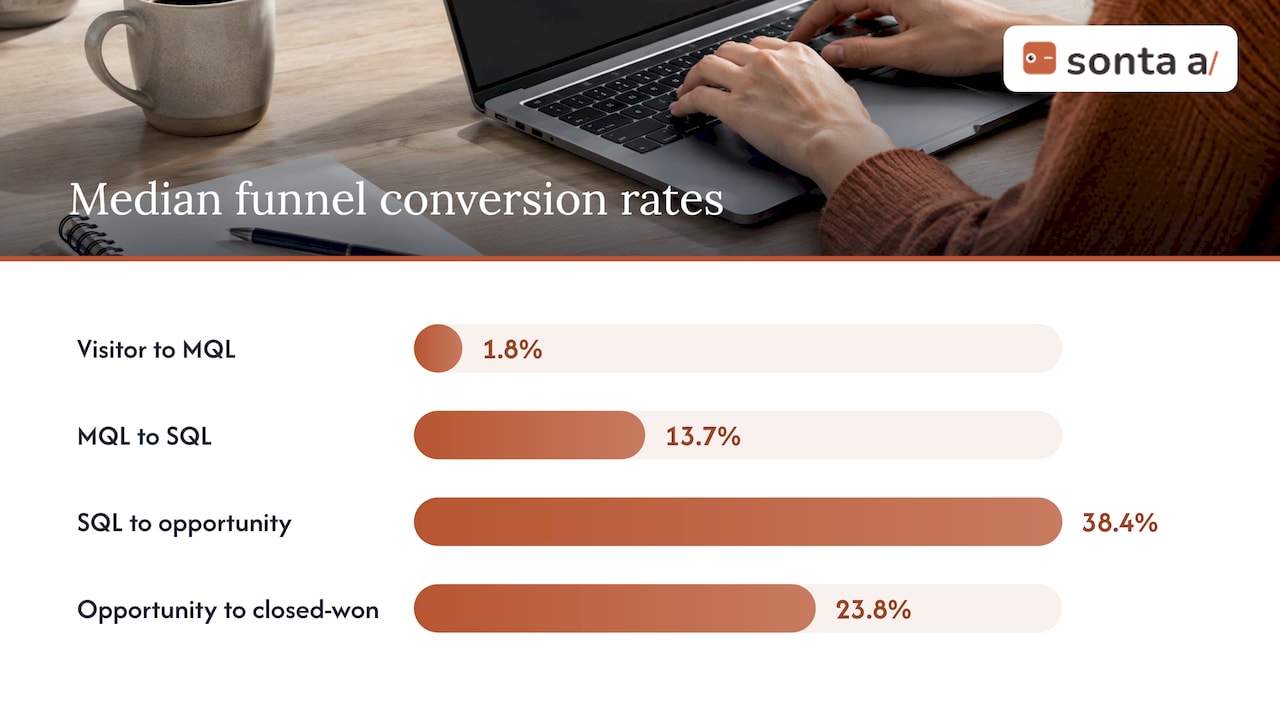
Benchmarks are a rough guide at best. A Visionary Marketing study of 28,400 B2B leads across 47 client accounts (February 2025 to February 2026) reported median conversion of 1.8% from visitor to marketing-qualified lead, 13.7% from there to sales-qualified, 38.4% to opportunity and 23.8% to closed-won. It also reported a median B2B sales cycle of 87 days and that leads matching the ideal client profile closed at 4.7 times the rate of those that did not.
A July 2026 analysis by Neil Patel of 300 companies found that B2B funnels lose 42.7% of sales-qualified leads before they become opportunities and 68.2% of opportunities before they become customers.
Use these to sanity-check your own figures, not to set targets. Your segment, deal size and channel will differ.
Count cohorts, not months
The most common reporting error is mixing deals that started at different times. Dividing this month’s wins by this month’s meetings compares unlike things. SalesHive’s advice is to follow one month’s booked meetings through to their outcomes and to allow for your sales cycle length before judging that cohort. Segment every rate by source, segment, deal size and channel, because a blended rate can hide a strong and a weak segment cancelling each other out.
A simple discipline from Redfox Digital (October 2026) helps. Spend one quarter counting honestly: how many enquiries arrived, how many were worth a call, how many reached a proposal, how many closed and how long each step took. Without those numbers, the default answer to a slow pipeline is more traffic.
Where a small team loses deals
The leaks are rarely at the very top. They tend to be in four places.
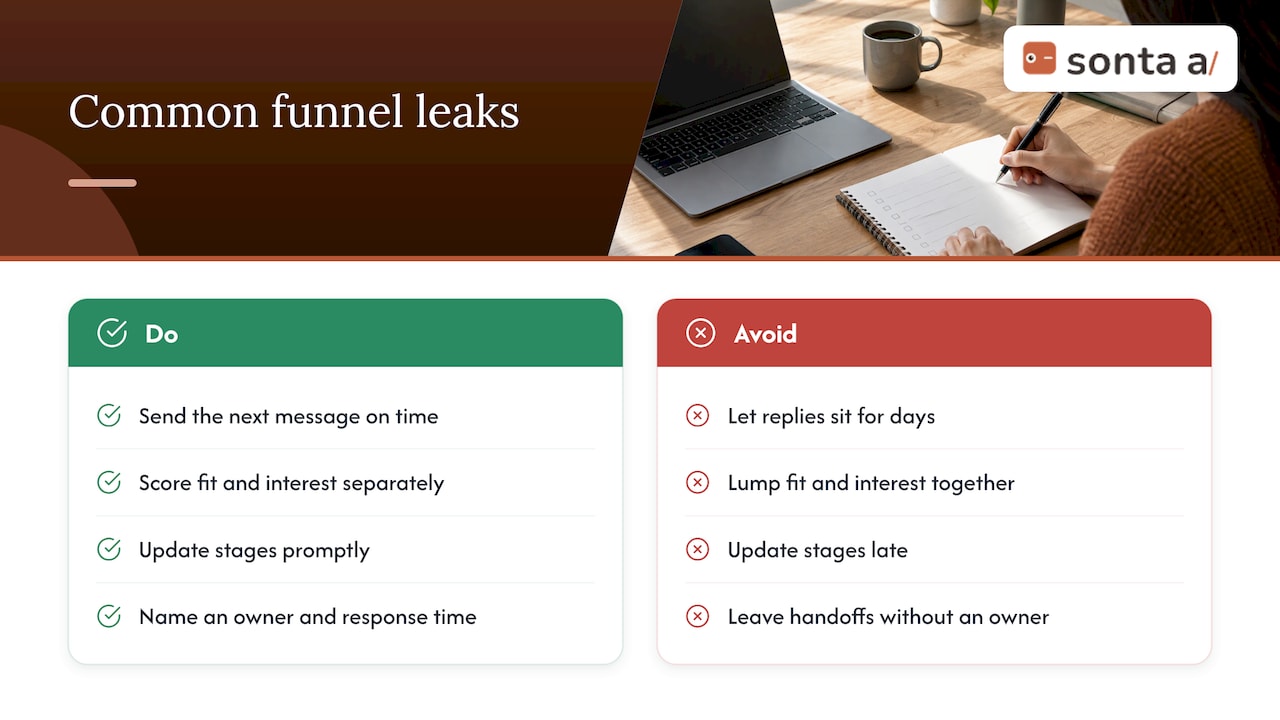
Slow or missing follow-up. A reply that sits for days cools a conversation. Sequences help here, because the next message goes out when it should. Our guide to automated follow-up emails covers the mechanics.
Unscored leads. If fit and interest are lumped together, the founder chases the loudest contact instead of the best-fitting account. Scoring them separately keeps the two questions apart. We explain this in our piece on AI lead scoring.
Stale records. If stages are updated late, every conversion rate is wrong. Reports built on them mislead the people who read them.
Unclear ownership. When nobody owns the move from meeting to proposal, it simply does not happen. Name an owner for every stage and a response time at each handoff.
At the top of the funnel, form design also matters. A 2025 Formstack study of 1,500 B2B decision-makers, reported by Whitehat SEO in March 2026, found forms with more than seven fields had a 67.8% abandonment rate. Some teams add a short quiz at the top of the funnel and build quiz funnels with AI to qualify visitors with fewer fields. If your clients come mainly from conversations rather than forms, put your effort into the middle stages first.
Outreach rules that shape your funnel
Early stages often depend on email and LinkedIn. Both have rules.
UK email. Under PECR, the rule requiring consent for marketing by email does not apply to corporate subscribers, meaning limited companies, LLPs and some public bodies. The ICO explains that sole traders and some partnerships are treated like individuals, so consent applies to them. UK GDPR still applies to how you store and use personal data. Small Business Guide (March 2026) makes the same point about nurture emails.
Europe. Rules differ by country. Business email needs prior consent before first contact in Germany, the Netherlands, Denmark and Poland. In South Africa, POPIA applies to first-contact rules. Check the country of each recipient before you add them to a sequence.
LinkedIn. LinkedIn’s prohibited software and extensions page says it does not permit third-party bots, plug-ins or extensions that scrape or automate activity on the site. Read it before you automate anything. No tool makes LinkedIn automation risk-free, and you should plan your outreach with that in mind.
These are rules for you to apply, not obstacles. A funnel that respects them is one you can keep running.
What each type of tool does well
Buyers consider several routes. Each has real strengths.
- Spreadsheets are free, flexible and fine for the first twenty deals. They break when you need dated stage history and reminders.
- HubSpot is strong where marketing and sales share one system. Forms, email marketing and reporting sit together. Pipedrive is well liked for a clean visual pipeline that sellers actually use.
- Attio offers a flexible data model and a modern interface for teams that want to shape their own records.
- Sequencers and outreach tools such as Instantly and HeyReach do one job well: Instantly sends email at volume and HeyReach manages LinkedIn outreach across accounts. Gojiberry AI focuses on surfacing prospects from signals.
- AI SDR tools such as Artisan and 11x run outbound with an agent. An AI SDR is one agent that stops at the meeting.
- A lead-generation agency takes the work off your plate. You pay for volume, and the conversations are held in someone else’s voice.
- Hiring a salesperson gives you a person who can build relationships. It is also the biggest fixed cost and takes months to pay back.
The common problem is the seams between tools. Signals live in one place, sequences in another, LinkedIn in a third and the CRM in a fourth. Someone copies data across, and stages fall out of date.
Sonta replaces a CRM, an email sequencer, a LinkedIn outreach tool and a signal tool in one app. It has an agent for every step and is the CRM too. On cost, the figure we can source is a median 36% less than the cheapest equivalent stack (Sonta value calculator, list prices read 17-18 Oct 2026). Your own result depends on the tools you use today.
If your team is happy on HubSpot or Pipedrive, nothing here says you must leave. The question is whether the stages before the deal are covered at all.
Perspective
We run our own sales on Sonta. That shapes how we think about funnels.
Most funnel advice treats the stages as a reporting exercise. We think they are a working list. Each record should show what happened, why it matters now and what comes next. That is why every opportunity in Sonta shows its reason with a link you can check, and why fit and intent are scored separately.
The Signal Agent watches public LinkedIn activity for moments such as a recommendation request, a new decision-maker, a company hiring or a contact changing jobs. A hiring post or a job change is a reason to talk. It is not buying intent, and we do not present it as such.
Sequences are native. They are written from the moment a signal fires, so the first message refers to something real. You decide which steps need your approval, and the same rules hold when you use Sonta from Claude or ChatGPT through the MCP server.
For teams that care where their data goes: it is stored in the EU under GDPR and is never used to train AI. You run AI on your own keys from Anthropic, OpenAI, Google or OpenRouter, so there is no markup on AI.
Pavel
Pricing and how to start
Sonta is billed per seat. Plans start at $16 a month per seat for Solo, $28 for Core and $65 for Pro, as listed on the pricing page. Signal packs start from $29 a month, with 5, 15 or 40 always-on searches. A LinkedIn account add-on costs $15 to $20 a month, and LinkedIn accounts are billed per seat. Email sequences are unlimited.
The agentic CRM finds opportunities and moves them forward. You can see how the agents work on the product page. Our guide to lead generation for UK B2B teams covers the earlier stages in more depth.
Book a demo and leave with your first leads.
FAQ
What are the stages of a sales funnel?
The common model runs awareness, interest, decision and action, sometimes with retention added. For B2B services, a more useful set is target, engaged, meeting held, qualified opportunity, proposal and won or lost. Define each by an event that happened, not an activity you carried out.
How many stages should a small team use?
Five or six. B2B Pipeline advises that fewer than four hides real work and more than eight is rarely followed. A team of two to ten people will keep stages updated only if there are few of them.
What is a good sales funnel example for a consultancy?
A typical route runs from a named target account to a reply, a first meeting, a confirmed need, a proposal and a signed engagement. The worked example above shows the arithmetic with illustrative figures. Replace them with your own cohorts as soon as you have two or three months of dated data.
How do I know which stage to fix first?
Calculate stage conversion for one cohort and find the largest realistic gap. Test one fix there. Redfox Digital notes that adding traffic is often the most expensive fix for a problem sitting further down.
Is a sales funnel the same as a sales pipeline?
No. The funnel covers everyone from first contact, while the pipeline covers deals your team has agreed are real. They overlap in the middle, and good stage definitions make the handoff clear.
Sources
- What is a sales funnel? Stages and how to build it, Xero UK
- Learn about the sales funnel, Adobe
- What is a Sales Funnel? IBM
- Sales Funnel vs Sales Pipeline, Unsnag
- B2B Sales Funnel: Stages, Metrics and Conversion Rates, SalesHive
- Set up a B2B demand generation operating workflow, B2B Pipeline
- Sales Pipeline Stages: 12 Examples, SME Software Help
- How to Use CRM Software Effectively as a Small Team, Lilach Bullock
- Demand Gen Funnel Benchmarks 2026, Visionary Marketing
- Where B2B and B2C Funnels Lose the Most Conversions, Neil Patel
- Sales funnel optimisation: where the sale gets lost, Redfox Digital
- B2B Convert-Stage Forms, Whitehat SEO
- Quiz funnels with AI, Will Buckley
- Business-to-business marketing, ICO
- Sales Funnels Explained, Small Business Guide
- Prohibited software and extensions, LinkedIn Help