Sales Rep Productivity: How to Measure and Raise It

Sales rep productivity is the amount of pipeline and closed business a rep produces for the hours they work. You raise it by giving reps more time with the right people, at the right moment, and by cutting the busywork between conversations. Sonta AI is an agentic CRM that finds opportunities and moves them forward. It puts the CRM, email sequences, LinkedIn outreach and signals in one app, so reps stop switching tools and start talking to clients.
This guide is for sales leaders with a team on HubSpot or Pipedrive. It is also for owner-led agencies, consultancies, IT services and software firms where the founder sells. You get the measures, the diagnosis, the fixes and a fair view of the options.
TL;DR
- Productivity is output per rep per period. Measure it through pipeline value, stage conversion and time to close, not through activity counts alone.
- Most lost time sits between conversations: research, logging, follow-ups and tool switching. Map it before you buy anything.
- Warwick Business School points to a mapped sales process, stage metrics and regular pipeline reviews as the base for UK SMEs.
- A signal-led approach gives reps a reason to talk. A job change or a hiring post is a reason to talk, never proof of buying intent.
- Sonta replaces a CRM, an email sequencer, a LinkedIn outreach tool and a signal tool. Book a demo and leave with your first leads.
Table of Contents
- What sales rep productivity means
- The four numbers that explain most of it
- Where selling time actually goes
- Five ways to raise productivity without another hire
- How an agentic CRM changes the daily work
- Rules you need to respect
- Comparing your options fairly
- What to measure after you change anything
- See it on your own pipeline
- FAQ
- Sources
What sales rep productivity means
Productivity is a ratio. The top line is output, such as pipeline created, deals won or revenue booked. The bottom line is input, such as hours worked, cost of the rep or number of accounts held.
That gives you three useful versions:
- Revenue per rep. Closed revenue in a period divided by the number of reps. Simple, but it hides why a number moved.
- Pipeline per selling hour. New qualified opportunity value divided by hours spent on selling activity. This shows whether time is being used well.
- Cost of sales per won deal. Total sales cost divided by deals won. This is the one a founder or finance director will ask for.
Quota attainment is the number most teams watch. It lags. By the time it drops, the cause is weeks or months old. The measures below move sooner.
The four numbers that explain most of it
Warwick Business School recommends tracking opportunity numbers and value at each stage, stage-to-stage conversion and how quickly opportunities move through the pipeline. That gives you four numbers per rep.
- Pipeline value by stage. How much is in discovery, proposal and negotiation right now.
- Stage conversion. The share that moves from one stage to the next.
- Time to close. How long an opportunity takes from first conversation to decision.
- Selling time. The share of the week spent in conversations, preparing for them or following up.
The Warwick worked example uses £30,000 in discovery, £40,000 in proposing and £30,000 in negotiating. Stage conversions are 60%, 50% and 90% respectively. The point is that a manager can work backwards from a target to the pipeline volume needed at the top. If the volume is not there, no amount of coaching in the late stages will fix it.
A simple illustration
This example is illustrative only. It is not a benchmark.
Take a rep who needs to close four deals a quarter. If one in five proposals converts, that rep needs twenty proposals. If one in three discovery calls becomes a proposal, that is sixty discovery calls. Now ask how many of those calls the rep can realistically book in a quarter alongside delivery, admin and follow-ups.
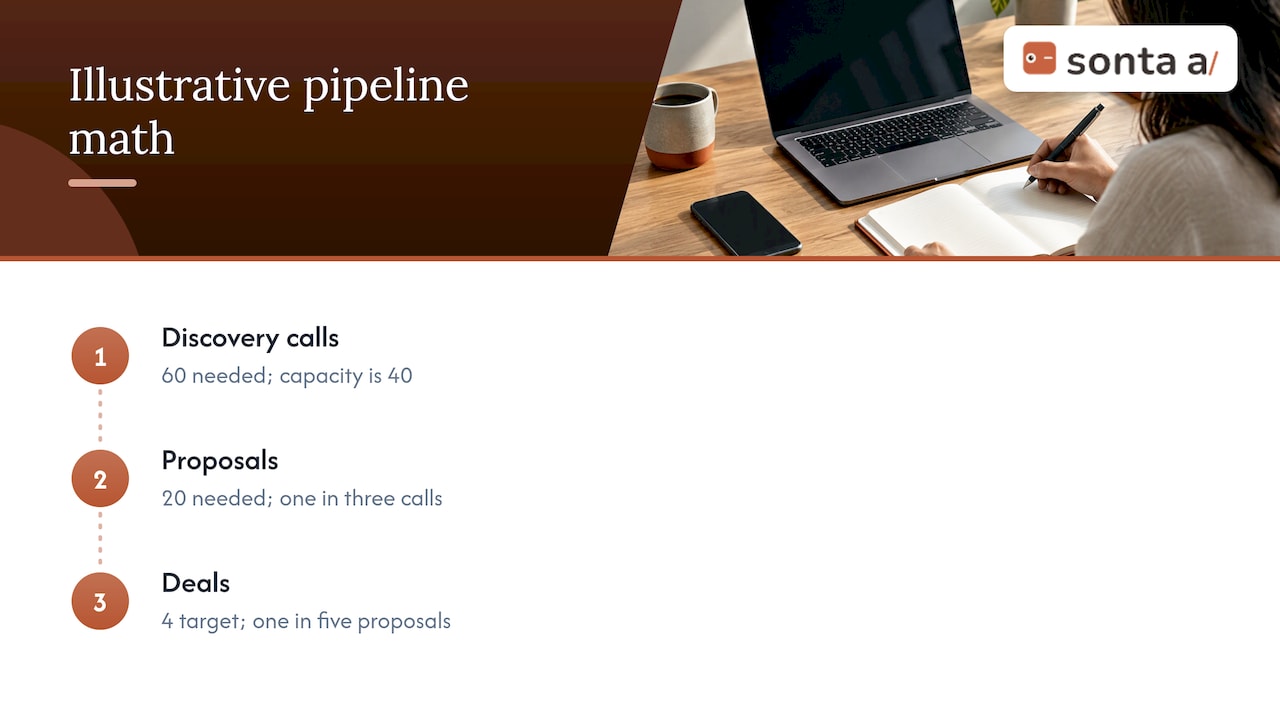
If the answer is forty, you have a pipeline problem and not a closing problem. You can improve that by raising the number of well-timed conversations, or by improving conversion at an early stage. Both are productivity gains, and they need different fixes.
Where selling time actually goes
The fastest way to find lost time is to map the process step by step. Write down every action from first signal to signed deal. Then mark who does it and which tool it lives in.
In most teams the same leaks appear:
- Research. Reps check LinkedIn, company sites and news before every outreach.
- Logging. Notes, stage changes and contact updates are typed into the CRM after the fact.
- Follow-ups. They depend on memory or on a spreadsheet reminder.
- Tool switching. One tool for the CRM, one for email sequences, one for LinkedIn and one for triggers.
- Meeting prep. Pulling together history before every call.
Warwick’s guidance is direct on what to do next. If time in the pipeline is long, revisit the sales process or opportunity qualification. The same source says regular, action-focused pipeline meetings are an important routine for UK start-ups and SMEs.
The 2024 Warwick Sales Excellence Hub State of Sales Study surveyed 125 sales professionals and involved about 70 sales leaders from UK sales organisations. It is a useful read on the UK picture if you want context for your own review.
Five ways to raise productivity without another hire
1. Map the process and name the weak stage
Start with the stage where conversion or speed is worst. Fix one stage at a time. If you change everything at once, you cannot tell what worked.
2. Run a short pipeline review every week
Keep it to actions. Which deals move this week, who does what and by when. Skip status reading. The CRM can show status.
3. Start conversations with a reason
McKinsey’s analysis of 40,000 deals found that in Europe, high performers made 16% more cold calls and sent 18% fewer unsolicited emails than low performers. The dataset is from 2020, so treat it as direction and not as a target. The lesson is that volume without relevance does not carry a rep far.
A timely reason is better than a generic opener. Useful public moments include:
- someone asking for a recommendation on LinkedIn
- a new decision-maker in a target account
- a company hiring for a role you can support
- a past contact changing jobs
Each of these is a reason to talk. None of them is buying intent. A good message says why you are writing now and makes no claim about what the person wants. For more on writing messages that stay relevant, see our guide to AI sales personalisation.
4. Cut the busywork between conversations
Research, logging and follow-up are the tasks most open to automation. The University of Reading study, a 2025 peer-reviewed paper based on interviews with 27 CEOs and sales directors from medium-sized firms in the UK, Finland, Germany and Denmark, identifies customer engagement, collaboration, information transparency and reduced sales time as non-financial benefits of sales-enablement platforms. The authors say the findings are qualitative and not meant to be generalised. Use them as a prompt for your own test, not as a forecast.
5. Reduce the number of tools
Every extra tool adds a login, a sync and a place where data goes stale. PwC Strategy& UK frames sales effectiveness around five pillars: people, structure, process, technology and strategy. It places CRM, enablement, dashboards and AI readiness within technology. Fewer tools with cleaner data serve both the process and technology pillars. Our sales tech stack guide walks through how to audit what you run today.
How an agentic CRM changes the daily work
An agentic CRM does not wait for reps to feed it. It finds opportunities and moves them forward. In Sonta, that means four tools in one app.
- Signals. The Signal Agent watches public LinkedIn activity such as a recommendation request, a new decision-maker, a company hiring or a contact changing jobs. It shows each reason with a link, so the rep can check it in seconds.
- Sequences. Email and LinkedIn sequences are native. They are written from the moment a signal fires. Email sequences are unlimited.
- Replies and meetings. Reply handling and meeting booking sit in the same place as the sequence.
- A CRM that keeps itself up to date. Agents research prospects, follow up, prepare meeting briefs and keep records current.
Fit and intent are scored separately. A company can match your ideal client and show no reason to talk. Another can show a clear reason and be a poor fit. Seeing both scores stops reps wasting time on either.
The customer decides which steps need their approval. You can let agents draft and wait for a yes, or let routine follow-ups run. That choice is yours, per step. We run our own sales on Sonta.
To read more about what an agent does in a sales process, see what an AI agent in sales is.
Your models, your keys, your data
Customers choose the AI model for each task. They run it on their own keys from Anthropic, OpenAI, Google or OpenRouter. There is no markup on AI when you use your own keys, and agent runs are never metered.
You can also use Sonta from Claude or ChatGPT through its MCP server. The same rules and approvals apply there.
Customer data is stored in the EU under GDPR. It is never used to train AI. For UK and European firms with client confidentiality duties, that is often the first question procurement asks.
Rules you need to respect
Productivity gains that create legal or account risk are not gains. Three points matter for outreach.
- LinkedIn’s rules. LinkedIn sets its own rules on automation and on how accounts may be used. Read them before you build any LinkedIn sequence. No tool can make automation safe or undetectable, and Sonta does not claim to.
- Prior consent for business email. In Germany, the Netherlands, Denmark and Poland, business email needs prior consent before first contact. If you sell into those countries, set your sequences accordingly.
- South Africa. POPIA, the Protection of Personal Information Act, applies to first-contact rules there.
This is general information and not legal advice. For a specific campaign, ask your solicitor or data protection adviser.
Comparing your options fairly
Most buyers weigh several routes before they choose. Each has real strengths.
| Option | Where it is strong | Where Sonta differs |
|---|---|---|
| HubSpot | A broad platform with a large ecosystem and familiar reporting | Sonta adds signals, native sequences and agents in the same app |
| Pipedrive | A clear visual pipeline that reps pick up fast | Sonta adds signals, sequences and a CRM that updates itself |
| Attio | A flexible, modern data model | Sonta adds an agent for each step and native outreach |
| Gojiberry AI | Focused on finding people to contact | Sonta also holds the CRM and runs the follow-up |
| HeyReach | Built for LinkedIn outreach at scale | Sonta covers email, LinkedIn, signals and the CRM together |
| Instantly | Strong for high-volume email sending | Sonta writes sequences from the signal and keeps the records |
| AI SDR tools such as Artisan and 11x | Hand a defined outbound task to one agent | An AI SDR is one agent that stops at the meeting. Sonta has an agent for every step and is the CRM too |
| Spreadsheets | Free to start and fully flexible | Sonta replaces manual upkeep and reminders |
| A lead-generation agency | Brings people and process you do not have in-house | Sonta keeps the work and the data inside your own CRM |
| Hiring a salesperson | A person can handle nuance and relationships | Sonta takes research and admin off whoever sells, including a founder |
If your team is on HubSpot or Pipedrive today, the decision is not a verdict on what you have. It is a question of whether four separate tools can be one.
What it costs
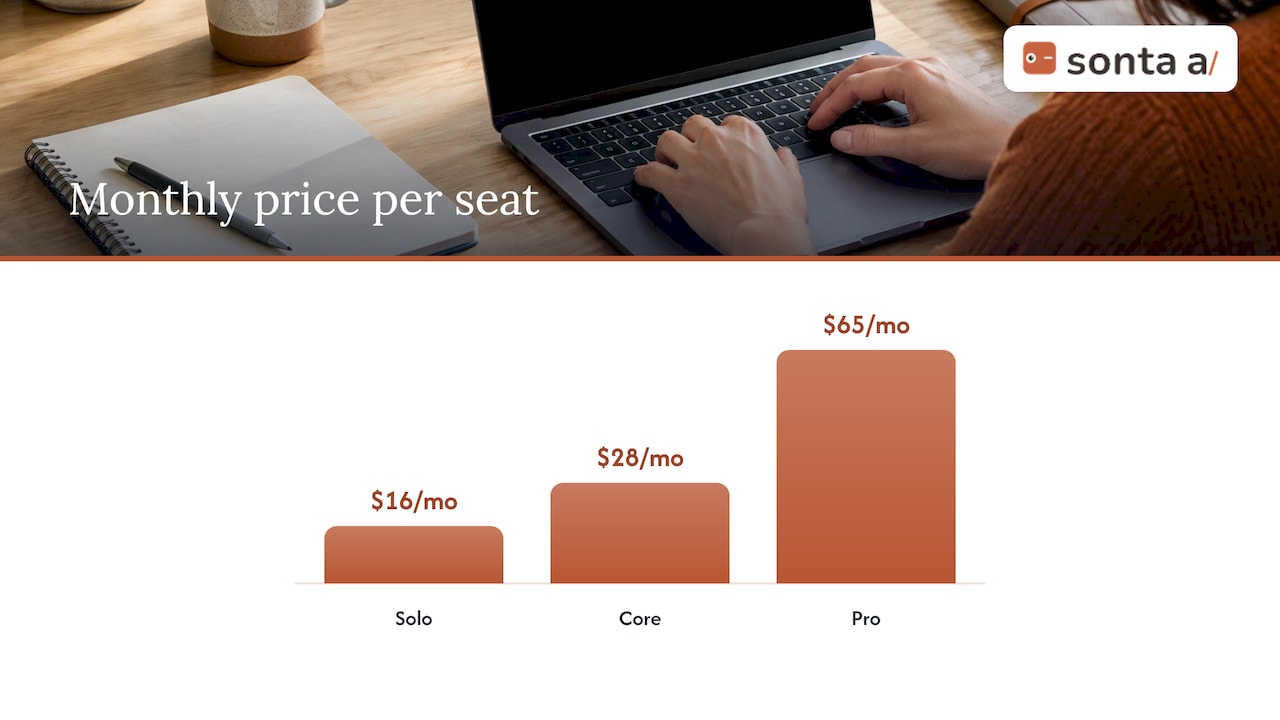
Sonta’s plans are priced per seat. Per Sonta’s pricing page, read on 6 November 2026, Solo starts from $16 a month per seat, Core from $28 and Pro from $65. Signal packs start from $29 a month for five always-on searches. The 15-search pack is $79 a month and the 40-search pack is $119 a month. LinkedIn accounts are billed per seat, with the add-on at $15 to $20 a month.
Sonta replaces a CRM, an email sequencer, a LinkedIn outreach tool and a signal tool. On the spend question, Sonta’s value calculator shows a median 36% less than the lowest-cost equivalent stack (Sonta value calculator, list prices read 17 to 18 October 2026). Your own figure depends on the tools you run now.
What to measure after you change anything
Set a baseline before the first change. Then check the same numbers each month.
- Pipeline value created per rep
- Conversion from first conversation to proposal
- Days from first conversation to decision
- Hours a week spent on research, logging and follow-up
- Share of follow-ups sent within your target window
PwC Strategy& reports a commercial-model case with an estimated 15% uplift in bookings potential. That is one case and not a promise. No tool can guarantee meetings, customers or revenue. What you can do is measure honestly and keep what moves your numbers.
Sonta’s reports and dashboards show these numbers from the CRM without a separate spreadsheet.
Our view on rep productivity
Most productivity advice tells reps to work harder at the same tasks. We think the better question is which tasks a rep should not be doing at all.
A rep who researches a prospect, writes the first message, logs the call and chases the follow-up is spending most of the week on work around the conversation. That is why we built one app that finds the reason to talk, writes the sequence from it, handles replies and keeps the record current.
We also think the buyer should stay in control. You choose the AI model for each task. You run it on your own keys. You decide which steps need your approval. The same rules hold when you work from Claude or ChatGPT through MCP.
We run our own sales on Sonta. We would rather show you that in a demo than describe it here.
Pavel
See it on your own pipeline
If your team sells from HubSpot or Pipedrive, or the founder still carries new business, a demo with Sonta shows the signal engine, the sequences and the CRM working together. You can see your own reasons to talk, each with a link to check it, and decide which steps need your approval. Plans are on the pricing page and the product is described on the Sonta home page.
Book a demo and leave with your first leads.
FAQ
How do you calculate sales rep productivity?
Divide the output you care about by the input it took. Common pairs are revenue per rep, pipeline created per selling hour and sales cost per won deal. Pick one pair, set a baseline and track it monthly, alongside stage conversion and time to close.
What are the key metrics for a sales team?
Start with pipeline value by stage, stage-to-stage conversion, time to close and selling time. Warwick Business School names pipeline value, conversion and time to close as the core view. Quota attainment is worth keeping, but it reports results after the fact.
How can a small team improve sales productivity without hiring?
Map your process, find the weakest stage and hold a weekly action-focused pipeline review. Then remove the busywork around conversations, such as research, logging and follow-up. Sonta’s agents take on those tasks, and you decide which steps need your approval.
Does a signal like a job change mean someone wants to buy?
No. A job change or a hiring post is a reason to talk, nothing more. Use it to open a relevant conversation and let the person tell you whether there is a need.
Is it legal to send automated outreach in Europe?
It depends on the country and the channel. Business email needs prior consent before first contact in Germany, the Netherlands, Denmark and Poland, and LinkedIn has its own rules on automation. For a specific campaign, check with your solicitor or data protection adviser.
Sources
- Why turning sales into a process can boost UK SME performance, Warwick Business School (2024)
- Sales digitization and sales process optimisation, University of Reading (2025)
- Sales Effectiveness: The overlooked growth engine, PwC Strategy& UK (2025)
- How data analytics helps sales reps win more deals, McKinsey (2020)
- State of Sales Study 2024, Warwick Sales Excellence Hub