Founder-Led Sales: How to Win New Clients Before You Hire
Founder-led sales means the founder finds, talks to and closes the first clients personally. It works because you carry the credibility and product knowledge that no hire has yet. It stops working when the business needs more selling hours than you have. The fix is not to leave sales. It is to take the busywork out of your week, so your hours go to conversations and the process gets written down while you sell. That is the job Sonta does as an agentic CRM that finds opportunities and moves them forward.
TL;DR
- Founder-led sales is a real sales motion, not a failure state. Its job is to teach you who buys, why and what makes them say yes.
- Start with a short list of named buyers and personal outreach. Work it for a month before you change the plan.
- Record every deal in one CRM with a next action and a date. Write down why you won and lost as you go.
- Hand over only when the process is documented and at least one lead source does not depend on your network.
- Sonta replaces a CRM, an email sequencer, a LinkedIn outreach tool and a signal tool in one app. You decide which steps need your approval.
Table of Contents
- What founder-led sales is, and why it works early
- Where founder-led sales breaks
- How to find your first clients yourself
- Outreach rules you need to know first
- Write the sequence from the moment
- What to record in your CRM
- Document the routine while you sell
- How the main options compare
- What this costs
- Control of data and AI models
- When to hand over
- Our view
- Start with your own pipeline
- FAQ
- Sources
What founder-led sales is, and why it works early
In a UK guide published on 17 August 2026, TrinityHawk describes it as the stage where the founder runs and closes most sales. They rely on their own credibility, product knowledge and network, not on a documented process or a sales team.
There are three practical reasons it works. Mistral Venture Partners’ playbook names them:
- Only the founder can change the product on the call.
- Early buyers are buying the founder’s judgement and commitment.
- The founder has to learn the motion (script, target, price, objections, answers) before teaching it to anyone.
For an owner-led agency, consultancy, IT services firm or software company, the same logic holds. Clients hire you because they trust you. A salesperson starts without that trust.
Where founder-led sales breaks
It breaks on time, not on skill. Client work fills the week, and new business gets done in the gaps. Follow-ups slip. Pipeline goes quiet two months after a busy stretch. Then the founder is told to hire.
Hiring early is a risk of its own. Growth Broker’s guide to UK founder-led sales mistakes (July 2026) calls hiring a VP of Sales just to escape selling a foundational error. Dominic Monkhouse of Monkhouse & Company puts it bluntly: founder-hero mode does not scale. His point is that founders keep winging it after the first ten deals, then wonder why the pipeline flatlines.
So the goal in the middle period is simple. Keep selling, cut the admin, and turn what you do by instinct into a routine.
How to find your first clients yourself
The method is plain and it is mostly about discipline.
- Pick one buyer. Name the sector, company size and the trigger that makes them need you.
- List 30 real people or companies. Wedgeup’s 30-day plan (4 November 2026) suggests contacting around 10 a day, then holding problem-focused calls.
- Start warm. Stripe’s guide to your first 10 customers says you will close more from warm introductions than from the same number of cold pitches.
- Work the list for 30 days. Change the offer only after you have heard the same objection several times.
The weak point is timing. A cold message lands when the buyer has no reason to reply. A message sent when something has just happened gets a different response.
Reasons to talk, not buying intent
Some public moments make a conversation timely:
- Someone asks for a recommendation on LinkedIn.
- A new decision-maker joins a target company.
- A company starts hiring.
- A past contact changes jobs.
These are reasons to talk. They are not proof that someone wants to buy. Treat them that way and write the first message around the moment, not around your pitch.
Our Signal Agent watches public LinkedIn activity for exactly these moments. It shows each reason with a link, so you can check what happened before you write a word. Fit and intent are scored separately, so a good-fit company with no timely reason does not look the same as a poor-fit company with a loud post.
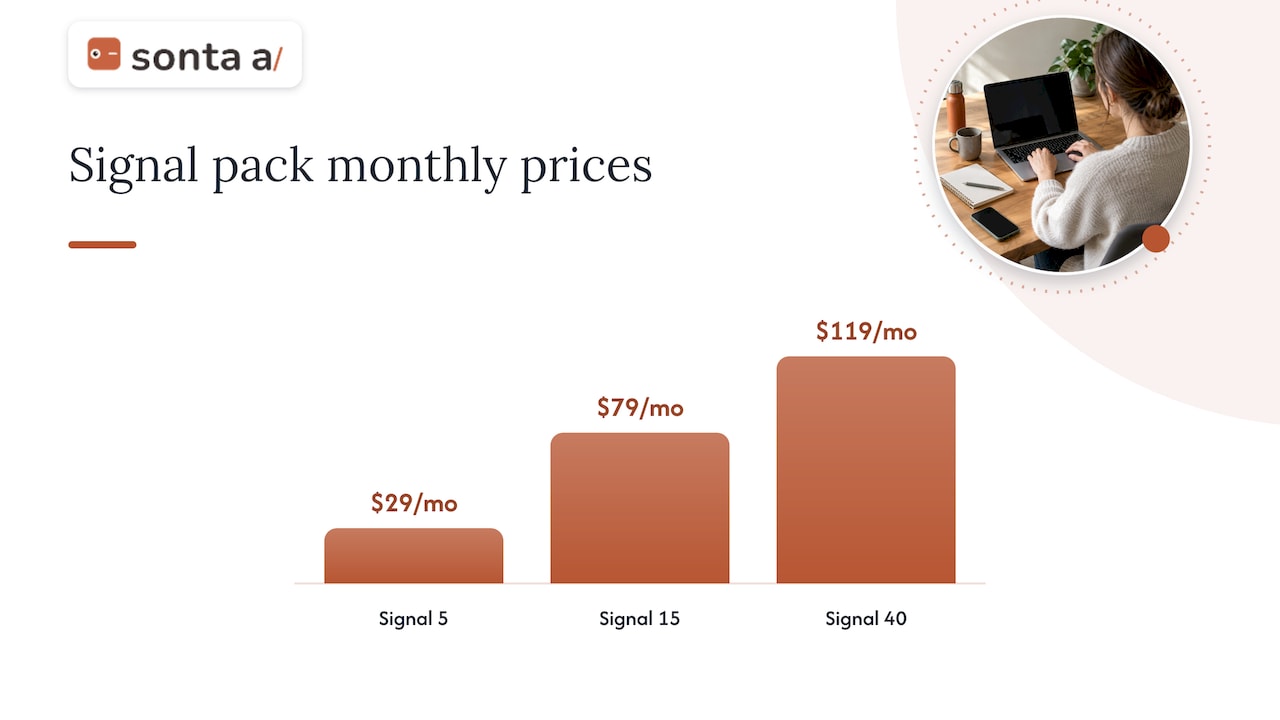
Signal packs start from $29 a month. The Signal 5 pack covers five always-on searches at $29 a month. The Signal 15 pack is $79 a month and the Signal 40 pack is $119 a month.
Outreach rules you need to know first
Automation touches rules, and they differ by country.
- LinkedIn. LinkedIn has its own rules on automated activity. Read its User Agreement before you connect any outreach tool to your account. No tool makes LinkedIn automation safe or undetectable, and we do not claim it.
- Business email in Europe. In Germany, the Netherlands, Denmark and Poland, business email needs prior consent before first contact. A sequence that works in the UK may not be lawful there.
- South Africa. POPIA applies to first-contact rules.
- The UK. UK GDPR and PECR apply to your own outreach. Check the ICO’s guidance for your situation.
This is why we let you decide which steps need your approval. A sequence can be written and queued, and you choose what goes out.
Write the sequence from the moment
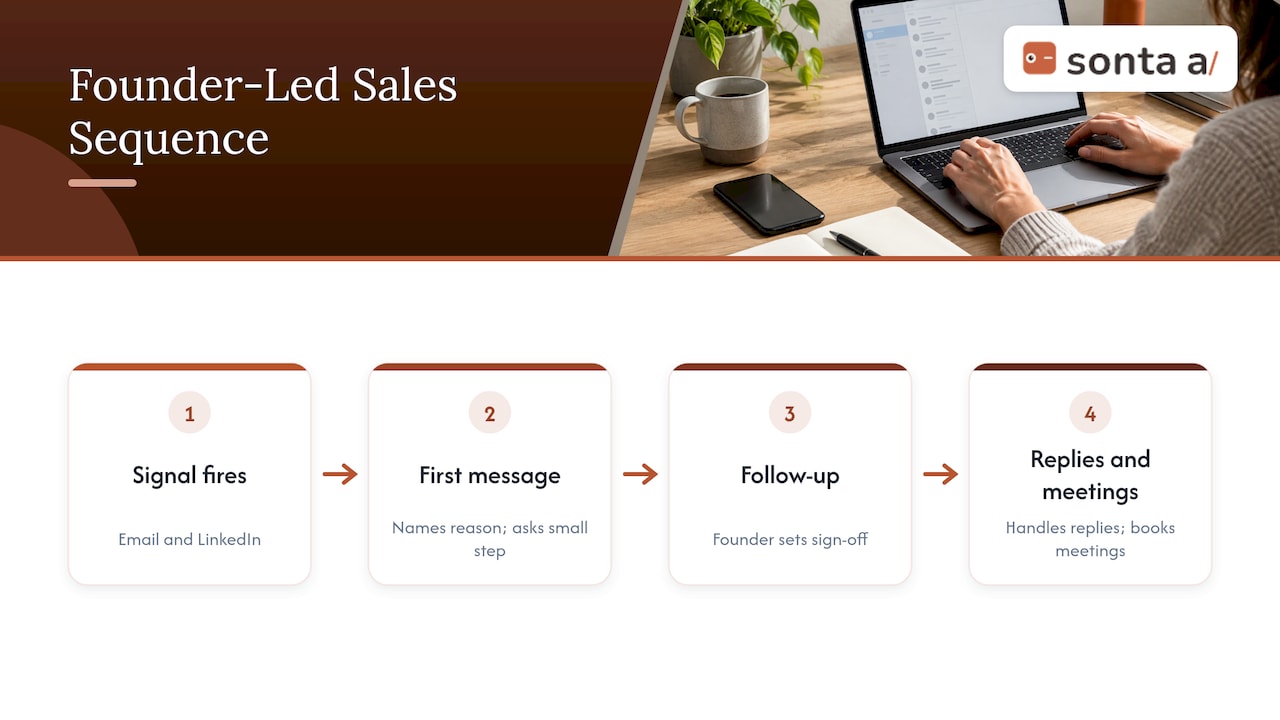
A good first message names the reason you are writing. It is short and it asks for one small step. Our sequences are native to Sonta and are written from the moment a signal fires, in email and on LinkedIn. Email sequences are unlimited. LinkedIn accounts are billed per seat.
If you want to go deeper on message craft, see our guide to personalised AI outreach. For follow-ups after the first reply, see automated follow-up emails.
Follow-ups are where founders lose the most deals. They are also the easiest step to hand to an agent. Replies get handled and meetings get booked. You still decide how much runs without your sign-off.
What to record in your CRM
Most founders on HubSpot or Pipedrive already have a CRM. The question is whether it tells the truth. Closing Foundry’s founder-led sales playbook (26 June 2026) says that at the £1m to £3m stage you need a process and a CRM that tells the truth. It adds that moving between stages should need evidence, not a feeling.
A simple record for each deal covers:
- Company and main contact
- Deal value and expected close date
- Current stage
- Next action and its date
- Where the deal came from
- The reason you won or lost
Sell Successfully’s early-stage CRM setup guide (10 February 2026) suggests the same kind of fields and five stages with entry and exit criteria. The hard part is not choosing fields. It is filling them in after a long client day.
This is where a CRM that keeps itself up to date matters. In Sonta, agents research prospects, follow up, prepare meeting briefs and keep records current. You see a pipeline that reflects what happened. The pipeline stage report shows where deals sit. If you want to map your own stages first, start with 20 wins and 20 losses.
Document the routine while you sell
Mercia Ventures says a repeatable sales process needs clear stages, qualification criteria, standard actions at each stage, and measured conversion and time to close (13 April 2026).
Monkhouse & Company adds a harder test. A founder who cannot document the process, even in bullet points, is not ready to hire.
A practical way to start:
- After each call, write two lines: what they said the problem was, and why they did or did not move on.
- Keep the questions that opened the best conversations.
- Note the objections and the answers that worked.
- Save the pricing you actually quoted.
Twenty entries like that become a playbook. Our guide on automating a sales playbook shows which parts of it can run on their own.
Workflow tooling outside sales follows the same logic. A short pilot on one repeated task shows what is worth automating, as in this B2B workflow automation pilot. Sales is no different. Pick one repeated task and fix it first.
How the main options compare
Buyers in your position usually weigh the same alternatives. Each has a real strength.
| Option | Where it is strong | Where Sonta fits |
|---|---|---|
| HubSpot or Pipedrive | Familiar pipelines, wide adoption, large app ecosystems | Sonta is an agentic CRM that finds opportunities and moves them forward. It brings signals, sequences and records into one app. |
| Attio | A flexible, modern CRM data model | Adds signals, native sequences and agents in the same app |
| Gojiberry AI | Finding LinkedIn-based prospects | Signals, sequences and the CRM live together, with each reason linked |
| HeyReach | LinkedIn outreach across accounts | One app covers LinkedIn, email and records |
| Instantly | Email sequencing at volume | Email sequences are unlimited and written from the signal moment |
| AI SDR tools such as Artisan and 11x | A single agent that works outbound | An AI SDR is one agent that stops at the meeting. Sonta has an agent for every step and is the CRM too. |
| Spreadsheets | Free, flexible, no setup | Records update themselves and follow-ups are tracked |
| A lead-generation agency | Outside capacity and experience | You keep the data, the conversation history and the records |
| Hiring a salesperson | Dedicated selling hours | Sonta takes the busywork off the founder first, so a hire starts with a clean record |
If your team is on HubSpot or Pipedrive today, that is a sound base. The question is whether you want to run a separate sequencer, outreach tool and signal tool beside it.
What this costs
Published plans are priced per seat per month. Solo is from $16, Core from $28 and Pro from $65. The LinkedIn account add-on is $15 to $20 a month. Current terms are on the pricing page.
On the total, our value calculator found a median 36% less than an equivalent stack of separate tools (Sonta value calculator, list prices read 17 to 18 October 2026). It compares list prices, so your own figure depends on the tools you run today.
AI runs on your own keys from Anthropic, OpenAI, Google or OpenRouter. With your own keys there is no markup on AI, and agent runs are never metered.
Control of data and AI models
Founders who sell to other businesses often care where client data sits. Customer data is stored and processed in the EU under GDPR. It is never used to train AI.
You choose the AI model for each task. You can also use Sonta from Claude or ChatGPT through its MCP server, under the same rules and approvals. See working with Sonta programmatically for how that works.
When to hand over
Hand over when the routine is written down, not when you are tired of selling. TrinityHawk lists four things to have before a first sales hire:
- A written ideal customer profile
- Reasons for your last twenty wins and losses
- Stage definitions with exit criteria
- At least one repeatable lead source that is not your personal network
TRG’s handover playbook (25 March 2025) says the handover usually runs over two to three quarters. The founder’s role changes from closer to coach. The pack includes the ideal customer profile, discovery guide, qualification standard, demo script, objection handling, pricing rules and a library of five won and five lost deals.
If you built your records in one system, that pack mostly exists already. The new hire inherits the history, the reasons and the next steps, not a spreadsheet.
Our view
Founder-led sales is not the problem to fix. The weekly admin around it is.
Most owners we speak to do not lack contacts. They lack the hours to notice the right moment, write the right message and follow up three times. That work is repeatable, so it belongs to agents. The conversation does not.
So we built one app instead of four. It watches for a reason to talk, writes from that reason, handles replies and books meetings. It keeps the record. You decide which steps need your approval.
We run our own sales on Sonta.
Pavel
Start with your own pipeline
Sonta is an agentic CRM that finds opportunities and moves them forward. It combines a Signal Agent, native sequences, reply handling and meeting booking, and a CRM that keeps itself up to date. The plans and add-ons are on the pricing page, and the overview is at sonta.ai. Our aim is to have you running in under an hour.
FAQ
What is founder-led sales?
It is the stage where the founder personally finds, pitches and closes clients. The founder learns who buys and why, then turns that into a process others can follow. It is a normal stage of growth, not a weakness.
Do I need a CRM for founder-led sales?
Yes, once you have more deals than you can remember. Record each deal’s stage, next action and date, and the reason you won or lost. Sonta keeps those records up to date for you, and works for teams moving from HubSpot or Pipedrive.
When should I hire my first salesperson?
When you can write down your ideal customer, your stages and the reasons behind your last twenty wins and losses. You also need a lead source that is not your own network. Until then a hire has little to follow.
Can I use AI without losing control?
Yes. In Sonta the customer decides which steps need approval. You run AI on your own keys, and the MCP server follows the same rules and approvals when you use Sonta from Claude or ChatGPT.
Sources
- TrinityHawk: From founder led sales to scalable revenue
- Mistral Venture Partners: Founder-led sales
- Growth Broker: The 12 most common founder-led sales mistakes
- Monkhouse & Company: Founder-Led Sales, the 6-Stage Guide
- Wedgeup: How to Get Your First Sale for a Startup
- Stripe: Your first 10 customers
- Closing Foundry: The founder-led sales playbook
- Sell Successfully: CRM Setup for Early-Stage SaaS
- Mercia Ventures: How do I build a repeatable sales process?
- TRG: Founder-led sales to first sales team
- Ampwise: B2B workflow automation pilot