Inbound Lead Management: How to Reply, Qualify and Follow Up
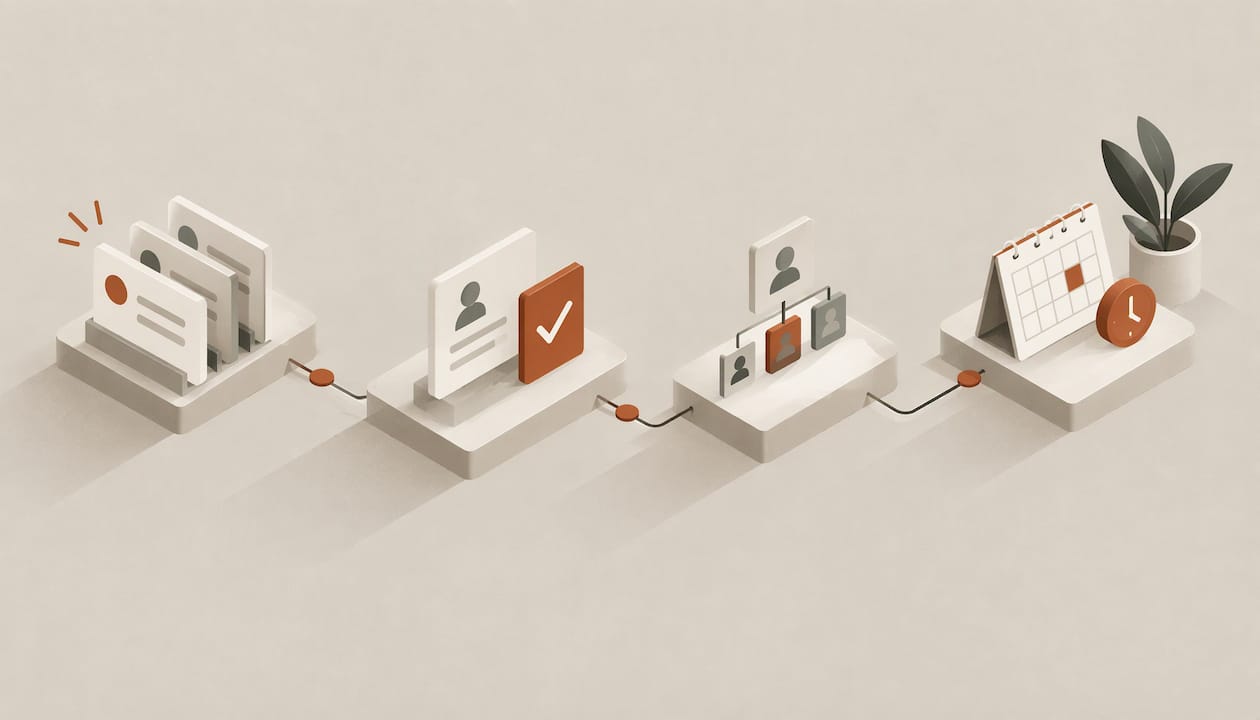
Inbound lead management is the routine that decides what happens in the minutes and days after someone asks to talk to you. Done well, every enquiry gets an owner, a fast first reply and a logged next step. Sonta AI is an agentic CRM that finds opportunities and moves them forward, so the same app that holds the enquiry can also chase it. This guide gives the process, the numbers worth tracking and the rules that apply in the UK and Europe.
It is written for sales leaders with a team on HubSpot or Pipedrive, and for founders at agencies, consultancies, IT services and software firms who still answer the contact form themselves.
- ✓Reply handling and meeting booking
- ✓AI agents follow up
- ✓CRM keeps records current
TL;DR
- Treat every enquiry as a process with seven steps: capture, acknowledge, qualify, route, book, record and follow up.
- Speed and ownership matter most. A 2026 study of 28,400 B2B leads found 11.4% end-to-end conversion for a first touch under five minutes and 0.6% after 24 hours.
- Ask three to five qualification questions, write down what a good fit looks like and score fit separately from interest.
- B2B email in the UK does not need PECR consent for corporate subscribers, but you must identify yourself and offer an opt-out. Some European countries differ.
- Keep AI drafting and scoring under your control. You decide which steps need approval.
Table of Contents
- What inbound lead management covers
- Step 1: Capture every enquiry in one place
- Step 2: Acknowledge fast and say what happens next
- Step 3: Qualify with the same questions every time
- Step 4: Route to one owner with context
- Step 5: Book the next step, not just a reply
- Step 6: Record it once and keep it current
- Step 7: Follow up on a fixed cadence
- The rules for email, LinkedIn and AI
- What to measure
- Beyond the enquiry: finding the next conversation
- How the options compare
- Perspective
- Sonta for inbound and outbound in one app
- FAQ
- Sources
What inbound lead management covers
An inbound lead is a person or company that has reached out to you. They filled in a form, replied to a post, emailed the info address or rang the office. Managing that lead starts at the moment of contact and ends when you have a won deal, a lost reason or a deliberate decision to nurture.
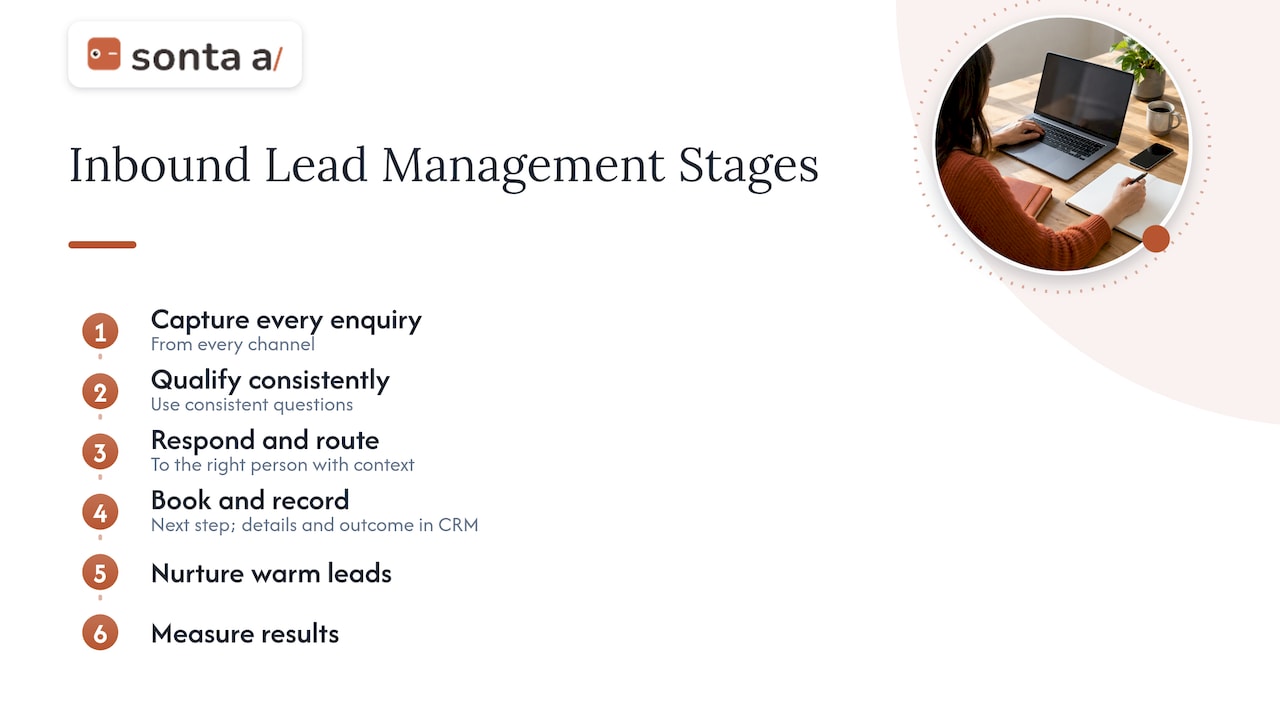
Moneypenny’s UK guide describes lead management as seven stages: capture every enquiry from every channel, qualify with consistent questions, respond and route to the right person with context, book the next step, record details and outcome in the CRM, nurture warm leads and measure the results. Its argument is that the first three stages are where most leads are lost, because they depend on speed and consistency straight after contact.
That matches how small teams actually leak deals. The enquiry arrives on a Friday afternoon. Nobody is sure who owns it. The reply goes out on Tuesday. By then the buyer has spoken to two other firms.
Step 1: Capture every enquiry in one place
Enquiries arrive by web form, email, LinkedIn message, phone and referral. If each one lands in a different inbox, you cannot reply fast and you cannot measure anything.
The aim is to capture the details once and have them flow into the CRM without re-typing. Moneypenny’s guide names smart forms, workflow tools and custom integrations as the usual routes, and warns that re-typed or missed details cause duplicate records and lost context. For teams on HubSpot or Pipedrive this is usually a forms and integrations job. If your enquiries come from email-heavy channels, this note on automating inquiry response for B2B teams shows how a single source of truth holds the data together.
In Sonta you can capture leads from your website straight into the CRM, so the record exists before anyone has opened an inbox.
Where it goes wrong:
- Phone and offline enquiries get no source recorded, so budget decisions rely on guesswork.
- Out-of-hours messages wait until Monday.
- The same person appears three times with different details.
Step 2: Acknowledge fast and say what happens next
How quickly should you reply? The evidence points one way. In the Visionary Marketing 2026 study of 28,400 B2B leads, reported in Moneypenny’s guide, end-to-end conversion was 11.4% when the first touch came in under five minutes and 0.6% when it came after more than 24 hours. That is one study, so treat the exact figures as direction rather than a target you will hit.
For most owner-led firms, five minutes on every enquiry is unrealistic. A workable standard has two layers:
- An immediate acknowledgement that confirms receipt, names who will reply and says when.
- A first human reply within one working day at the latest. Chapman’s Consulting lead management guide uses one working day for this step.
A good first response includes four things: the name of the person who owns the enquiry, a short sentence showing you read what they wrote, one or two questions that move things forward and a way to book time.
A drafted reply is a good use of AI here. The draft saves the typing. The customer decides whether it goes out automatically or waits for approval.
Step 3: Qualify with the same questions every time
Not every enquiry deserves the same effort. Moneypenny’s guide builds qualification around four things: need, budget, decision-maker and timeline. It advises asking only three to five questions and writing down what a good lead looks like so everyone applies the same test.
A simple version for an agency or consultancy:
- What problem are you trying to solve, and why now?
- Who else is involved in the decision?
- What range have you set aside, or what would make this worth doing?
- When do you need it started?
Then sort each lead into hot, warm or cold, and decide in advance what each group gets. Hot leads get a call booked. Warm leads get a short sequence of follow-ups. Cold or poor-fit leads get a polite reply and a logged reason, and they stay out of the sales queue.
Score fit and interest separately
A single score hides too much. A small firm can write a warm, detailed enquiry and still be a poor fit for your services. A large target can send a vague one-liner and be exactly your client.
Sonta scores fit and intent separately, so you see both. If you want to go deeper on scoring, we cover it in our guide to AI lead scoring.
Step 4: Route to one owner with context
Every lead needs one named owner. Chapman’s guide recommends one owner and a logged next step for each lead, and the reason is plain. When two people could reply, neither does.
Routing rules can stay simple:
- By service line: the partner who sells that service takes it.
- By size: larger accounts go to the founder or sales lead.
- By source: referrals get a call, form fills get an email first.
The hand-off must carry notes. A salesperson who opens a record and finds only a name and an email address has to start again, and the buyer notices. Moneypenny lists hand-offs with no notes as a common cause of lost enquiries.
Step 5: Book the next step, not just a reply
A reply that ends with “let me know if you’re interested” hands the work back to the buyer. End with a proposed time, or a booking link, and a clear reason for the call.
Sonta handles reply handling and meeting booking inside the same app as the CRM. Agents prepare meeting briefs, so whoever takes the call has the enquiry, the history and the company context in front of them.
Step 6: Record it once and keep it current
The CRM should be the single source of truth for every lead: who they are, where they came from, what was said and what happens next. Moneypenny’s guide says as much, and it is where inbound management usually breaks down. Records go stale because updating them is busywork.
Sonta is a CRM that keeps itself up to date. Agents research prospects, follow up and keep records current. You choose which steps need your approval before anything changes.
Two related routines are worth setting up here:
- Log calls automatically so phone enquiries leave a trace. See our note on call logging automation.
- Connect your forms, inbox and other systems so data moves without copying. See CRM integration automation.
Step 7: Follow up on a fixed cadence
Most enquiries do not convert on the first reply. They go quiet because nobody owns the next touch. Chapman’s guide recommends a pre-agreed follow-up cadence, and the point is that the cadence is decided before the enquiry arrives, not improvised.
A cadence a small team can keep:
| Day | Touch | Content |
|---|---|---|
| 0 | Acknowledgement | Receipt, owner, when you will reply |
| 1 | First human reply | Answer, questions, booking link |
| 3 | Follow-up | One useful thing relevant to their problem |
| 7 | Follow-up | A short question about timing |
| 14 | Close the loop | Say you will stop unless they want to continue |
The days are a starting point. Adjust them to your sales cycle.
Sonta’s email sequences are native and unlimited, and they are written from the moment that prompted the conversation. For an inbound lead, that moment is the enquiry itself. For the wider workflow, see our guide to AI follow-up automation.
The rules for email, LinkedIn and AI
Inbound leads have reached out, so the first reply is rarely controversial. Follow-up sequences and outbound contact to people who have not enquired need more care.
Email in the UK and Europe
In the UK, the ICO’s guidance says the PECR rule on electronic mail marketing does not apply to corporate subscribers. You can send B2B marketing emails to a company without PECR consent. You must not disguise your identity and you must give a valid address to opt out. Rules differ for individual subscribers such as sole traders.
If you sell in Europe, check each country. Business email needs prior consent before first contact in Germany, the Netherlands, Denmark and Poland. In South Africa, POPIA applies to first-contact rules. Take local advice before you contact people in those markets.
If you use LinkedIn automation, read LinkedIn’s rules first. Automation can breach them, and we do not describe any tool as safe or undetectable. Sonta bills LinkedIn accounts per seat, and you decide how much to run through them.
AI drafting and scoring
AI-generated scores can count as profiling under UK GDPR. The ICO’s innovation advice says that automated processing to evaluate or predict behaviour meets the definition of profiling, and that Article 22 restricts decisions based solely on automated processing that have legal or similarly significant effects. It also says AI-drafted replies can rely on legitimate interests only if necessary and proportionate.
In practice, sales qualification rarely produces legal effects, but the habit to build is the same. Keep a named person accountable, record your lawful basis and keep the approval step where it matters. For a closer look at the privacy side, this explainer on AI lead qualification sets out how to approach it. BhavPro’s UK guide adds that AI automation is not automatically UK GDPR compliant and that the account owner should approve the final CRM record and message.
Sonta stores customer data in the EU under GDPR and never uses it to train AI.
What to measure
Moneypenny’s guide suggests tracking a short list. Pick the ones you can act on:
- First response time.
- Lead-to-qualified rate.
- Qualified-to-appointment rate.
- Appointment show rate.
- Lead-to-customer rate by source.
- Missed enquiry rate.
The last one is the most useful. It counts enquiries that never got a reply. Fixing that number usually beats polishing the later stages.
Sonta has reports and dashboards and a pipeline stage report that show where deals sit and where they stall.
Beyond the enquiry: finding the next conversation
Inbound leads depend on people finding you. Many firms want a second stream that does not depend on the contact form.
Sonta’s Signal Agent watches public LinkedIn activity for moments that make a conversation timely. Examples are a recommendation request, a new decision-maker, a company hiring or a contact changing jobs. It shows each reason with a link, so you can check it. A job change or a hiring post is a reason to talk. It is not buying intent.
For more on this side, read how UK B2B teams find new clients.
How the options compare
Buyers usually weigh a handful of routes. Each has strengths.
| Option | Where it is strong | Where Sonta differs |
|---|---|---|
| HubSpot or Pipedrive | Established CRMs with wide adoption in sales teams | Sonta adds signals, sequences and LinkedIn outreach in the same app |
| Attio | A flexible CRM with a modern data model | Sonta’s agents act on the pipeline, not just store it |
| Email sequencer such as Instantly | Focused sending at volume | Sonta writes sequences from the signal and keeps the CRM in the same place |
| LinkedIn tools such as HeyReach or Gojiberry AI | Specialist LinkedIn outreach or signal tracking | Sonta combines them with the CRM and email |
| AI SDR tools such as Artisan and 11x | One agent that works leads | An AI SDR is one agent that stops at the meeting. Sonta has an agent for every step and is the CRM too |
| Spreadsheet | Free and familiar | Sonta keeps records current without manual updates |
| Lead-generation agency | Outsourced capacity | Sonta keeps the pipeline and the history in your hands |
| Hiring a salesperson | A person who owns relationships | Sonta takes on the follow-up and record-keeping |
Your current CRM can stay the system you know. If you want one app instead of four, Sonta replaces a CRM, an email sequencer, a LinkedIn outreach tool and a signal tool.
Perspective
Most inbound problems are not strategy problems. They are follow-up problems. An enquiry arrives, someone intends to reply and the week gets busy.
We built Sonta as an agentic CRM that finds opportunities and moves them forward, because the gap between a lead arriving and the next step happening is where deals are lost. Every opportunity shows what happened and a link to check it. Fit and intent are scored separately. You decide which steps need your approval, and the same rules hold when you use Sonta from Claude or ChatGPT through our MCP server.
You run AI on your own keys, from Anthropic, OpenAI, Google or OpenRouter, so there is no markup on AI. Agent runs are never metered. We run our own sales on Sonta.
Pavel
Sonta for inbound and outbound in one app
Sonta brings the CRM, email and LinkedIn sequences, reply handling, meeting booking and the Signal Agent into one app. Plans are billed per seat. Solo starts from $16 per month, Core from $28 and Pro from $65. Signal packs start from $29 a month, and the LinkedIn account add-on is $15 to $20 a month. Email sequences are unlimited.
On cost, a median 36% less than the cheapest equivalent stack (Sonta value calculator, list prices read 17-18 Oct 2026). Your own figure depends on the tools you pay for now.
To see how the agentic CRM handles your enquiries, start with the demo.
FAQ
How fast should we reply to an inbound enquiry?
Send an acknowledgement straight away and aim for a first human reply within one working day at most. Faster is better. A 2026 study of 28,400 B2B leads reported in Moneypenny’s guide found much higher conversion for first touches under five minutes than after 24 hours.
What should the first reply include?
Name the owner, show you read the enquiry, ask one or two questions and offer a time to talk. Keep it short. The goal is a booked next step.
Do we need consent to email an inbound lead?
They contacted you, so replying to their enquiry is normal. For later marketing to companies in the UK, PECR consent does not apply to corporate subscribers, but you must identify yourself and offer an opt-out, according to the ICO. Sole traders are treated differently. Business email needs prior consent in Germany, the Netherlands, Denmark and Poland.
Can AI handle inbound follow-up?
Yes, for drafting replies, researching the lead and keeping the record current. Keep an accountable person in charge and decide which steps need approval. In Sonta, the customer decides which steps need their approval.
Sources
- What is lead management? A complete guide for UK businesses | Moneypenny
- Lead management process: from enquiry to paid invoice | Chapman’s Consulting
- Business-to-business marketing | ICO
- Previously asked questions | ICO
- 50 AI Automation Examples for UK Businesses | BhavPro
Book a demo and leave with your first leads.