Recruitment Business Development: Win Clients Without a BD Hire

Recruitment business development means winning new client accounts and job orders. It is separate from sourcing candidates, which fills the roles once you have them. For a small agency, the work comes down to one routine: spot the companies with a reason to talk, reach the person who owns the vacancy, and follow up until you get an answer.
Most agencies do this in bursts between desk work. Then a key client goes quiet and the pipeline is empty. We built Sonta AI, an agentic CRM that finds opportunities and moves them forward, so that routine keeps running. This guide sets out the routine first, then shows where the busywork goes.
TL;DR
- Recruitment BD is the client side of the desk: finding companies that need help hiring, reaching the right person, agreeing terms and keeping the account.
- A job advert is a reason to talk. It does not show the company needs an agency. Qualify on fit, need, timing and access.
- Most replies come from follow-up, so the sequence matters more than the first email. Write each message from the moment that made the contact timely.
- Check the rules before you automate. LinkedIn restricts automation, and UK email rules depend on who you write to.
- Track a short set of weekly numbers, from conversations to first briefs, and judge BD over months, not days.
Table of Contents
- What recruitment business development covers
- Decide who is worth contacting
- Treat signals as reasons to talk, not proof of demand
- Open with their problem, not your credentials
- Build the follow-up sequence
- Know the rules before you automate
- Compare the ways to do recruitment BD
- Measure BD weekly
- Turn a first win into repeat business
- Our view: BD should not depend on who is billable
- What Sonta gives a recruitment agency
- FAQ
- Sources
What recruitment business development covers
A 360 recruiter does both halves of the job. They win the client and fill the role. A delivery recruiter or sourcer only does the second half. Business development is the first half: winning client accounts and new job orders, from finding the company to agreeing terms and keeping the relationship.
For owner-led agencies, the founder often does both halves. That is where BD slips. Delivery is urgent and billable. Prospecting is neither, so it waits.
The usual BD activities are:
- Outbound contact with hiring managers and talent acquisition leads.
- Getting onto preferred supplier lists (PSLs), the approved agency lists larger companies keep.
- Working your warm network and referral partners.
- Following up quotes and lapsed clients.
- Holding your fee in negotiation.
- Reporting what the pipeline looks like.
The first and fourth are where a CRM and automation help most. They are repetitive, they depend on timing, and they fail when nobody has time.
Decide who is worth contacting
Start with fit, then look for a reason to talk. Fit is a short list you can write down: sector, company size, region, the roles you place, the fee value and the chance of repeat work. If you place software engineers in the Midlands, a 40-person software firm in Birmingham fits. A national retailer with its own recruitment team may not.
Size matters more than logo
The biggest logo is rarely the best first target. Large companies tend to have a PSL and a procurement process. A founder-led business with one hard role often has neither. It can say yes in a single call. Smaller firms also tend to answer cold outreach more often, so a reply is likelier from the owner of a 40-person company than from a director at a group of thousands.
Check access before you invest time
A company with many vacancies can still be a poor prospect if agency access is locked down. Ask early whether a PSL exists, when it is reviewed and whether new suppliers can apply. Also ask who internally owns the decision.
Internal capacity changes the question rather than answering it. A company with several open roles and no internal recruiter cannot fill them alone. A company with a large in-house team may still need you for the specialist roles it has failed to fill.
Treat signals as reasons to talk, not proof of demand
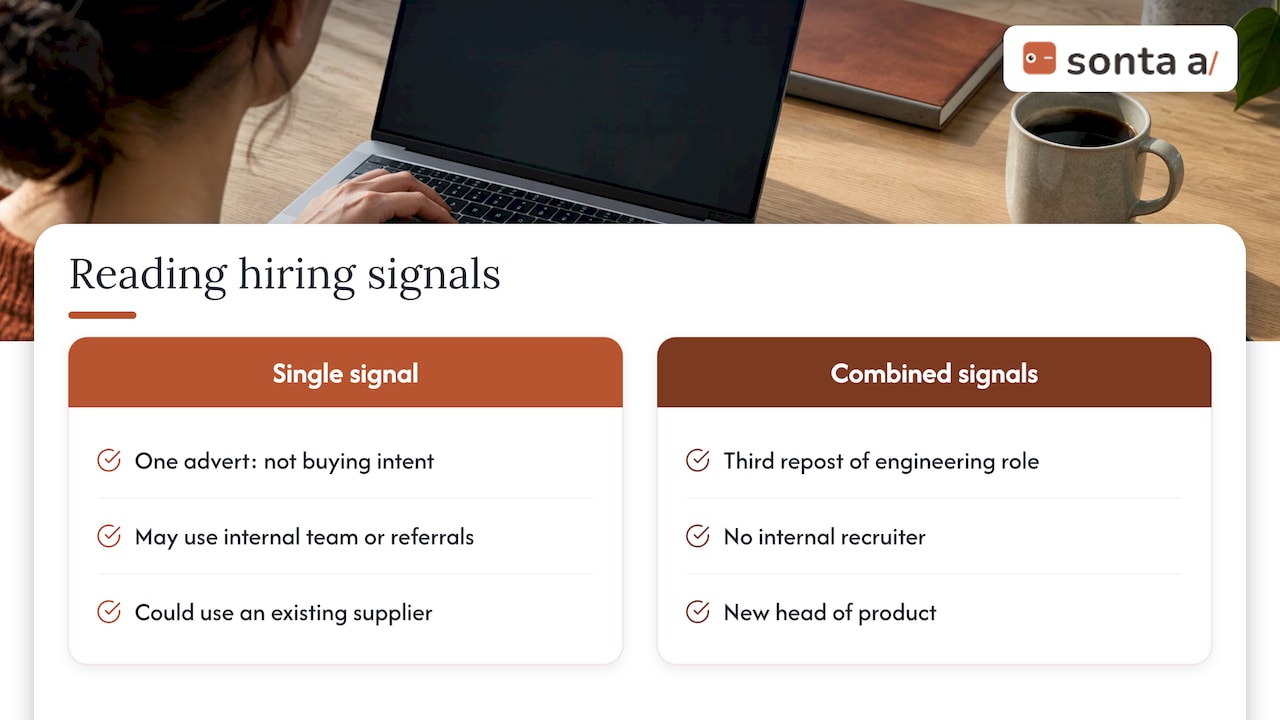
A job advert shows a company wants to hire. It does not show it needs an agency. It may fill the role through its own team, referrals, direct applicants or an existing supplier. The same goes for every other signal. A new decision-maker, a funding round, a repeat advert for the same role or a past contact changing jobs is a reason to start a conversation. It is not buying intent.
That distinction should shape your first message. You are not saying “I know you are ready to buy”. You are saying “I noticed this, and here is something relevant”. The strongest approach combines signals. A company that reposts the same engineering role for the third time, has no internal recruiter and just hired a new head of product has more going on than one advert alone.
UK agencies can also use public company data. Companies House filings show sector codes, registered location and average staff numbers, which helps you build a fit list. They are a starting point for fit, not a trigger on their own.
Where Sonta fits
Our Signal Agent watches public LinkedIn activity for moments that make a conversation timely: a recommendation request, a new decision-maker, a company hiring or a contact changing jobs. It shows each reason with a link, so you can check what happened before you write. Fit and intent are scored separately, so a perfect-fit company with no trigger does not look the same as a trigger at the wrong kind of company.
Signal packs start from $29 a month for five always-on searches. There are also packs of 15 searches at $79 a month and 40 at $119 a month. Full details are on the pricing page.
Open with their problem, not your credentials
The most common BD mistake is leading with the agency. Database size, awards and success rates make buyers feel sold to. A hiring manager cares about the vacancy, the pressure on the team and the cost of a wrong hire.
A good first message does three things in a few lines:
- Names the reason you are writing, such as the role or the change.
- Offers something relevant, such as a salary benchmark for that job family and region, or what you are seeing from candidates in that market.
- Asks for a small next step, such as a short call about that one role.
Compare two openers. The weak one: “I wanted to introduce myself and see if you had any hiring needs.” The stronger one: “I saw you have reposted the senior DevOps role. Candidates in the region are asking for a different package than the advert implies. Worth a ten-minute call on that role?” The second shows you did your homework. It also gives the reader something forwardable if they are not the person who signs agency terms.
In a meeting, the same rule applies. Ask about the vacancy, the pressures and the plans for growth. Then connect your approach to what you heard.
Build the follow-up sequence
One email rarely wins a client. Research from RAIN Group, cited in recruitment BD guides, puts an average of eight touches to secure a first meeting with a new prospect. Replies cluster in later steps. In the Belkins dataset reported in a UK recruitment outbound analysis, steps two to six produced most replies. That is why a single send-and-wait approach underperforms.
A workable sequence runs over six to eight weeks and combines channels:
- A short LinkedIn connection request with no pitch.
- A first email tied to the trigger.
- A shorter follow-up a few days later.
- A message with a different hiring angle.
- An insight from the candidate market, such as a benchmark.
- A final check-in.
- A phone call once the person has shown interest.
Each message needs a fresh reason to reply. “Just checking in” is not one. Keep emails short, with three or four sentences. Measure replies and conversations, not opens.
Where Sonta fits
Our sequences are native. They are written from the moment a signal fires, so the follow-up refers to the role or the change that made the contact timely. Email sequences are unlimited. The agents handle replies and meeting booking, and the customer decides which steps need their approval. You can set approvals so that, for example, first messages wait for you while routine follow-ups go out. For the follow-up mechanics, see our guide to automated follow-up emails that book meetings and our piece on personalised outreach with AI.
Know the rules before you automate
This part protects your agency. Read it before you set anything up.
LinkedIn’s own help page says it does not permit third-party software, including bots and browser extensions, that automates activity on its site. Any tool that works with your LinkedIn account carries that risk, and no tool can promise otherwise. Decide what you automate and what you do by hand, and read LinkedIn’s rules for yourself. Our note on what to automate and what to keep covers the split. LinkedIn accounts in Sonta are billed per seat, and the LinkedIn account add-on is $15 to $20 a month.
Email in the UK
Under the UK’s Privacy and Electronic Communications Regulations (PECR), the ICO explains that the email marketing consent rule does not apply to corporate subscribers. Companies, LLPs and Scottish partnerships count as corporate subscribers. Sole traders and some other partnerships are treated as individuals, so they need more care. Other rules still apply, including identifying yourself and honouring opt-outs. If you are unsure, take advice from a data protection professional.
Email in Europe
If you write to prospects outside the UK, the rules change. Business email needs prior consent before first contact in Germany, the Netherlands, Denmark and Poland. In South Africa, POPIA applies to first-contact rules. Check the country of the recipient before you add them to a sequence.
Data
Sonta stores and processes customer data in the EU under GDPR. Customer data is never used to train AI.
Compare the ways to do recruitment BD
Every option below has a real strength. The right one depends on how much time you have and who is selling.
| Option | Where it is strong | Where Sonta differs |
|---|---|---|
| HubSpot or Pipedrive | Mature CRMs your team may already know, with deep pipeline views and large ecosystems | Sonta adds signals, native sequences and LinkedIn outreach in the same app, so you do not stitch tools together |
| Attio | A flexible, modern CRM with a clean data model | Sonta adds the signal engine and the agents that act on what it finds |
| Gojiberry AI | Built to surface LinkedIn-based lead signals | Sonta pairs signals with sequences, reply handling and the CRM |
| HeyReach | Focused LinkedIn outreach, including multi-account campaigns | Sonta covers email and LinkedIn in one place, with the records updated for you |
| Instantly | Email sending at volume | Sonta writes sequences from the signal and keeps the CRM current |
| AI SDR tools such as Artisan and 11x | A single agent that works outbound prospects | An AI SDR is one agent that stops at the meeting. Sonta has an agent for every step and is the CRM too |
| Spreadsheets | Free, familiar and flexible for a small list | Sonta keeps records current without manual entry |
| A lead-generation agency | Outsourced capacity and experience | You keep the data, the sequences and the relationship in your own system |
| Hiring a salesperson | A person who can build relationships and run meetings | Sonta takes the research and follow-up busywork off whoever sells |
If your team already runs HubSpot or Pipedrive, nothing here says that CRM is wrong. Many teams keep it. The question is whether you also pay for a sequencer, a LinkedIn tool and a signal tool. Sonta replaces a CRM, an email sequencer, a LinkedIn outreach tool and a signal tool in one app. On cost, our value calculator found a median 36% less than the cheapest equivalent stack (Sonta value calculator, list prices read 17-18 Oct 2026). That is a median across the calculator’s comparisons, not a promise for your stack.
Measure BD weekly
BD results take time. A first brief from a new client can follow months after the first message. So judge the first months on activity and movement, and look at revenue later.
Track a short set of numbers each week:
- Connection requests sent and accepted.
- Replies.
- Interested replies.
- Meetings held.
- First briefs from new clients.
- The source of every new client.
Then watch conversion between stages: contacted to conversation, conversation to job brief, brief to submission, submission to interview. Divide monthly BD spend by meetings held to get a cost per meeting. It tells you whether a salaried BD hire, an agency or a tool is earning its place.
The pipeline stage view in Sonta’s reports and dashboards shows where deals sit. The pipeline stage report shows how they move between stages. Because the CRM keeps itself up to date, you are not rebuilding the numbers by hand on Fridays.
Turn a first win into repeat business
The cheapest new brief comes from a client who already trusts you. After a placement:
- Debrief with the hiring manager.
- Check in at week two and again at month three on how the hire is settling.
- Ask the new advocate for introductions to other teams while goodwill is high.
- Ask a specific referral question, such as who else is hiring a platform engineer. Do not ask “do you know anyone who needs us?”
Put these on the account as follow-ups, so they happen without anyone remembering. Our guide to prospecting for new clients as an owner-led firm sets out a routine you can adapt.
Our view: BD should not depend on who is billable
In most small agencies, pipeline belongs to whoever is not busy on a desk. That is the problem. A founder who fills roles all week has nothing left on Friday for prospecting.
We built Sonta AI to run the new-business work between client work. The Signal Agent watches for the moment a conversation becomes timely and shows you why, with a link. The sequence is written from that moment. Replies and meeting booking are handled, and the CRM records what happened.
You decide which steps need your approval. The same rules hold when you use Sonta from Claude or ChatGPT through our MCP server. You run the AI on your own keys, from Anthropic, OpenAI, Google or OpenRouter, with no markup on AI. Agent runs are never metered.
We run our own sales on Sonta. We think that is the fair test of any sales tool.
Pavel
What Sonta gives a recruitment agency
Sonta is an agentic CRM that finds opportunities and moves them forward. For an agency, that means a list of companies with a reason to talk, a sequence written from that reason, replies handled, and a pipeline that stays current. It runs in one app. Plans start at $16 a month per seat for Solo, $28 for Core and $65 for Pro, and the current terms are on the pricing page. Our agentic CRM page shows how the pieces fit. We aim to have you running in under an hour. The demo ends with your first leads.
FAQ
What does a business development manager do in a recruitment firm?
A BDM wins new client accounts and job orders. That includes identifying and approaching companies, running pitches, agreeing terms and managing a pipeline of follow-ups. In a 360 consultancy, consultants do this alongside delivery. In a 180 set-up, the BDM does only the client side.
Do I need a dedicated BD hire?
Not always. An owner-led agency can run BD through a routine and the right tools, as long as someone reviews the pipeline every week. A salesperson becomes worth it when the volume of conversations and meetings exceeds what the founder can handle.
Is a job advert enough to contact a company?
It is a good reason to talk. It does not show that the company needs an agency. Check fit and access, look for other signals, and write about the role, not about your agency.
Can I automate LinkedIn outreach?
LinkedIn restricts third-party automation in its rules. Read them before you set anything up. Decide which steps you keep manual, and use approvals so you control what goes out.
How long before BD brings in revenue?
It varies by sector and deal size. Expect weeks to first meetings and longer to first briefs. Judge the early months on activity and pipeline movement, then on new clients and fees.
Sources
- Recruitment Business Development: How Agencies Win Clients
- Business-to-business marketing, ICO
- Prohibited software and extensions, LinkedIn Help
Book a demo and leave with your first leads.