How to Scale a Sales Team Without Scaling the Busywork

You scale a sales team by first making the selling repeatable, then adding capacity where deals are actually waiting. The capacity does not always have to be another salesperson. For many owner-led agencies, consultancies and software firms, the first gain is taking research, follow-ups and record-keeping off the people who sell. Sonta AI is an agentic CRM that finds opportunities and moves them forward, so the team you already have spends its hours on conversations.
This guide is for sales leaders with a team on HubSpot or Pipedrive, and for founders who still sell and want new clients without a hire. It covers readiness, process, structure, tooling and the metrics that tell you it is working.
TL;DR
- Readiness is evidence, not a revenue figure. You need a win rate you can repeat, reps other than the founder who can close, and stages everyone defines the same way.
- Fix the system before you add people. More activity on a leaky process only builds a longer queue of stuck deals.
- Name an owner and a dated next step for every deal. Split roles only when a real bottleneck appears.
- Automate the middle-ground work first: research, follow-ups, meeting prep and CRM updates. Keep discovery, pricing and closing with your people.
- Track conversion by stage, time in stage and follow-up speed. Judge any change by those numbers.
Table of Contents
- Check you are ready before you add capacity
- Define the stages, owners and next steps
- Structure the team around bottlenecks
- Add capacity without adding headcount
- Keep outreach compliant
- How the alternatives compare
- Measure whether it is working
- What the 2-2-2 rule is, and whether it helps
- Perspective: why we think the first hire is software
- Where to start with Sonta
- FAQ
- Sources
Check you are ready before you add capacity
There is no magic revenue number at which sales becomes scalable. The UK consultancy The Scale Hack makes the point with a contrast: a £3m business can still rely almost entirely on founder relationships, while a £1m business may already have two sellers winning independently through a clear motion. What matters is evidence on five points:
- You know where to play, meaning which clients you serve best.
- Strangers engage and buy, not only people who know the founder.
- Someone other than the founder can run the sales motion.
- The founder can leave routine deals alone.
- The economics work.
Win rate is the simplest single test. Pete Kazanjy’s Founding Sales handbook (2022) says a good B2B win rate is typically 15–30% of demos or first meetings turning into closed-won deals. A reliable rate in that range, with a steady deal size and cycle, points to scaling. A lower one points to fixing messaging, product or pricing first. His image is easing into a hot bath rather than flipping a switch. Add a little, validate, then add more.
Campbell Advisory (2026) adds a second test. Decide whether you have a shortage of selling capacity or a problem with how selling works. If conversion is weak or deals stall at the same stage, fix that point first. More early-stage activity would only create a larger queue of unresolved deals.
A quick self-check for your own team:
- Are your reps’ hours going on selling, or on logging, chasing and preparing?
- Do deals stall at one stage more than the others?
- Could a new seller use your ideal client definition without asking you what you meant?
- Does every live deal have a named owner and a next step with a date?
If the answers show time lost to admin, you have a capacity problem that tooling can ease. If they show stalls at one stage, you have a process problem, and the next section is where to start.
Define the stages, owners and next steps
A team scales on a process everyone reads the same way. Scale DNA, a UK sales consultancy, sets out the minimum: five to seven named stages, exit criteria for each, a defined action at each stage and one named owner with a dated next step for every live deal. A typical run is New, Qualified, Discovery, Proposal, Negotiation, Closed Won. A deal counts as Qualified only once budget, authority, need and timing are confirmed.
Three habits make this work in practice:
- Write exit criteria in plain words. If two reps would disagree on whether a deal has left a stage, the criteria are not clear yet.
- Set a time limit per stage. A deal that sits too long gets chased or parked, not left to drift in the forecast.
- Keep one source of truth. Revenue Works UK advises mid-market firms to agree one definition of lead and opportunity and one CRM as the source of truth, with side spreadsheets removed, before adding AI.
The CRM matters here because stages that are not enforced in the tool tend to be forgotten. Sonta’s pipeline stage report shows where deals sit by stage. Our guide to AI pipeline management covers how to start.
Structure the team around bottlenecks
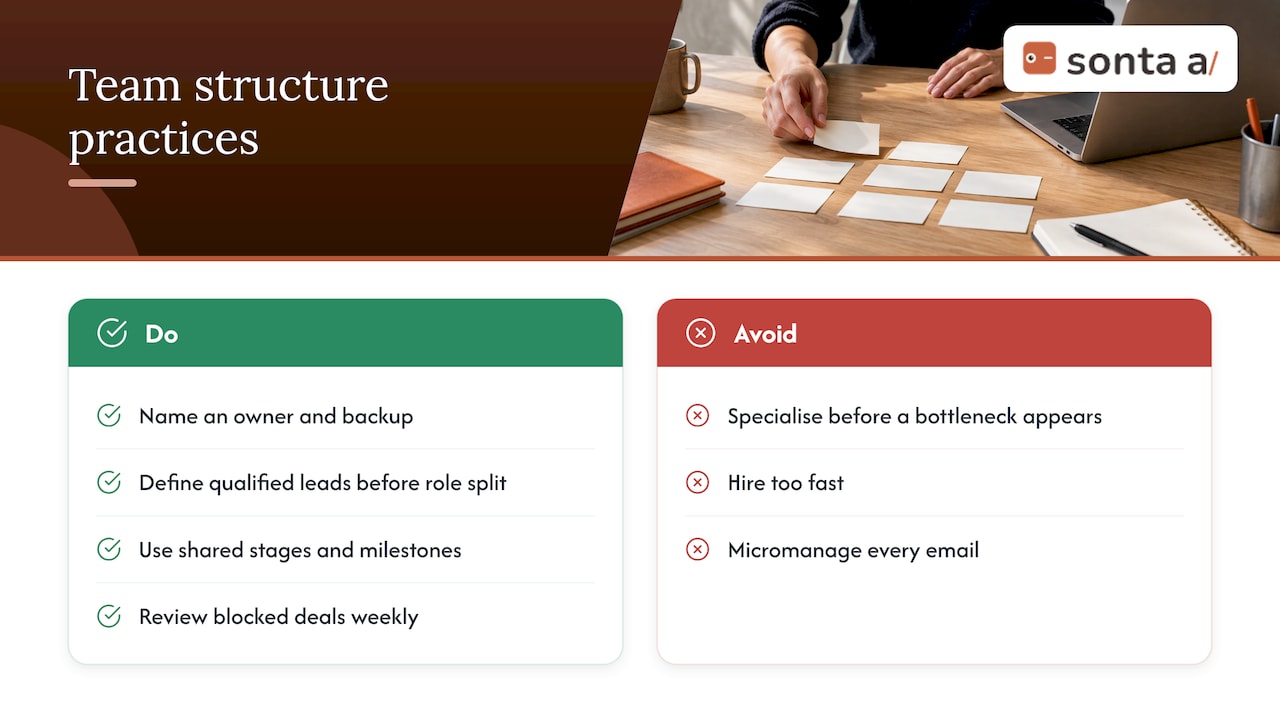
On a small team, one person can prospect, advise and look after existing accounts. BuildBuddy Consulting (2026) says each task, from lead handling to quote creation, approval, closing and account management, needs a named owner and a backup. Specialise only when a real bottleneck appears. Describe the work first, then the position.
Gain.io’s 2026 guide says the first real structural change comes when deal volume becomes predictable: splitting prospecting from closing, with a development rep feeding qualified leads to an account executive. It also warns that before the split you must define what counts as a qualified lead.
That warning is the useful part. A split built on a vague definition only moves the argument between two people. If the definition is sharp, much of the prospecting work is the kind software can now do. It is research, timing and follow-up, and it is the work that normally justifies the first junior hire.
Monkhouse & Company’s guide for UK founder-led firms (November 2025) names two opposite errors: hiring too fast, so quality falls, or micromanaging every email. Its answer is the same stages and milestones for every rep, freedom in how they deliver, and a founder who moves from playing to coaching. Pipeline reviews do that job. A weekly look at blocked deals and next steps is a better basis for staffing than a revenue plan alone, as BuildBuddy’s Christian Priess argues.
Add capacity without adding headcount
Hiring is one way to add capacity. It is slow, it is a fixed cost, and a new seller dropped into an undefined system tends to struggle. The other route is to move the repeatable work to software and keep the judgement with your people.
GBL (8 October 2026) suggests UK firms move support work such as lead logging, qualification, diary booking, quote chasing and CRM updates away from sellers, while discovery calls, pricing and closing stay in-house. Evans Sales Consultancy (2 October 2026) describes the same shift as moving from labour-intensive to system-intensive growth. In its words, AI and automation now handle the middle-ground work that usually needs junior staff, such as lead research, first outreach, scheduling and basic reporting.
That list is a useful map of what to hand over. It is also close to what Sonta does.
- The Signal Agent watches public LinkedIn activity for a reason to talk. That might be someone asking for a recommendation, a new decision-maker, a company hiring or a past contact changing jobs. Each reason is shown with a link, so you can check it.
- Fit and intent are scored separately, so a good-fit company with no recent moment is not confused with a timely one.
- Sequences are native. Email and LinkedIn sequences are written from the moment a signal fires. Email sequences are unlimited.
- Replies and meeting booking are handled by agents, and the CRM keeps itself up to date.
- You decide which steps need your approval. The agents research prospects, follow up and prepare meeting briefs, and you set the checkpoints.
A job change or a hiring post is a reason to talk. It is not proof that someone wants to buy. Good sequences treat it that way and open with something relevant, not a pitch. Our posts on personalised outreach and automated follow-up emails go deeper on the writing.
If your plans go beyond sales, such as voice, WhatsApp or ERP workflows, there are specialists building custom AI agents for business workflows. For the sales pipeline itself, the work above sits in one place.
Keep outreach compliant
Scaling outreach raises the stakes on the rules. Three points matter for UK and European teams.
UK email. The ICO’s guidance says the PECR rule on direct marketing by email does not apply to corporate subscribers, so B2B emails to a company are treated differently from emails to individuals. Data protection law still applies to the personal data you use. Read the ICO page on who counts as a corporate subscriber before you build a list.
Elsewhere in Europe. Business email needs prior consent before first contact in Germany, the Netherlands, Denmark and Poland. If you sell into those countries, set the rule in the sequence before anything is sent. In South Africa, POPIA applies to first-contact rules.
LinkedIn. LinkedIn has its own rules on automation, set out in its User Agreement and help pages. Read them before you connect any account to any tool. No tool makes automation safe or undetectable, and we do not claim that. Decide what to automate and what to keep by hand. Our guide to LinkedIn sales automation sets out that split.
On data, Sonta stores and processes customer data in the EU under GDPR. It is never used to train AI.
How the alternatives compare
Buyers weigh several routes. Each has a real strength.
| Route | Where it is strong | Where Sonta differs |
|---|---|---|
| HubSpot or Pipedrive | Mature CRMs your team already knows, with wide ecosystems | Sonta adds signals, native sequences and LinkedIn outreach in the same app |
| Attio | A flexible, modern CRM | Sonta adds agents for each step and signals |
| Gojiberry AI | Signal-led lead discovery | Sonta adds sequences, reply handling and the CRM |
| HeyReach, Instantly | Focused LinkedIn outreach or email sending at volume | Sonta replaces the separate sequencer and LinkedIn tool with one app |
| AI SDR tools such as Artisan and 11x | A single agent doing outbound work | An AI SDR is one agent that stops at the meeting. Sonta has an agent for every step and is the CRM too |
| Spreadsheets | Free, familiar, fully flexible | Records stay current without manual logging |
| Lead-generation agency | Outsourced effort and experience | Your pipeline and data stay in your own system |
| Hiring a salesperson | Human judgement in conversations | Software takes on the admin, so the hire, when it comes, starts on a working system |
Sonta replaces a CRM, an email sequencer, a LinkedIn outreach tool and a signal tool. The value calculator puts the saving at a median 36% less than the cheapest equivalent stack (Sonta value calculator, list prices read 17-18 Oct 2026). If your team is on HubSpot or Pipedrive, nothing here says your CRM is wrong. The question is whether you also pay for three other tools beside it.
On AI, customers choose the model for each task and run it on their own keys: Anthropic, OpenAI, Google or OpenRouter. There is no markup on AI, because the keys are yours. Agent runs are not metered. The MCP server lets you use Sonta from Claude or ChatGPT under the same rules and approvals.
Measure whether it is working
Pick a few numbers and review them weekly. Morton Kyle suggests tracking conversion by validated stage, time in stage against the ideal cycle and executable next steps. For a team adding automation, add follow-up speed and a hygiene check on records.
A workable set:
- Win rate on qualified deals. Compare it with the 15–30% range above for first meetings.
- Conversion at each stage. The stage where it drops is where to look first.
- Time in stage. Long waits point to unclear owners or missing next steps.
- Speed to reply. GBL suggests answering every new lead within one working hour, after first measuring selling hours per week.
- Pipeline hygiene. Check for duplicates, missing fields and stale deals.
Data quality comes first. Data Broker UK (November 2026) says AI can process large volumes of CRM data but cannot turn contradictory, duplicated or outdated records into dependable insight. Clean the records before you automate. Elevate AI (2026) adds that AI-drafted follow-ups should keep their source available and flag missing information rather than invent it. That matches how Sonta works. Every opportunity shows what happened, with a link to check it.
Our posts on sales rep productivity and AI lead scoring cover measurement in more detail.
What the 2-2-2 rule is, and whether it helps
The 2-2-2 rule is a follow-up cadence. SaaS Hero describes it as three touchpoints at two days, two weeks and two months after a triggering event. It suits slower B2B buying cycles, because the two-month span keeps the thread alive without constant chasing.
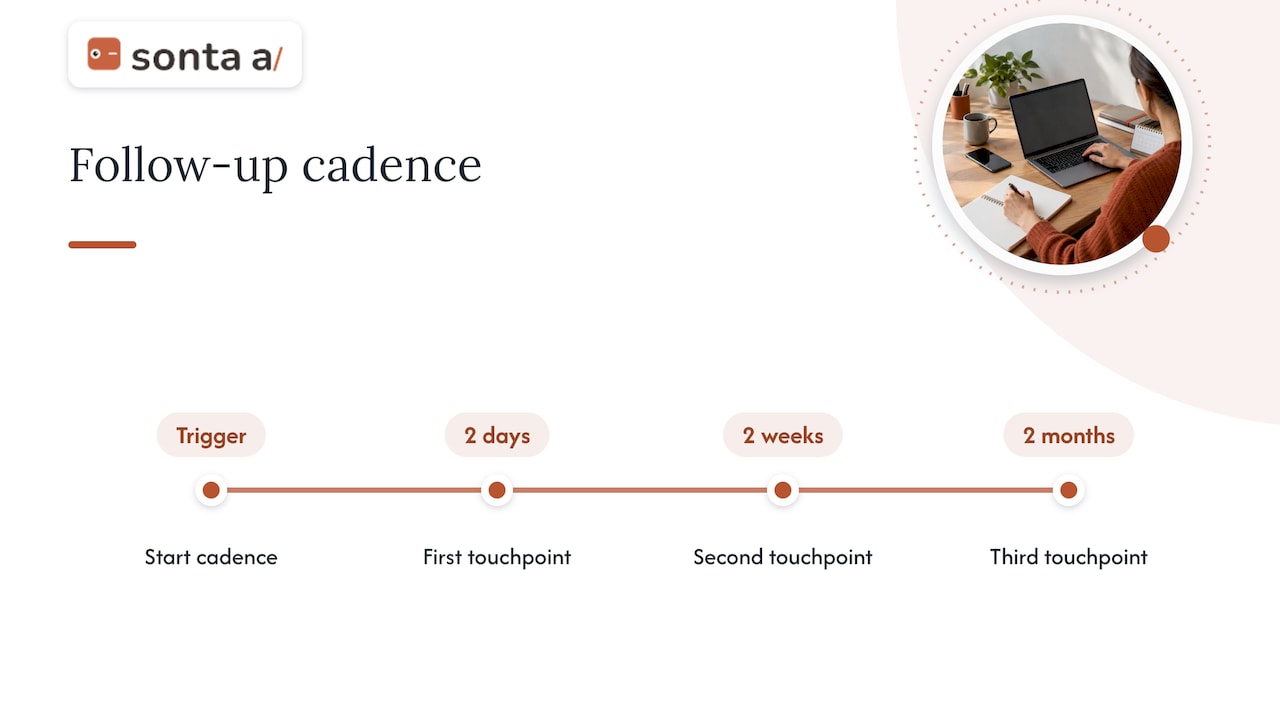
It is a useful default for a team that forgets to follow up. It also shows why timing matters. The trigger is the part that counts, and a signal such as a job change or a hiring post is a natural trigger. The cadence only works if someone remembers to run it, which is where unattended follow-ups usually fail.
Perspective: why we think the first hire is software
Most teams that ask how to scale sales are really asking where their hours go. A founder or a rep spends part of the week on research, part on chasing, part on updating the CRM and part on prep for meetings. Only a fraction is spent talking to clients.
We built Sonta on the view that this work should be done by agents and that people should decide what matters. The Signal Agent finds the moment that makes a conversation timely. Sequences are written from that moment. The CRM keeps itself current. You choose which steps need your approval, and the same rules hold when you work from Claude or ChatGPT through MCP.
We run our own sales on Sonta. That is the standard we hold the product to. Scaling is not about more tools or more people. It is about one app where the opportunity, the message and the record live together, so the next hire joins a working system.
Pavel
Where to start with Sonta
Sonta is an agentic CRM that finds opportunities and moves them forward. Plans are billed per seat: Solo from $16 a month, Core from $28 a month and Pro from $65 a month. Signal packs start from $29 a month, for five always-on searches. LinkedIn accounts are billed per seat, as an add-on at $15-20 a month. Full details are on the pricing page. You can see the product on the Sonta homepage.
Book a demo and leave with your first leads.
FAQ
When should a founder stop doing all the selling?
When the evidence says others can win without you. That means a repeatable win rate, a clear client definition and reps who close routine deals alone. Until then, take the admin off your plate first and keep the conversations.
Do I need to hire before I automate?
No. Define your stages and owners first, then automate research, follow-ups and record updates. A hire made later joins a process that already works, and that is easier to coach.
Can I keep HubSpot or Pipedrive while I scale?
Yes, and many teams do while they assess their options. The question is how many separate tools sit around the CRM. Sonta brings a CRM, sequences, LinkedIn outreach and signals into one app.
How do I keep AI outreach accurate?
Start with clean records and make every reason traceable. In Sonta, each opportunity shows what happened with a link to check it. You also decide which steps need your approval before anything is sent.
Sources
- Minimum Viable Repeatability, The Scale Hack
- When Is the Right Time to Scale Sales? Founding Sales
- Fix the sales system before adding more people, Campbell Advisory
- The Sales Process Blueprint, Scale DNA
- AI for RevOps in B2B, Revenue Works UK
- How to build a sales organization, BuildBuddy Consulting
- Sales Team Structure Explained, Gain.io
- Founder-Led Sales guide, Monkhouse & Company
- How to scale sales without hiring more salespeople, GBL
- Increase B2B Revenue Without Hiring, Evans Sales Consultancy
- Business-to-business marketing, ICO
- Sales Metrics to Avoid, Morton Kyle
- Is Your CRM Data Ready for AI Marketing? Data Broker UK
- How to Integrate AI With Your Existing CRM, Elevate AI
- What Is the 2-2-2 Rule in Sales? SaaS Hero